The complex structure splits the complexified cotangent bundle into its and parts. Thus the space of smooth differential forms of type (p, q) isHere denotes smooth sections of a vector bundle; exterior multiplication identifies the displayed bundle with a subbundle of the complexified exterior algebra. In holomorphic coordinates, such a differential form of type (p, q) has the expressionwhere the coefficients are smooth and both multi-indices are increasing. Negative bidegrees, or bidegrees exceeding the complex dimension, give the zero space.
On a complex manifold, the exterior derivative has just two type components, . The conjugate Dolbeault operator and the Dolbeault operator are, respectively,Keeping the differentiating factor at the front fixes the signs. These definitions are intrinsic because holomorphic coordinate changes preserve type. The two operators are the type projections of the exterior derivative, raising and , respectively.
For a holomorphic map , its differential is a complex-linear map, so the pullback of a differential form sends covectors to covectors and covectors to covectors. In coordinates on ,The pullback of a differential form commutes with the wedge product of differential forms, so it preserves the counts of these factors. ConsequentlyIt also commutes separately with the Dolbeault operator and the conjugate Dolbeault operator, because it commutes with and preserves type.
The assertion requires . As printed, it also includes , where the nonzero constant function is closed but cannot be the exterior derivative of a negative-degree form. The zero constant is harmless; below we prove the intended positive-degree result.
Set , let , and letThe polydisc is preserved by these dilations. The radial homotopy operator isHere is the interior product of a differential form. For a smooth -form, its pulled-back contraction is , so the integral and its coefficient derivatives converge at zero. The identity for a pullback of a differential form along the radial flow and Cartan's magic formula giveIntegrating yields . The final pullback vanishes in positive degree; since , we have .
Each is a holomorphic map, so its pullback of a differential form preserves bidegree. Contracting with the part of lowers by one, and contracting with its part lowers by one. Therefore the primitive has precisely the permitted types:This is a type-preserving refinement of the Poincaré lemma; when one index is zero, the corresponding negative-degree summand is simply absent.
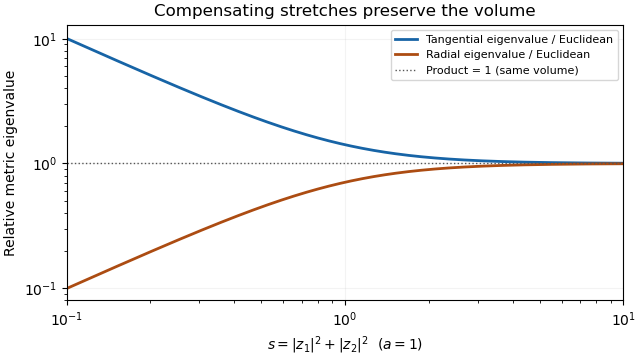
Use a radial geometric Kähler potential. Write and . The coefficient Hermitian matrix of isIts eigenvalues are in the complex tangential direction and in the complex radial direction. A Kähler metric is positive precisely when both are positive. The standard form has coefficient matrix , so equality of the Riemannian volume forms is the conditionIndeed, the volume form is and its coefficient is proportional to . Multiplying the determinant equation by gives , so we can takeAn explicit antiderivative isIt is smooth for . Its two eigenvalues areThe form is real and closed because it is of a real function, so it is a Kähler metric on the punctured space. Since , neither eigenvalue equals , and the metric differs from the Euclidean one. The radial and tangential stretches compensate exactly, preserving the volume form:This is a radial Kähler metric with Euclidean volume in complex dimension two.

For the nonnegative Hodge Laplacian , the Kähler Laplacian identity gives . If is a holomorphic function, then , while by degree. ThereforeThe divergence-of-gradient convention printed in part (b) is on functions. The sign changes no kernel, so the requested harmonicity of holomorphic functions on a Kähler manifold isHolomorphic functions are harmonic without any compactness assumption. This is a local identity from the Kähler Laplacian identity, not an integration argument requiring a compact manifold.
The real coordinate functions are real and imaginary parts of the holomorphic coordinates . Part (a), together with the real coefficients of the Laplace-Beltrami operator, therefore shows that every is a harmonic function. For the given divergence-of-gradient convention, applying the operator to givesThese are the harmonic coordinate identities. Expanding the operator on an arbitrary smooth function now givesThe bracketed coefficients vanish. Hence there is no first-derivative term in these coordinates:The reason is that the real components of holomorphic coordinates are harmonic coordinates for a Kähler metric; a general real coordinate change need not retain this simplification.
Let be the quotient covering maps. Since the source universal cover is simply connected, the lifting criterion for a covering space gives a lift of . The lift is a holomorphic map because is locally a biholomorphism.
For every , the difference belongs to the discrete Euclidean lattice . It is a continuous function of on a connected space, hence is constant. Differentiating shows that each coefficient of is -periodic. Such a coefficient is bounded on a compact fundamental parallelepiped, and periodicity bounds it on all of . The several-variable Liouville theorem, obtained by applying the one-variable theorem on coordinate lines, makes every coefficient constant.
Consequently for a constant complex-linear map and . The period differences become . Thus the affine lift of a holomorphic map between complex tori givesEvery holomorphic map between complex tori is a homomorphism followed by a translation. The translation vector is determined modulo , while is the derivative of any lift and is unaffected by that ambiguity.
Choose a constant positive Hermitian form on . Its underlying flat Kähler metric is translation-invariant and descends through the Euclidean lattice to the compact complex torus . The Dolbeault Hodge decomposition gives a unique Dolbeault Laplacian-harmonic representative of every Dolbeault cohomology class. By the Kähler Laplacian identity, these are also Hodge Laplacian-harmonic.
Choose a constant coframe on . A lifted harmonic form is a sum of constant wedge basis forms with smooth periodic coefficients. For the flat metric, the Hodge Laplacian acts coefficientwise by the scalar constant-coefficient Laplacian. Each coefficient is a harmonic function on a compact flat real torus, hence is constant: integration by parts gives . Conversely every constant-coefficient form is harmonic. Thus the harmonic representatives are exactly the translation-invariant differential forms of type (p, q).
The constant covectors form ; the constant covectors form the space of antilinear maps . Sending a constant wedge form to its cohomology class givesThe map is intrinsic and does not depend on the auxiliary flat metric: that metric proves every class has exactly one constant representative, while the inclusion of constant forms is defined directly by the quotient. The Dolbeault cohomology of a complex torus consists of constant forms, and in particularFor indices outside , both the exterior-power expression and the cohomology group vanish.
A connection on a vector bundle is a real-linear map (complex-linear for a complex bundle)It extends to the covariant exterior derivative by when has degree . Its square is linear over smooth functions: in the two terms have opposite signs and . The curvature form of a connection is therefore the endomorphism-valued two-formIn a local frame with , it is .
Define the tensor product connection on decomposable sections byThe Leibniz rule for makes this well-defined over smooth functions and makes it a connection on a vector bundle. Applying its covariant exterior derivative again givesThe mixed terms cancel by the graded sign. Thus curvature adds on the two tensor factors:Equivalently, the mixed terms in cancel because operators on the different factors commute. This also proves the curvature of a tensor product connection formula in local frames.
Fix the convention that the Hermitian metric is conjugate-linear in its first argument. In a holomorphic local frame , let , so . Write , or equivalently .
Compatibility with the holomorphic vector bundle structure means . Since the frame is holomorphic, this forces . Metric compatibility meansor, in the chosen frame, . Conjugate transpose here also conjugates the one-form factors. Taking the component gives , and henceThis proves uniqueness and suggests existence. The proposed has type , and its conjugate transpose obeys , since . Therefore , proving metric compatibility as well.
Under a change of holomorphic local frame , we have and . A direct computation yieldsBecause is holomorphic, ; this is exactly the transformation rule for a connection one-form. The locally defined connections therefore glue to a global connection on a vector bundle. The Chern connection exists uniquely, and its local formula for the Chern connection on a vector bundle is
The orthogonal projection is a smooth bundle map, since the Hermitian metric and the subbundle vary smoothly. The mapis independent of the representative, bijective on each fibre, and smooth with smooth inverse supplied by the quotient map on . Hence it is a natural isomorphism of smooth vector bundles. It need not be holomorphic. The quotient Hermitian metric isIt is well-defined and positive definite because represents each quotient class uniquely.
On sections of , set . The Leibniz rule makes a connection on a vector bundle. For , the orthogonal terms vanish in the metric pairing, soThus has metric compatibility. Because is a holomorphic subbundle, the part of preserves and restricts to . Therefore . The uniqueness of the Chern connection in part (b) gives the projected Chern connection formulaIt follows that is a quotient-valued one-form. The printed target is missing a dual: the cotangent bundle is the correct factor,Complex-valued forms use the complexified cotangent bundle here. In fact the part cancels, so is the second fundamental form of a holomorphic subbundle, an element of . Finally the two connection Leibniz rules giveThis proves its tensoriality and all the asserted quotient and projection properties.
For the usual additive Čech cohomology groups, is understood to be a sheaf of abelian groups. Order the index set of the open cover . The Čech cochain group isAn empty intersection contributes the zero group. The Čech coboundary is the alternating sum of restriction maps:Every double omission appears twice with opposite sign, so . The Čech cohomology is the cohomology of this cochain complex:Here . The sheaf gluing axiom identifies with . This definition is for the fixed cover; no limit over refinements is part of the group requested here. Without the abelian-group structure, this additive Čech cochain complex is not defined.
The two opens are and ; their intersection is . There is just one degree-one term in the Čech cochain complex, and no degree-two term. The Čech coboundary sends to , soThe denominator denotes the sum of the restricted function spaces.
To make the quotient explicit, expand a holomorphic function on the intersection in a normally convergent two-variable Laurent series,The terms with extend to . Of the remaining terms, those with extend to . Both subseries converge normally on their stated domains, by the coefficient bounds from the Cauchy integral formula. The unique remaining representative is the doubly negative partNo nonzero series of this form lies in the denominator, since a function on has no negative exponents and a function on has no negative exponents.
Writing , these representatives are exactly with an entire holomorphic function on . To see that is entire, integrate for the coefficients on arbitrarily small product circles: . Choosing gives absolute convergence for , for every finite pair . Conversely every such entire supplies a normally convergent representative on the intersection. Therefore the quotient consists of convergent doubly negative Laurent series, not merely finite Laurent polynomials:This gives the holomorphic first cohomology of punctured complex two-space; for instance represents a nonzero class.
For the comparison with sheaf cohomology, and their intersection are Stein manifolds. They can be realized as closed complex submanifolds of affine complex spaces by adding equations for their nonzero coordinates. Cartan theorem B makes their higher cohomology with coefficients in the sheaf of holomorphic functions vanish. Thus the cover is acyclic for , and the acyclic cover theorem givesThe individual cover members are Stein; their union has the nonzero cohomology just computed.
Treat as the trivial group if is not abelian. The restriction maps satisfy the presheaf identities. To verify the sheaf gluing axiom, take an open cover of . If , every section group is trivial. If , at least one contains . Every two such opens have an overlap containing , so compatibility forces all their sections to have the same value . Opens not containing have their unique trivial section. The value is exactly the unique glued section. Thus the stated presheaf is a skyscraper sheaf, including for nonabelian groups.
For the stalk of a sheaf, take the direct limit over neighbourhoods of . If some neighbourhood of omits , neighbourhoods inside are cofinal and all their groups are trivial. If every neighbourhood of contains , every group in the system is and every transition map is the identity. Consequently, on the arbitrary topological space in the question,Membership in this closure means exactly that every neighbourhood of contains . In particular . If is a closed point, the closure is just and the familiar point-supported answer results. The separation assumption is not present in the printed question, so it cannot be imposed silently.
Let , the sheaf of meromorphic principal parts. Exactness of taking stalks givesChoose a holomorphic coordinate vanishing at . Every meromorphic germ has a finite negative tail in its Laurent series; the holomorphic tail vanishes in the quotient. HenceThis coordinate description is a vector-space identification; the intrinsic space is the quotient of germs, so a coordinate change need not preserve the displayed basis.
For each point inclusion , a principal part defines a local meromorphic germ near , whose quotient class is zero off . Gluing with zero on the complement gives a map from its skyscraper sheaf to . These maps induce an isomorphism on every stalk and therefore an isomorphism of sheaves:The direct sum of sheaves means the sheafification of the sectionwise direct-sum presheaf. Its sections can have infinitely many nonzero components globally, but their point supports form a locally finite family of subsets. This matches the fact that poles of a meromorphic function are locally finite. On a compact Riemann surface only finitely many points can occur; on a noncompact one a discrete infinite family is allowed.
For a global principal-part family , choose local meromorphic lifts on a sufficiently small open cover. The differences are holomorphic functions and form a Čech cocycle. The connecting homomorphism sends to the resulting class in . If this class vanishes, after refining the cover write ; then the functions glue to a global meromorphic function. Conversely any global lift makes the class zero. Equivalently, exactness of the given long exact sequence in sheaf cohomology saysThe connecting class is the obstruction to the Mittag-Leffler problem on a Riemann surface. It rules on the specified poles and their finite negative Laurent tails, with no additional poles allowed. When a solution exists, any two solutions differ by a global holomorphic function.
This is the Poincaré residue of a meromorphic top form with a simple pole. Write and locally , with a holomorphic -form. The proposed residue is the pullback of to .
First it does not depend on the choice of : if , then at each point the difference has a factor , and its pullback to is zero. Now change the local defining coordinate to , where is a nowhere-zero holomorphic function. Such a factor exists because both coordinates define the same smooth complex analytic hypersurface. If , thenAt points of , this is an equality in the ambient exterior-power fibre, and the last term is zero. It follows that there, so their pullbacks to agree. This also covers changes of the tangential coordinates.
The restrictions are holomorphic top forms on , and their agreement on overlaps makes them a global section of the canonical bundle. Thus the residue is independent of the adapted coordinates:The ambient-fibre comparison is important: pulling an ambient -form directly back to the -dimensional hypersurface would give zero and would not prove the required independence.
On , let and let be the Euler vector field. The numerator is its interior product of a differential form, soBoth numerator and denominator have homogeneous scaling degree . Thus this meromorphic -form is invariant under constant nonzero scalings, and makes it horizontal for the quotient to Complex projective space.
To check descent using the hint, take a local holomorphic section of the quotient and another section , where is a nowhere-zero holomorphic function. In the evaluationevery term involving has two collinear arguments and vanishes. The remaining term is , while . Hence . The forms therefore glue to a meromorphic section of the canonical bundle of Complex projective space.
On the affine chart , use the section and list the remaining coordinates as in increasing original-index order. If is the resulting polynomial, thenAt a point of , some derivative is nonzero. Otherwise all the homogeneous derivatives except possibly would vanish; the Euler homogeneous function theorem gives there, forcing too. This contradicts the permitted smoothness criterion. The holomorphic inverse function theorem now makes a transverse coordinate, so the pole is simple. On a neighbourhood with , rearranging the wedge product of differential forms givesBy part (a), its Poincaré residue is consequentlyThe remaining coordinates form a holomorphic coordinate system on , and is nonzero in this neighbourhood. The displayed top form is therefore nowhere zero. These neighbourhoods cover and part (a) guarantees agreement on their overlaps. The residue is a nowhere-vanishing global holomorphic section:This is the explicit residue trivialization for a degree n+1 projective hypersurface, consistent with the adjunction formula , but obtained here directly from the indicated form.
Articles by others on the same topic
There are currently no matching articles.