Use geometrized units and metric signature . Put in the Schwarzschild metric. The Schwarzschild tortoise coordinate satisfies , soSubstituting gives the ingoing Eddington-Finkelstein coordinates:The radial metric tensor has determinant and inverse components , , . Thus it is nondegenerate and analytic at . The same expression defines a Lorentzian metric for every , extending the exterior across the future Schwarzschild event horizon into the black hole. It does not include the other exterior or the white hole of the full Kruskal spacetime. At , the Kretschmann scalar diverges, so this is a curvature singularity, not a removable coordinate singularity.
The radial null geodesics satisfyThe ingoing family has , with decreasing toward the future; its tangent is affinely parametrized because . The outgoing family hasAway from the Schwarzschild event horizon, integration gives . These are null geodesics up to reparametrization: a null direction in the two-dimensional radial geometry is automatically pregeodesic, and the angular geodesic equations are satisfied by constant angles. On the Schwarzschild event horizon the outgoing family instead has , with tangent proportional to .
In a Finkelstein diagram, plot vertically and horizontally. Ingoing rays obey ; outgoing rays obeyOutside the Schwarzschild event horizon, outgoing rays increase ; on it they remain at ; inside it they decrease even though increases. Thus both radial future null directions point toward smaller inside the black hole. Every future timelike direction lies between these null directions, so it also moves toward smaller there.
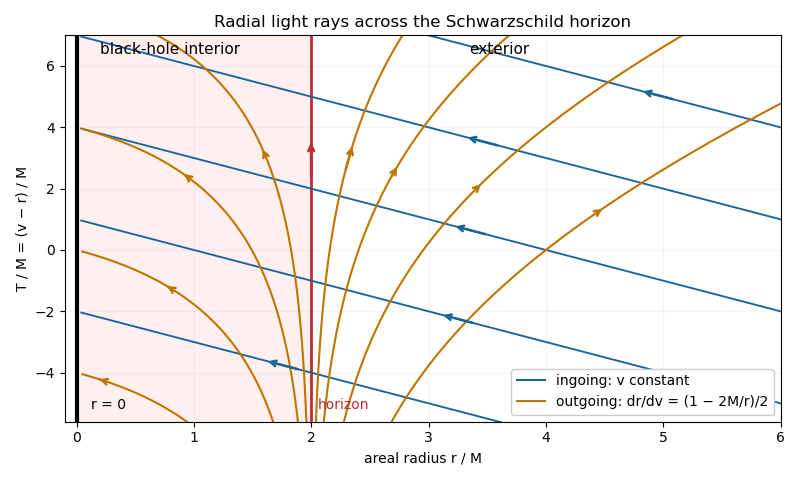
Radial light rays in ingoing Eddington-Finkelstein coordinates across the Schwarzschild horizon
. Details. 
Arrows show future propagation. The vertical red line is the Schwarzschild event horizon; the black boundary at is the Schwarzschild singularity.
A spacetime is geodesically complete if every maximal geodesic has an affine parameter ranging over all of . For timelike geodesics this is equivalent to unbounded proper time in both directions. An extendible geodesic segment can be prolonged in the same spacetime; an inextendible geodesic cannot. A finite coordinate endpoint need not imply finite affine parameter.
For the Kruskal spacetime, use withIn the right exterior . A truncated ray , is an extendible geodesic of radial null type: neither artificial endpoint is a spacetime boundary. A future ray in the black hole reaches , hence , and is inextendible geodesic and future null-geodesically incomplete. Its Killing energy gives , so the Schwarzschild singularity occurs at finite affine parameter. The maximal continuation toward the past supplies the other half of this same null geodesic.
There is no inextendible, complete radial timelike geodesic in positive-mass Kruskal spacetime. This requested example is impossible as printed. For a radial timelike geodesic, the conserved Killing energy and normalization giveIf , has at most one turning point, a maximum ; a maximal trajectory runs from the white hole Schwarzschild singularity to the Schwarzschild singularity. If , there is no finite turning point; one end can lie at infinity but the other reaches . The exceptional trajectory through the bifurcation surface also reaches in both time directions. Near ,whose integral is finite. Constant- radial timelike curves are accelerated, not geodesics.
Two plausible repairs have different meanings. Removing “radial” permits a complete circular timelike geodesic at , with nonzero angular momentum and proper time ranging over . Replacing “timelike” by “null” permits a complete horizon null geodesic: , , with an affine parameter. The Penrose diagram shows both repairs explicitly, together with the two valid requested examples; the circular trajectory is only a radial projection and is labelled as nonradial.
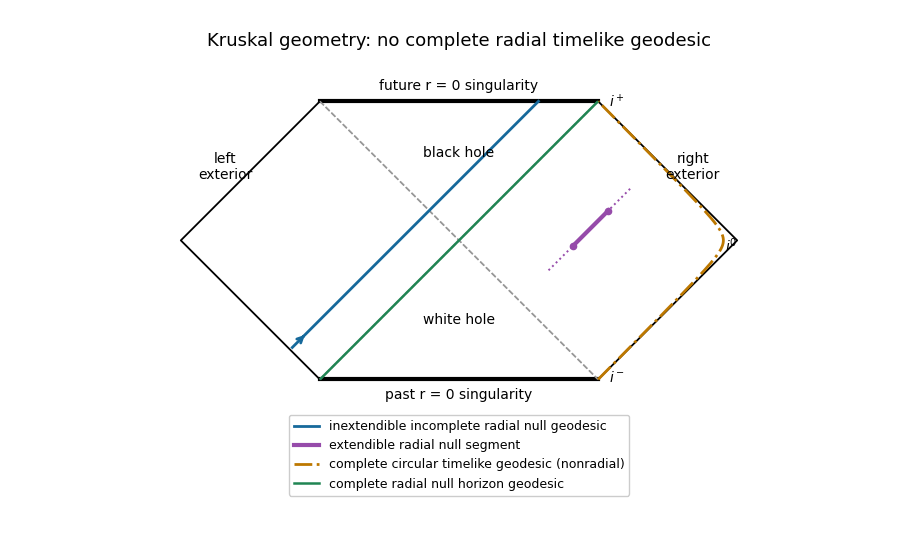
Kruskal causal diagram with extendible and incomplete null rays and explicitly labelled repairs to the impossible radial timelike example
. Details. 
The horizontal boundaries are the Schwarzschild singularities, diagonal dashed lines are the Killing horizons, and outer diagonal edges are null infinity.
Define outgoing Eddington-Finkelstein coordinates by . The radial Schwarzschild metric becomesOutgoing radio rays have constant . Two nearby wave crests emitted at Alice's proper times and have separation . At Bob's fixed radius , and , where . Thus the exact local redshift isHere the wavelength ratio equals the proper time period ratio in geometric optics. Equivalently, the phase gradient gives Alice's measured frequency and Bob's .
In the asymptotically distant-observer limit , this becomes . “Far away” is the approximation behind the printed formula; at finite the factor remains.
For radial free fall, let be Alice's conserved Killing energy. The inward branch of the timelike geodesic has , henceWith , the near-horizon geodesic equations giveThe constants in the logarithms are understood to make their arguments dimensionless. Therefore . For an outgoing signal reaching the fixed-radius Bob, , so . The redshift consequently behaves asThis is the answer when is Bob's Schwarzschild time, as appropriate to the stated observation. It is the Schwarzschild surface gravity . If instead means the emission Schwarzschild time , the same redshift is proportional to and gives . The two answers use different clocks, not different dynamics. If the measured exponential uses Bob's proper time , its rate is . In SI units the reception-time result is .
The reception-time exponent also holds for smooth radial infall crossing the future Schwarzschild event horizon with finite nonzero : regular ingoing Eddington-Finkelstein coordinates give finite there, . Thus no special value of is needed.
Articles by others on the same topic
There are currently no matching articles.