The test-function space is . Its topology is the strict inductive limit topology of the spaces of smooth functions supported in a fixed compact set , each with the seminorms . In particular, a sequence converges in precisely when its supports lie in one compact set and all its derivatives converge uniformly. The indices use multi-index notation.
The distribution space consists of continuous complex-linear forms on . Equivalently, for every compact there are and an integer such thatWe use distributional convergence: means for every . The pairings are bilinear, with no complex conjugation. A test function is identified with its regular distribution .
For a distribution and a test function , their smoothing convolution with a test function isIt is a smooth function, with . Indeed, for in a compact neighborhood all translated tests have support in one compact set, and their difference quotients converge in the space of test functions. Notice that need not be compactly supported.
Choose a nonnegative mollifier with , and write . If , thenThe right-hand test tends to in : its supports lie in for , and every derivative converges uniformly by the approximate-identity argument. Thus the smooth regularizations converge to as distributions.
To obtain actual compactly supported approximants, choose a smooth cutoff function equal to one on and supported in , and setFor each fixed test function , the cutoff is identically one on its support once is large. Hence . This proves is dense in , and in fact establishes the density of test functions in distributions and gives a convergent approximating sequence for each distribution. The expanding cutoff is essential when has noncompact support of a distribution.
For the radial limit, take a test function and introduce in polar coordinates. The Jacobian givesWhen is supported away from the origin, vanishes near and extends to a compactly supported smooth function on the whole line. The folded sine approximation to a Dirac delta is exposed by setting : integration by parts givesby the Riemann-Lebesgue lemma. ThereforeThis surface delta distribution is arclength measure on the unit circle. By the level-set normalization of a surface delta, it is : the factor two cancels the gradient magnitude on the circle. It is not twice arclength measure.
For a test function that can meet the origin, the endpoint cannot be discarded. Now . Its right derivative is integrable, with from differentiated Taylor expansion: the angular average cancels odd Taylor terms, so near . Applying integration by parts separately on the negative and positive intervals givesThe last two integrals tend to zero by the Riemann-Lebesgue lemma. Thus the radial quadratic oscillation defect in two dimensions gives the stronger oscillating point-mass defect formulaChoose supported in with . Its pairing is , which does not converge. For completeness, if had a limit , the recurrence would force , whereas the even subsequence identity would then force . Consequently there is no limit in .
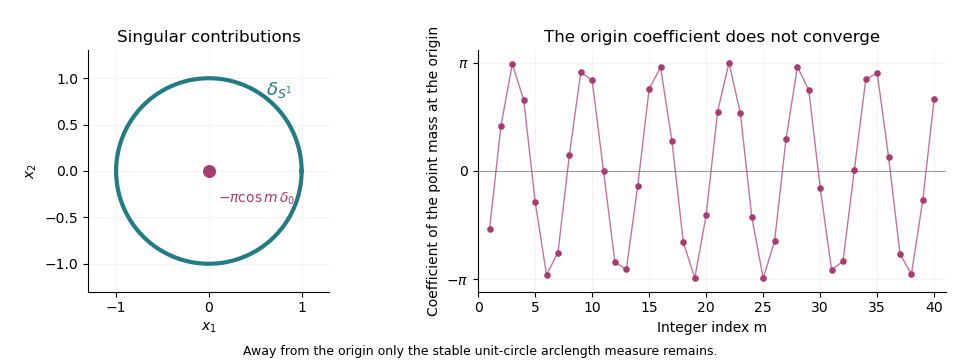
The stable unit-circle arclength contribution and the oscillating point-mass coefficient at the origin
. Details. 
Use the Fourier transform convention , with inverse factor . The Paley–Wiener–Schwartz theorem can be stated with sharp convex support: for a nonempty compact convex set , let its support function be . Then is the Fourier transform of a unique distribution supported in if and only if it is entire andfor some and nonnegative integer . For , this is the familiar bound . Allowing some characterizes all compactly supported distributions. Here the extension of the Fourier transform is , interpreted with a cutoff equal to one near the support of a distribution.
First suppose . Fix one smooth cutoff function equal to one near . Pairing the resulting compactly supported exponential with shows that is an entire function: differentiation with respect to inserts , and the power series converges in the test-function seminorms uniformly on compact subsets of .
To keep the exponential type exactly , rather than that of a fixed larger neighborhood, use a shrinking-cutoff exponential-type estimate. There are cutoffs equal to one on , supported in , and satisfying for . One construction convolves the indicator of with a unit-mass mollifier supported in . Continuity of on a fixed compact neighborhood gives a finite order of a distribution there. By the product rule,Taking proves the required bound with , since the extra exponential factor is at most . The value of the pairing is independent of the chosen cutoff because all cutoffs agree near . Thus the forward direction has the exact asserted support function, without an unproved estimate on derivatives restricted only to .
Conversely, suppose the entire has the stated bound. Its restriction to real frequency has polynomial growth, so define a tempered distribution byThe Schwartz space decay makes this integral absolutely convergent and continuous; by Fourier inversion, on real frequency. It remains to prove the support assertion by mollifier regularization for contour recovery of support.
Choose a nonnegative unit-mass mollifier supported in , and setOn real frequency, decays faster than any polynomial after enough applications of integration by parts to ; hence is smooth, by differentiation under the integral sign. More generally, for every integer there is such thatTo obtain this estimate, write the transform of as the real-frequency transform of and integrate by parts; each derivative introduces at most one factor of .
Fix a unit vector and take . A contour-shift proof of the Paley–Wiener–Schwartz theorem moves the inverse-transform contour to :Here is a justification of the shift. Rotate coordinates so is the first coordinate direction, apply the Cauchy integral theorem on a rectangle in the first complex variable, and integrate over the other real variables. For fixed , the vertical sides at real part have an integrated bound proportional to , and hence vanish as . The same decay bounds give absolute convergence on the horizontal sides. No contour shift of an unregularized polynomially growing integral is needed.
Positive homogeneity of the support function now givesIf , the Hahn-Banach separation theorem supplies a unit vector with . Letting proves . Therefore and .
Since and its modulus is at most one on real frequency, the dominated convergence theorem in the formula for gives as tempered distributions, and thus as distributions. A test function supported outside has positive distance from , so its pairing with is zero for all sufficiently small . This proves . The Fourier transform of a compactly supported distribution constructed in the forward direction equals on ; applying the one-variable identity theorem successively in each coordinate extends the equality to . Injectivity of the Fourier transform of a tempered distribution proves uniqueness and completes both directions.
For the independence application, put and . The ball version of the Paley–Wiener–Schwartz theorem supplies a nonzero distribution supported in with . By the Translation property of the Fourier transform,where . Distinct integer points are at least distance one apart. For distinct positive indices , the largest possible radius sum is . Thus these closed balls, and hence the distribution supports, are pairwise disjoint.
If , injectivity of the Fourier transform gives . For each , choose a smooth cutoff function equal to one near its ball and zero near all other balls. Multiplying the distributional identity by this cutoff isolates . Since is not identically zero, , so . Consequently are linearly independent over . This Fourier independence from disjoint distribution supports uses the quantitative exponential types to establish support separation.
With , the symbol class consists of complex-valued such that, for every compact and every pair of multi-indices ,An derivative preserves symbol order, while a derivative lowers it by one. The definition is local in and imposes estimates of every derivative order.
In the homogeneous convention, a phase function is real, smooth on , positively homogeneous of degree one in , and satisfiesOnly the large-frequency behavior is relevant to the regularization argument; any prescribed smooth modification near contributes an ordinary convergent integral. If the phase is presented on all of , homogeneity can be required outside a bounded frequency region. Equivalently for this construction, its large-frequency symbol bounds and the following uniform estimate are sufficient:For a homogeneous phase function, this follows from compactness of . Nonvanishing of the total gradient is the condition; may vanish. The displayed definition does not impose the stronger rank condition sometimes called a nondegenerate phase in Fourier-integral-operator theory.
We construct the oscillatory integral by integration by parts in both and . For , setThen . The coefficients of the derivatives have symbol order and those of the derivatives have order zero. Use the bilinear formal transpose of a differential operator, not the Hermitian adjoint:The symbol order reduction by a phase integration operator follows from the product rule and the symbol class estimates: locally in . Differentiating the coefficients preserves precisely these orders because is elliptic of degree two on each compact set.
Let equal one on and vanish on . The low-frequency part is an ordinary integral. For an integer , define the high-frequency part byIf the homogeneous phase is only defined off zero, its value at the single point zero is immaterial to the low-frequency integral; its modulus remains one. In the high-frequency term all coefficients are used away from zero. For , repeated product rules giveSince , both terms converge absolutely. They are linear in the test function, with the continuity boundThus , with order of a distribution at most on each compact set.
To check that this construction is the intended oscillatory integral and does not depend on , or the large-frequency cutoff, let equal one near zero and formAfter applications of integration by parts, the term without a derivative on tends to the absolutely convergent high-frequency term by the dominated convergence theorem. Each extra term is supported in an annulus . A derivative of contributes , so those terms have total absolute value at most . The low-frequency part is unchanged for large . Hence tends to the displayed functional, independently of all cutoffs and of the permissible number of integrations. This proves the cutoff independence of an oscillatory integral as well as its continuity.
For the final distribution, the derivative convention identifies it as . The delta derivatives from polynomial oscillatory amplitudes identity yieldsHere , , and is nonzero for . Thus the phase is admissible even though vanishes on the distribution's support.
For a direct proof of the sign and normalization, put . The cutoff integral isThe Fourier transform is rapidly decreasing, so the dominated convergence theorem and differentiated Fourier inversion giveThis is exactly the required pairing, so the oscillatory representation gives the prescribed distribution, not its negative or a multiple of it.
Articles by others on the same topic
There are currently no matching articles.