The WKB approximation treats the vertical wavenumber as locally constant over one vertical wavelength. Write , with and . For the stationary internal-wave WKB solution, away from singular or turning levels. A small terrain slope and small perturbations are also needed for Linearized Boussinesq equations.
Let be the perturbation fluid pressure divided by reference mass density, and the buoyancy perturbation. The steady Linearized Boussinesq equations and incompressibility condition areFor an component, elimination gives , and . Substitution into vertical momentum gives the exact stationary Taylor–Goldstein equationThe leading WKB approximation therefore identifiesThe kinematic boundary condition fixes the horizontal wavenumber to for the sinusoidal forcing.
For explicit heights assume a constant positive buoyancy frequency , , and . The latter is a large gradient Richardson number. The linear shear flow has , so the propagation condition is .
For , the first obstruction is the critical level of an internal gravity wave atAs , . The critical-height approach of a stationary wave in linear shear has upward group velocity , so the travel time to diverges: the height is a supremum, approached in the ideal ray model. Here , which can remain small; it would be incorrect to say that the short-wavelength WKB approximation necessarily fails solely because diverges. Nevertheless and displacement , so a finite disturbance eventually violates linearity. Dissipation and overturning also matter near this singular level.
For , the turning height of a stationary wave in linear shear isAt , and the WKB approximation fails. An Airy function matching region describes reflection and an upper evanescent wave. Thus is the highest height of vertical propagation, rather than a sharp cut-off of every disturbance.
The problem initially allows to vary. Without the extra constant- assumption, replace the explicit turning height by the first root of encountered on a propagating branch. A declining can cause a turning level before the negative-shear critical level. The two closed-form heights require the stated constant-stratification assumption.
Take a common constant buoyancy frequency and put . Define to be vertical parcel displacement; the kinematic boundary condition is . In either uniform region the exact Taylor–Goldstein equation givesNo WKB approximation is needed. If the earlier is genuinely nonconstant, the exact regional equation is instead ; its fundamental solutions, not plane exponentials, must be used. For example, let , , , , and let be an outgoing upper solution. Then , , with determined by and . This gives the exact arbitrary-profile field implicitly, while a simple angle-only coefficient requires further stratification assumptions.
Under the common constant- assumption, propagating incident internal gravity waves requireFor co-directed upper flow, the outgoing propagating branch exists for and has . The radiation condition chooses because the laboratory vertical group velocity is positive on the negative intrinsic frequency branch. Define , so .
At the velocity jump, the material-interface jump conditions for stratified inviscid shear flow require continuity of displacement and of fluid pressure. Vertical velocity itself is generally discontinuous: . In terms of displacement the pressure is . The displacement impedance for an internal wave at a velocity jump is . An upward incident component of complex displacement amplitude at , a reflected component and a transmitted component therefore obeyConsequentlyFor a one-pass incident displacement , a real wave field is the imaginary part ofThe incident vertical-displacement amplitude is , the reflected amplitude is and the transmitted amplitude is ; the sign of encodes a phase reversal. The other fields follow from , , and . If a perfectly reflecting terrain boundary is enforced after the return wave arrives, replace the incident coefficient by . The one-pass amplitudes use the permitted neglect of repeated terrain reflections.
For common , . The physical vertical-displacement transmission coefficient is thereforeThe printed coefficient has a different denominator and cannot be obtained for this standard displacement convention. For example, when , there is no interface scattering and the vertical amplitude stays , whereas the printed expression gives . A total displacement magnitude would instead be the vertical amplitude divided by ; with unequal velocities it still does not give the printed expression. The transmission formula needs an explicit correction or a different, presently unspecified amplitude/interface model.
For , choose with : the transmitted response decays as and the same impedance equations give a complex , with . At the steady equation is singular. Oppositely directed upper flow formally supports propagating waves when , but upward radiation then requires and signed ; the positive-angle co-directed formula is not valid there. A real velocity jump can also have Kelvin-Helmholtz instability, which is excluded from this formal steady scattering calculation.
Consider the permanent stationary topographic internal gravity wave component of a localized source, with constant buoyancy frequency in each layer and positive . A sufficiently broad obstacle spectrum is assumed. The dispersion relation on the upward branch in a uniform layer isFor a stationary wave, . Differentiating before imposing stationarity gives the laboratory group velocityThe vertical component is at most , attained at . The first arrival of a stationary internal wavefront at a layer boundary is thusIf the obstacle spectrum lacks that wavenumber, the first arrival of its actual permanent wave packets is later. This statement concerns the stationary part; arbitrary long-wave startup transients are not bounded by this particular envelope.
In the lower layer an elapsed propagation time gives , . Elimination gives the causal envelope of stationary internal wavesLater-emitted packets fill the interior. At this semicircle just touches at . At its unobstructed continuation would reach , but rays that hit the interface must instead be refracted or reflected.
For a lower-layer ray labelled by , its interface arrival time and point areThe refraction of a stationary internal-wave causal envelope conserves horizontal wavenumber, so . If and , its transmitted front is parametrized byThe reflected front instead has and , until it reaches the ground. At that first return just touches the ground. If the incident ray is evanescent upstairs, upper-layer propagating arrival is delayed until an allowed ray reaches ; this does not change the first lower-layer arrival time .
The stationary phase of topographic internal waves also gives the phase sketch. In a uniform lower layer the Fourier transform integrand has phase . The stationary phase method requires , giving phase . Thus the dominant permanent phase lines are downstream circular arcs centred on the obstacle. Reflected phase arcs have the image source . Upstairs the ray arriving at has phasewhich is continuous at the interface and determines refracted constant-phase curves. Individual monochromatic components have straight phase lines of slope instead; the arcs describe their localized-source superposition.
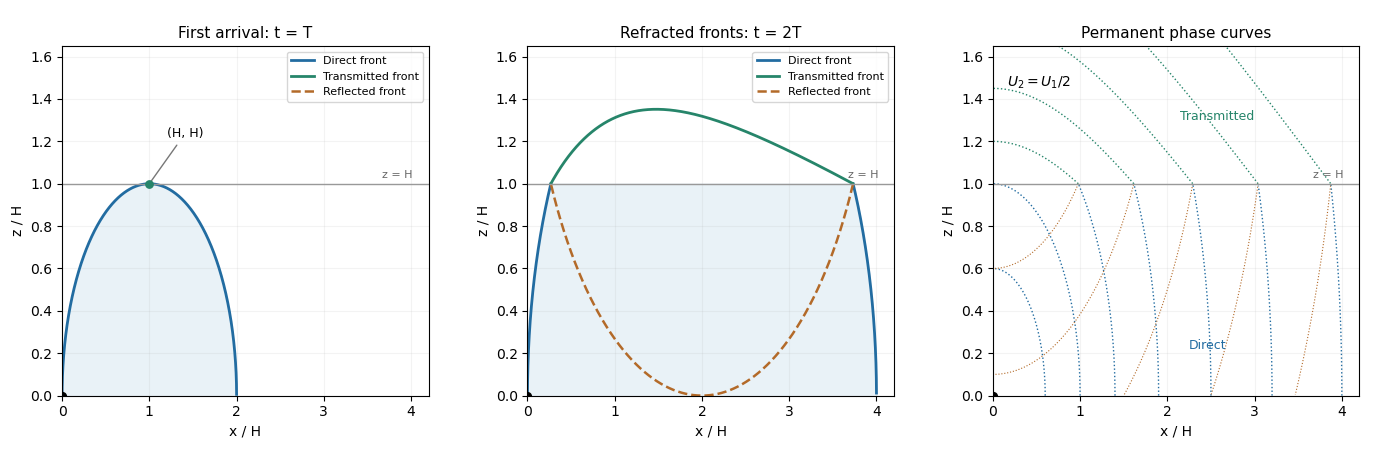

The schematic uses and . It shows the direct front below , the transmitted front above it and the reflected front below it; dotted arcs are permanent phase curves, not material trajectories.
Articles by others on the same topic
There are currently no matching articles.