The three allowed tree-level Feynman diagrams are shown below, using physical-particle Feynman propagators in unitary gauge. Solid arrows follow fermion number and the wavy lines denote the charged vector Feynman propagator.
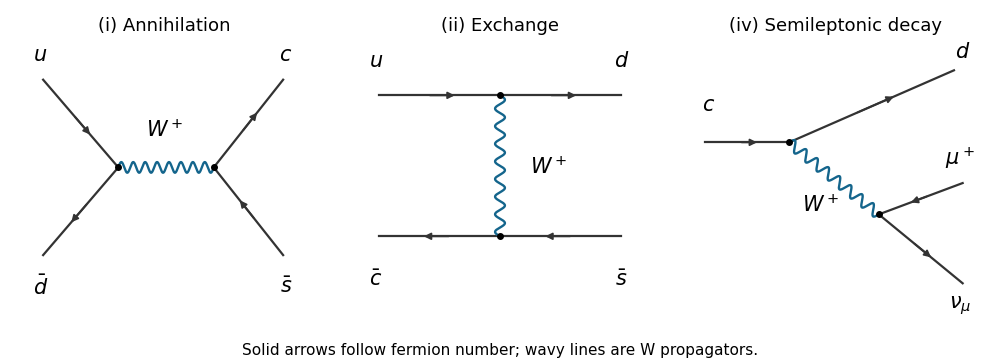
Charged-current interaction diagrams
. The allowed s-channel, t-channel and semileptonic weak charged current graphs. Details.
Allowed through an s-channel W boson. The initial up quark and down antiquark annihilate into a virtual , which produces the final charm quark and strange antiquark. The two weak charged current vertices contain the nonzero CKM matrix elements and , with complex conjugations determined by fermion-flow conventions.
The left panel shows the unique physical-particle tree-level Feynman diagram. A neutral exchanged gauge boson cannot connect these charged annihilation currents, and flavour-diagonal neutral vertices cannot turn an up quark into a charm quark. There is no additional elementary charged scalar in the minimal Standard Model.
Allowed through a t-channel W boson. Along one fermion line the up quark becomes a down quark by emitting a virtual ; along the other the charm antiquark absorbs it and becomes a strange antiquark. The middle panel shows this weak charged current exchange. Both electric charge and baryon number are conserved at each vertex, and the relevant CKM matrix entries are nonzero.
This is the unique physical-particle tree-level Feynman diagram. A neutral exchange would require a flavor-changing neutral current on each line, absent at tree level in the Standard Model. An annihilation into a neutral boson would likewise require an off-diagonal up-type neutral current. The different generations do not forbid the charged-current graph.
Forbidden by electric-charge conservation. The initial bottom quark has electric charge , while the displayed final electric charges sum to . Therefore no Standard Model Feynman diagram, at tree level or any loop order, can realize this channel.
This is an intentionally disallowed process, not a transcription correction. The charge-conserving semileptonic bottom decay instead has an electron and an antineutrino of electron flavour, while a Positron accompanies the conjugate antiquark decay. Replacing the displayed particles silently would change the requested classification.
Allowed through a virtual W boson. The charm quark emits a and becomes a down quark through the nonzero CKM matrix element . The virtual W boson produces a positive muon and a muon neutrino through the leptonic weak charged current. The right panel is the unique physical-particle tree-level Feynman diagram.
Its total electric charge is , equal to the initial charge, and its final lepton number is . The decay is Cabibbo suppressed, rather than forbidden. These diagram counts use unitary gauge: in covariant gauges charged unphysical Goldstone bosons can supply gauge-dependent pieces of the same physical amplitudes, not additional physical channels.
Articles by others on the same topic
There are currently no matching articles.