The three allowed tree-level Feynman diagrams are shown below, using physical-particle Feynman propagators in unitary gauge. Solid arrows follow fermion number and the wavy lines denote the charged vector Feynman propagator.
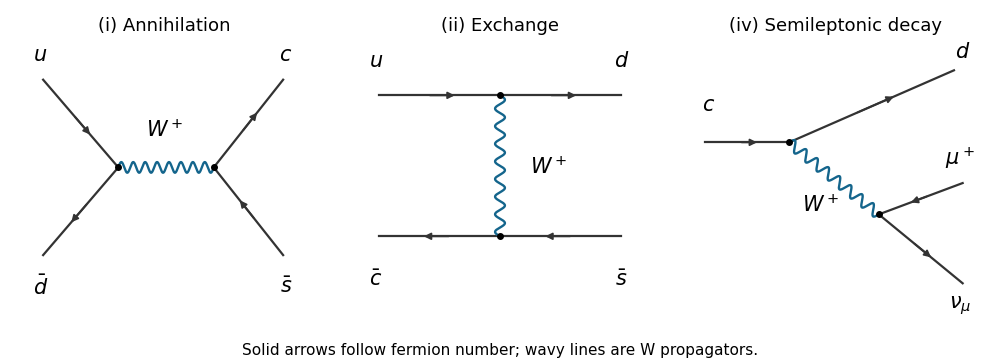
Charged-current interaction diagrams
. The allowed s-channel, t-channel and semileptonic weak charged current graphs. Details.
Allowed through an s-channel W boson. The initial up quark and down antiquark annihilate into a virtual , which produces the final charm quark and strange antiquark. The two weak charged current vertices contain the nonzero CKM matrix elements and , with complex conjugations determined by fermion-flow conventions.
The left panel shows the unique physical-particle tree-level Feynman diagram. A neutral exchanged gauge boson cannot connect these charged annihilation currents, and flavour-diagonal neutral vertices cannot turn an up quark into a charm quark. There is no additional elementary charged scalar in the minimal Standard Model.
Allowed through a t-channel W boson. Along one fermion line the up quark becomes a down quark by emitting a virtual ; along the other the charm antiquark absorbs it and becomes a strange antiquark. The middle panel shows this weak charged current exchange. Both electric charge and baryon number are conserved at each vertex, and the relevant CKM matrix entries are nonzero.
This is the unique physical-particle tree-level Feynman diagram. A neutral exchange would require a flavor-changing neutral current on each line, absent at tree level in the Standard Model. An annihilation into a neutral boson would likewise require an off-diagonal up-type neutral current. The different generations do not forbid the charged-current graph.
Forbidden by electric-charge conservation. The initial bottom quark has electric charge , while the displayed final electric charges sum to . Therefore no Standard Model Feynman diagram, at tree level or any loop order, can realize this channel.
This is an intentionally disallowed process, not a transcription correction. The charge-conserving semileptonic bottom decay instead has an electron and an antineutrino of electron flavour, while a Positron accompanies the conjugate antiquark decay. Replacing the displayed particles silently would change the requested classification.
Allowed through a virtual W boson. The charm quark emits a and becomes a down quark through the nonzero CKM matrix element . The virtual W boson produces a positive muon and a muon neutrino through the leptonic weak charged current. The right panel is the unique physical-particle tree-level Feynman diagram.
Its total electric charge is , equal to the initial charge, and its final lepton number is . The decay is Cabibbo suppressed, rather than forbidden. These diagram counts use unitary gauge: in covariant gauges charged unphysical Goldstone bosons can supply gauge-dependent pieces of the same physical amplitudes, not additional physical channels.
Use metric , and relativistically normalized external spinors. The Fermi interaction givesup to an irrelevant phase. The fermion spin sums replace and by the slashed massless momenta. Write . The gamma matrix trace identities yieldThe symmetric-antisymmetric mixed contractions vanish. The symmetric contraction is , while the two epsilon tensors contract to . Including and the initial-spin average therefore givesThe singlet color charge contractions have net factor one after summing final colours and averaging initial color charge states. Thus this is also the colour-averaged partonic result; no extra factor three is required.
In the centre-of-momentum frame, let . The Mandelstam variables satisfy and , giving and . HenceThe massless invariant flux factor is and , so the weak charged-current quark scattering cross-section isFor a purely left-handed weak charged current, , , this reduces to , fixing the sign of the forward term. Purely right-handed weak charged currents at both vertices have the same unpolarized angular law. The factorization convention for could be rescaled by a common numerical factor; the displayed product fixes the normalization.
For fixed the effective Fermi interaction predicts . The angular odd term integrates to zero, while , soThe corresponding fixed-spin scattering amplitudes grow as , eventually conflicting with partial-wave unitarity. This is a failure of extrapolating the effective field theory, whose contact approximation requires , not a failure of the Standard Model.
Restoring the virtual W boson Feynman propagator replaces its constant low-energy denominator by , away from the resonance. The massless external Dirac equations give zero contraction of each current with the exchanged momentum, so the longitudinal numerator does not contribute. Its squared modulus multiplies the effective cross-section. For the resulting tree-level rate decreases as rather than growing as . Near the pole one must include the W boson decay width. These statements assume the same massless conserved external currents; the contact expression alone is not valid there.
Opposite directions replace by . The even term cancels from the numerator and the odd term from the denominator. For , the angular asymmetry of a chiral charged-current interaction isHere denotes the antipodal direction in the stated angular law. If , both rates vanish and the asymmetry is undefined.
The overall Fermi constant, energy-dependent prefactor and common normalization cancel. Thus this observable constrains the relative vector current and axial current couplings of the weak charged current rather than only their total strength. Pure vector currents or pure axial currents give zero asymmetry; gives the maximal coefficient, . The inequality ensures .
It does not uniquely identify the handedness: the formula is insensitive to , , and interchanging . In particular equally strong purely left- and right-handed weak charged currents at both vertices are indistinguishable in this unpolarized measurement. Additional spin-sensitive observables would be needed to remove that degeneracy. The cancellation and constraints are within the massless parton approximation specified for the calculation.
Articles by others on the same topic
There are currently no matching articles.