Differentiating the disturbing function in Lagrange planetary equations givesFor the complex eccentricity ,Use . Each planetary term becomes , soUnlike the polar orbital element equations, this linear equation is nonsingular at .
The planetary expansion is a decomposition into secular eigenmodes of conservative linear Laplace-Lagrange secular theory. It assumes small orbital eccentricities, coplanarity, approximately constant semi-major axis values, and averaging over fast orbital phases away from important mean-motion resonances and close encounters. Dissipation, migration, and nonlinear secular effects are absent from this constant-coefficient representation.
The are real eigenfrequencies of the Laplace-Lagrange secular matrix, describing apsidal precession. For mode , the signed real coefficients give its amplitude in planet ; their relative magnitudes are fixed by an eigenvector, and their signs distinguish aligned and anti-aligned apsides. The common phase specifies that mode's orientation at the chosen time origin. A planet's actual orbital eccentricity is , which generally varies through interference of modes; it is not a sum of the positive mode amplitudes.
Put . For , the solution of the linear secular forcing of a test particle equation isThe initial condition gives and . The proper eccentricity is the constant amplitude of the homogeneous response; its proper longitude of periapsis is . The forced eccentricity is the driven vector , not necessarily a constant magnitude.
On an Argand diagram, describes a circle of radius . Its center can itself move under the planetary modes, so need not trace one fixed circle in the inertial complex plane. At a secular resonance , that mode instead produces , and the undamped linear response grows until the approximation fails.
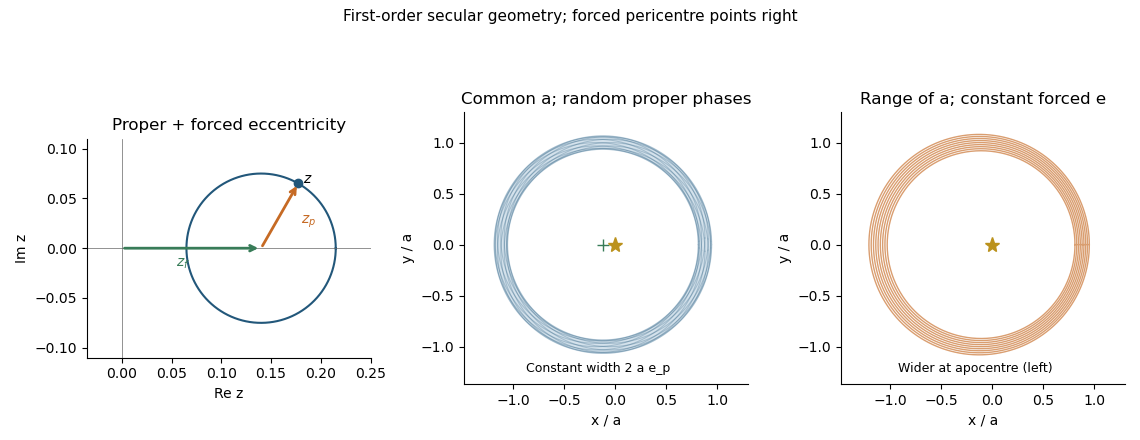

For one isolated perturbing planet, its Kepler orbit has fixed longitude of periapsis, so is constant and its secular forcing frequency is zero. A constant forced eccentricity satisfies . Since ,This assumes . If an external process made the planet precess at frequency , the particular solution would instead be ; the stated formula relies on the isolated single-planet case.
To first order in orbital eccentricity, the semi-minor axis is , while the ellipse's center is displaced from the star by . Thus each orbit is a circle of radius about , in complex spatial coordinates.
Write at one secular epoch. The centers of the individual circles lie on a circle of radius about . Their union is the proper-eccentricity annulusIts full radial width is and its center is displaced by toward the forced apoapsis direction. Relative to the star, if the forced longitude of periapsis is zero,The middle panel of the preceding figure shows this construction. For fully sampled orbital phases and proper phases, the annulus is occupied throughout, but its density need not be uniform; turning points in the proper radial excursion give integrable edge enhancements. The construction requires and is an instantaneous secular geometry.
If the proper eccentricity is negligible and the semi-major axis ranges over , particles lie on nearly aligned forced Kepler orbits. For a locally constant forced vector, these are geometrically similar ellipses, represented to first order by circles of radius centered at .
The boundaries of the aligned eccentric ring are thereforeIt is narrower at forced periapsis and wider at forced apoapsis, unlike the constant-width proper-eccentricity annulus. Its centers shift slightly between the two edges, as shown in the right panel of the figure. The condition makes the proper radial excursion negligible compared with the variation in forced center location.
The forced vector need not actually be constant across the interval. More generallyFor aligned apsides this becomes , provided the orbits remain nested. The radial gradient of forced eccentricity matters for the density comparison even in a narrow ring.
For a phase-mixed orbit, probability in a short arc is , so the line density on a Kepler orbit is inversely proportional to speed. At true anomaly ,Using the vis-viva equation, and hence . ThereforeFor one particle, the normalized line probability is . This is density per arc length; density per unit polar angle has a further factor and is proportional to .
In the proper-eccentricity annulus, averaging over random proper phases cancels the proper vector in the first-order angular variation. The mean line density is proportional to , while the full ring width is independent of angle. Thus at corresponding radial locationsThere is a forced-apocentre enhancement in number surface density of a disk, together with the proper-excursion edge profile.
For a narrow aligned eccentric ring with locally constant , its width has the same first-order factor as its line density. Their ratio is constant: the constant-eccentricity aligned ring has no first-order surface-density contrast. It still contains more particles per unit longitude at apoapsis, spread across a wider area.
The more general surface density contrast in an eccentric ring depends on the eccentricity gradient. With a smooth number distribution per unit semi-major axis and aligned apsides,Hence decreasing can also make the aligned ring apocentre-dense; for it has the same first-order contrast as the proper-phase case. A positive gradient gives a pericentre enhancement. The problem leaves this profile unspecified, so there is no universal observational distinction based solely on the two apse densities.
Resolved ring width and a measured forced-eccentricity profile can distinguish the constant-width and similar-ellipse constructions. Interpreting observed brightness additionally requires the grain temperature, illumination, emissivity, and viewing geometry; brightness is not itself particle number density. Inferences from one contrast alone can therefore be degenerate.
Articles by others on the same topic
There are currently no matching articles.