Take the pivot as origin, with horizontal and vertically upward. For the simple pendulum, putThe velocity and acceleration areThe forces are the tension and gravity . Taking the dot product of Newton's second law with eliminates the tension and givesNear the downward stable equilibrium , the small-angle approximation gives to first order. Since , its linearization isThis is simple harmonic motion with angular frequency ; the restoring sign confirms the stable equilibrium.
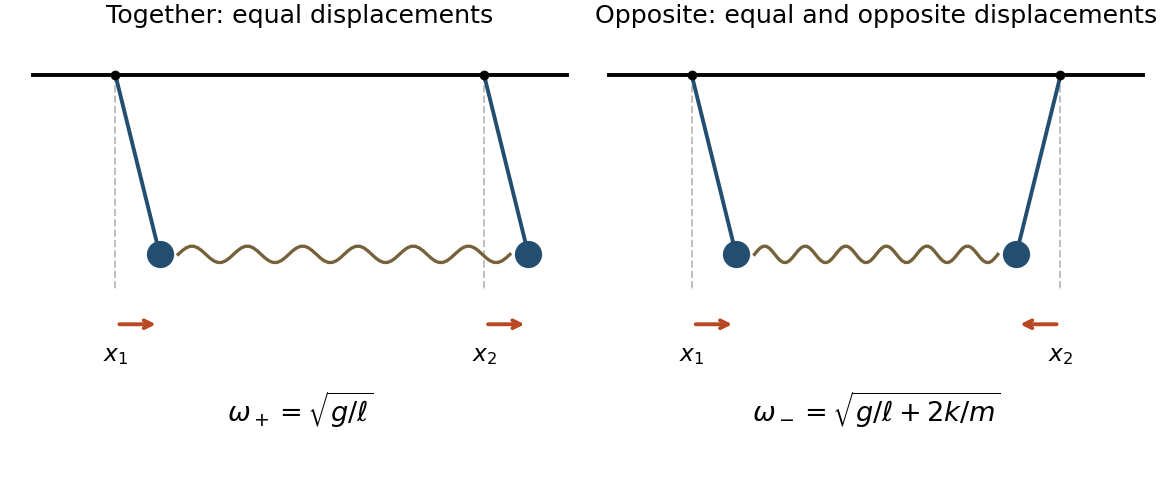
Measure as horizontal displacements from the respective downward equilibrium positions; the absolute horizontal coordinates are and . Each vertical displacement is of second order in its small angle. Thus the spring is horizontal to first order, its extension is , and Hooke's law gives horizontal forces and . Combining these with the linearized simple pendulum restoring force yieldsFor the normal modes of two spring-coupled equal pendulums, add and subtract these ordinary differential equations. The normal mode coordinates and satisfyHence the two natural angular frequencies and displacement patterns areOrdinary frequencies are and . In the first normal mode, both particles swing together with equal amplitudes and the spring is unextended to first order. In the second normal mode, the particles swing in opposite directions with equal amplitudes, so the spring adds a restoring force and increases the angular frequency.

Articles by others on the same topic
There are currently no matching articles.