The scalar product, also called the dot product, and the vector product, also called the cross product, areFor nonzero vectors, let be their angle. Their Euclidean norms satisfyThe cross product is orthogonal to both vectors, with its orientation determined by the right-hand rule. If either vector is zero, both products vanish, although the angle is undefined.
A real square matrix is an orthogonal matrix whenHere is the transpose and the identity matrix; equivalently, its columns form an orthonormal basis. If this holds, the squared Euclidean norm obeysso the linear transformation preserves length.
Conversely, suppose for every vector . Put , a symmetric matrix. Then for every vector. Taking , the standard basis vectors, gives . Taking for gives . Thus , proving that the linear transformation preserves length if and only if is an orthogonal matrix.
Choose the first orthonormal basis vector to be . If is not parallel to , choose along ; otherwise choose any unit vector orthogonal to . Complete to an orthonormal basis with . The matrix with rows is an orthogonal matrix, and expressing the three unit vectors in this basis givesThe last two components of have polar coordinates of the displayed form; we may choose . If they vanish, is arbitrary.
An orthogonal transformation preserves dot products. Taking dot products with , and then using the unit Euclidean norms, givesThe remaining dot product givesAn orthogonal matrix has determinant , so it preserves the absolute scalar triple product. In the new coordinates this scalar triple product is . ConsequentlyTaking the nonnegative square root provesNo division by or was used, so the proof includes parallel vectors. Equivalently, the expression under the square root is the Gram determinant of the three unit vectors.
A hyperbola with focus of a conic , directrix of a conic not containing , and eccentricity is the locusPut and . For and , the defining equality becomesBoth sides are nonnegative, so squaring is reversible. Expanding and cancelling the linear terms givesThus the two matched focus of a conic and directrix of a conic choices, related by reflection, areThe signs in each pair must agree.
On the hyperbola, . As ,Hence the perpendicular distance to one of the two straight lines tends to zero on each end of a branch. The asymptotes are therefore
A nondegenerate hyperbola centred at the origin has a quadratic equationThere are no linear terms because the origin is its centre. Its asymptotes are the zero set of the homogeneous quadratic form . Requiring the directions and gives , hence and . Since the conic section is nondegenerate, and are nonzero. Thus all such hyperbolas with prescribed asymptotes are exactlyFor these rectangular hyperbolas open along the -axis, and for along the -axis. Conversely, each displayed hyperbola has the required centre and asymptotes. Two distinct members have different values of , so they cannot intersect.
For the second pair of asymptotes, the same argument gives , . The intersections of concentric hyperbolas therefore satisfyIf both right sides are positive, there are four independent sign choices. If precisely one is zero and the other is positive, there are two points. If either is negative there are none; both cannot vanish because . Each possibility occurs: take for four, for two, and for none. Hence
At a regular point of the parametrized surface, the partial derivatives and are linearly independent tangent vectors. Their cross product gives a nonzero normal vector:Dividing by its Euclidean norm gives a unit normal; changing the sign chooses the opposite orientation. If the cross product vanishes, this parametrization is singular there and cannot determine a normal vector by this formula.
An infinitesimal parameter rectangle becomes a parallelogram with edges and . Its area is the Euclidean norm of their cross product, giving the surface area elementThus, for a regular parametrization covering the surface once except possibly on sets of area zero,For several patches, add their surface integrals while avoiding overlap; repeated coverage would otherwise count area with multiplicity.
The partial derivatives of this parametrized surface areTheir cross product isThe mixed terms cancel in its squared Euclidean norm:Since , the surface area element is . There is no repeated coverage: recovers , and then recovers . Therefore the surface area is
Use the polar radius as the parameter of the Archimedean spiral. Its angle in polar coordinates is . The radial and angular contributions to its arc length are orthogonal, soThere is no need to evaluate this integral. The simple bounds implyThe squeeze theorem therefore gives the scaled length of an Archimedean spiral:Geometrically, the radial contribution becomes negligible after multiplying the arc length by ; the remaining contribution is the area under the function graph on .
Take the pivot as origin, with horizontal and vertically upward. For the simple pendulum, putThe velocity and acceleration areThe forces are the tension and gravity . Taking the dot product of Newton's second law with eliminates the tension and givesNear the downward stable equilibrium , the small-angle approximation gives to first order. Since , its linearization isThis is simple harmonic motion with angular frequency ; the restoring sign confirms the stable equilibrium.
Measure as horizontal displacements from the respective downward equilibrium positions; the absolute horizontal coordinates are and . Each vertical displacement is of second order in its small angle. Thus the spring is horizontal to first order, its extension is , and Hooke's law gives horizontal forces and . Combining these with the linearized simple pendulum restoring force yieldsFor the normal modes of two spring-coupled equal pendulums, add and subtract these ordinary differential equations. The normal mode coordinates and satisfyHence the two natural angular frequencies and displacement patterns areOrdinary frequencies are and . In the first normal mode, both particles swing together with equal amplitudes and the spring is unextended to first order. In the second normal mode, the particles swing in opposite directions with equal amplitudes, so the spring adds a restoring force and increases the angular frequency.
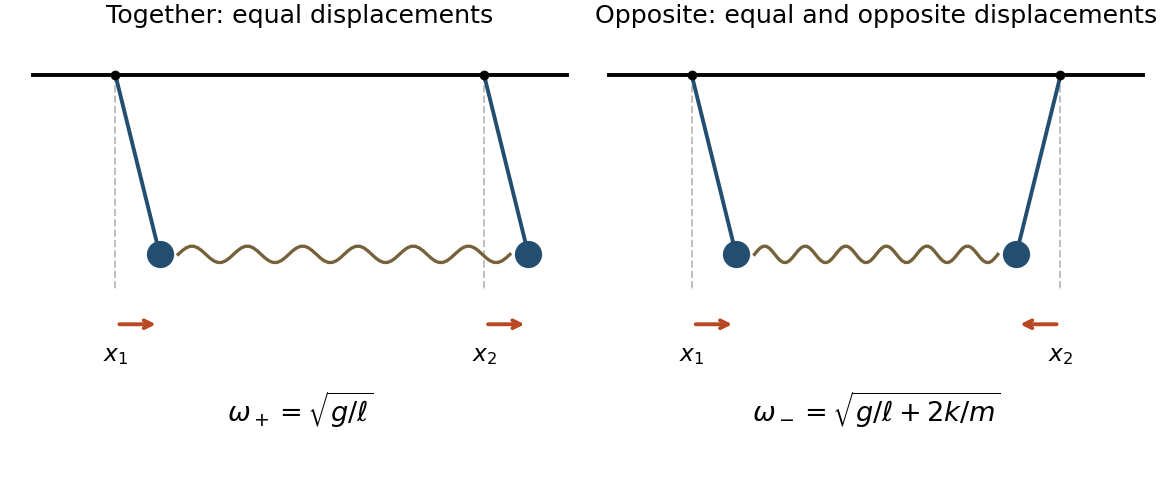

Use as the gravitational acceleration, so the weights are and , consistently with the requested equations. The printed introductory phrase calling a force magnitude omits the factor .
For the particle on a cone coupled to a hanging mass, write and use the cylindrical coordinates unit vectors . The ideal string segment from the cone particle to the hole has length and direction . If is the downward length of the hanging segment and the fixed total length, thenThe light ideal string and smooth hole give the same tension on both sides. Applying the vertical component of Newton's second law to the hanging particle givesWrite the normal reaction on the cone particle as , allowing to be signed according to the side of the ideal constraining surface. The acceleration in cylindrical coordinates and Newton's second law giveThere is no azimuthal force. Multiplying the middle equation by proveswhere the positive angular direction is chosen along the initial velocity. This is conservation of angular momentum about the vertical axis.
Subtract the radial equation from the vertical equation to eliminate the normal reaction. Since , this givesSubstitute the tension and the conserved angular momentum, using :Multiplication by now gives an exact time derivative:Initially and , because the initial velocity is horizontal. ThereforeThis is also total mechanical energy divided by , with an irrelevant constant removed: the two particles contribute to the radial and vertical kinetic energy, while their combined gravitational potential energy is plus a constant.
In terms of the positive cylindrical radius , the conserved mechanical energy becomesThe effective potential tends to infinity at both ends of for , and . Thus its two turning points enclose the allowed radial motion. At a turning point, , soBesides , the positive root of a polynomial isthe other root of a polynomial is negative. The quadratic polynomial is negative at zero and has just one positive root of a polynomial. Since , we have when , and when .
Height is , so its maximum occurs at the smaller positive turning point. HenceIndeed, the initial vertical acceleration isBelow the critical speed the particle first rises to ; above it the particle initially descends, and its initial height is already its greatest height. At the turning points merge and the particle follows a horizontal circular orbit at . For zero initial speed the radial conservation of energy gives motion to the apex level ; if the hole excludes the apex itself, zero is the supremum of the heights before arrival at the hole.
These are the heights under the maintained mechanical constraint used in part (a). A unilateral contact with only one side of a cone would additionally require checking the sign of the normal reaction; the ideal constrained equations alone do not impose that condition.
By symmetry, the centre of mass is . Choose horizontal axes through and the vertical symmetry axis as the third axis, writing . With uniform mass density , the inertia tensor has entriesReflection in each coordinate plane makes all the mixed integrals , , and vanish. Rotational symmetry about the vertical axis gives . Thus these are principal axes andThe axial moment of inertia of a hollow cylinder isIts mass is . Dividing and factoring the difference of squares gives
Choose positive downhill and positive in the corresponding rolling direction, with initially. For rolling without slipping, the contact point has zero velocity, so . Integrating the rolling constraint givesLet be the uphill static friction. Along the inclined plane, Newton's second law for the centre of mass givesThe weight passes through the centre of mass, and the normal reaction has its line of action through it. Thus only static friction supplies torque about . The angular velocity is along the cylinder's symmetry axis, so the inertia tensor gives angular momentum in that direction. The torque equation is thereforeEliminating static friction and inserting givesThe extra term represents the rotational inertia that must be accelerated along with the translational mass.
For a uniform solid cylinder, set in the moment of inertia formula, givingFor the hollow cylinder, makes the denominator larger:on a downward incline with . Thus the solid cylinder accelerates faster, assuming rolling without slipping for both. More of the hollow cylinder's mass lies far from the rotation axis, increasing its moment of inertia relative to .
Start with . At stage , form the midpoint . If , stop; for a sequence defined for all later indices, repeat forever. Otherwise retain the half-interval with opposite endpoint signs: set if , and otherwise. This is the bisection method.
If it never stops, the closed intervals are nested, retain , and have lengthsBy the nested interval theorem, there is a unique real in their intersection. In particular, , , and the sequence of midpoints satisfiesSince is continuous, . All these products are negative, so their limit of a sequence is nonpositive. Therefore , forcing . We have proved that the sequence is a convergent sequence whose limit of a sequence is a zero of a function:The error bound applies at every stage before exact termination; after termination the error is zero. The intermediate value theorem also guarantees a zero of a function in each retained interval, but the nested-interval argument identifies the particular one to which the sequence of midpoints converges.
For an unconstrained differentiable function of two real variables, an interior local minimum must solve the simultaneous stationary point equationsApply Newton's method in optimization to this gradient equation. The Jacobian matrix of the gradient is the Hessian matrixAt , solve the linear system , then set . When the Hessian matrix is invertible, this isThis follows by setting the first order Taylor expansion equal to zero. Solving the linear system avoids explicitly computing a matrix inverse. A stationary point need not be a local minimum: for example, a positive-definite matrix suffices to classify a stationary point as a strict local minimum, whereas an indefinite Hessian matrix identifies a saddle point of a scalar function.
Expanding and taking partial derivatives gives the gradient and Hessian matrixAt , these are andThus the Newton step solvesThe second equation gives ; substituting into the first gives . HenceAt , however,The eigenvalues of this Hessian matrix are in direction and in direction . It is invertible but indefinite. Thus the Newton step is zero, andThis illustrates that stationary points are fixed points of Newton's method. Here the fixed point is a saddle point of a scalar function, not a local minimum. Indeed, direct substitution along the two eigenvector directions givesFor sufficiently small nonzero , one direction decreases and the other increases it. The global minimum is instead zero: the sum of squares vanishes at and . These are the only real zeros, since and imply . Thus a zero gradient is an insufficient stopping certificate for minimization problem without classifying the stationary point.
Articles by others on the same topic
There are currently no matching articles.