The two-vector Gram matrix isThe upper bound follows because the subtracted square is nonnegative. If either vector is zero, the determinant is zero. Otherwise apply the non-strict version of the calculation in i: with gives . ThereforeEquality on the left holds exactly when the two vectors are linearly dependent; equality on the right holds exactly when they are orthogonal. The Gram determinant measures the squared area of their parallelogram: in the nonzero case, , the square of base times perpendicular height.
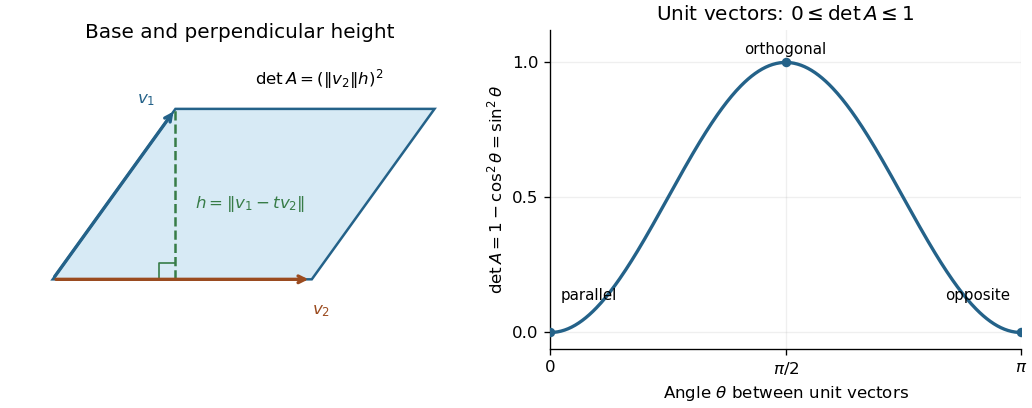
The Gram determinant as squared parallelogram area, and its dependence on the angle between unit vectors
. Details. 
Articles by others on the same topic
There are currently no matching articles.