The hypothesis implies , since the zero vector is a scalar multiple of every vector. SetSince is not a scalar multiple of , . Positive definiteness and bilinearity of the real inner product giveMultiplying by and taking square roots proves the strict Cauchy-Schwarz inequalitySince every real number satisfies , this proves, in particular,The argument derives the required inequality directly from the inner product axioms.
The two-vector Gram matrix isThe upper bound follows because the subtracted square is nonnegative. If either vector is zero, the determinant is zero. Otherwise apply the non-strict version of the calculation in i: with gives . ThereforeEquality on the left holds exactly when the two vectors are linearly dependent; equality on the right holds exactly when they are orthogonal. The Gram determinant measures the squared area of their parallelogram: in the nonzero case, , the square of base times perpendicular height.
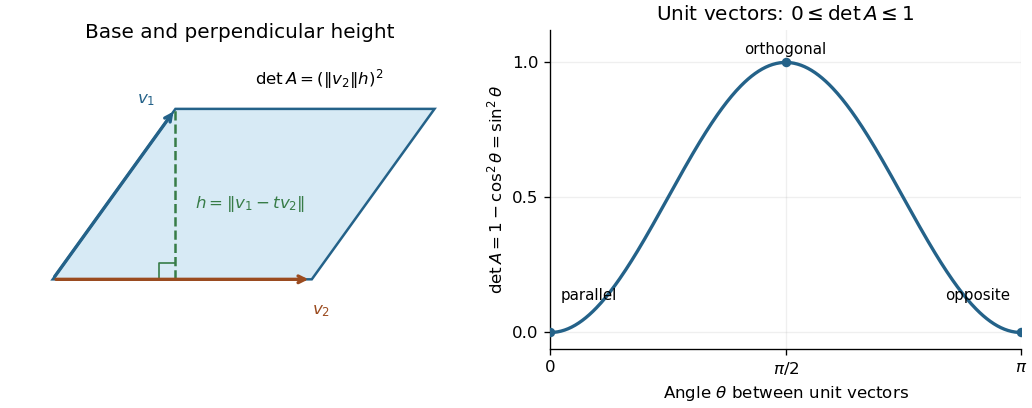
The Gram determinant as squared parallelogram area, and its dependence on the angle between unit vectors
. Details. 
Bilinearity of the real inner product gives, for the specified linear combinations,The last equality is the entrywise rule for matrix multiplication, with the transpose of the column vector .
Symmetry of the real inner product gives . Moreover, i with shows thatso the Gram matrix is a positive semidefinite matrix. To also check reality of every eigenvalue, allow a nonzero vector with . Since is a real symmetric matrix,Here is the conjugate transpose, and cancels the imaginary part. Thusbecause . This proves both that every eigenvalue is real and that it is nonnegative.
By the spectral theorem for real symmetric matrices, there is an orthogonal matrix such thatFor clarity, the diagonalization can also be justified recursively. The characteristic polynomial has a complex root of a polynomial by the fundamental theorem of algebra. By ii its eigenvalue is real; taking a nonzero real or imaginary part of an associated eigenvector in gives a real eigenvector, which can be normalized. Its orthogonal complement is invariant, because . Restriction to this linear subspace is again symmetric, and induction on dimension gives an orthonormal basis of eigenvectors.
All by ii. The permitted invariance of determinant and matrix trace under change of basis, applied to the diagonal matrix, yields
If every , then each diagonal entry of the Gram matrix is , so its matrix trace is . Using iii and the permitted arithmetic-geometric mean inequality,The bound is attained by any orthonormal family, whose Gram matrix is the identity matrix.
Articles by others on the same topic
There are currently no matching articles.