Continuity. The function is continuous at when . Equivalently, for every there exists such that within the domain of a function implies ; this is the epsilon-delta definition of continuity.
Differentiability. At an interior point , the difference quotient must have a finite two-sided limit of a function:This defines differentiability and the derivative. At an endpoint one may instead state a one-sided definition relative to the interval. Differentiability implies continuity, because the increment is times a quotient with finite limit, but continuity alone does not guarantee differentiability.
For the derivative at zero use its definition, rather than substituting into a formula obtained away from zero:Indeed, putting makes the absolute value , which tends to zero since Gaussian decay dominates every power. Therefore is continuous and differentiable at zero, with . Away from zero, the chain rule gives .
For , induction giveswhere each is a polynomial. This recurrence follows from the product rule and . Since Gaussian decay dominates every power,These limits also describe the derivatives of the extension at zero. If , its next difference quotient is , which again tends to zero. Induction proves existence and continuity of every derivative, all zero there. This is a flat function, covered more generally by polynomial multiples of a Gaussian flat function.
Insert into the exponential series . For every fixed , this gives the expansion with absolute convergenceThis is a Laurent series in inverse powers of , as requested. It is not a Maclaurin series about zero: that series has every coefficient zero and cannot equal on a punctured neighborhood of zero. There is no contradiction, since the inverse-power expansion does not apply at .
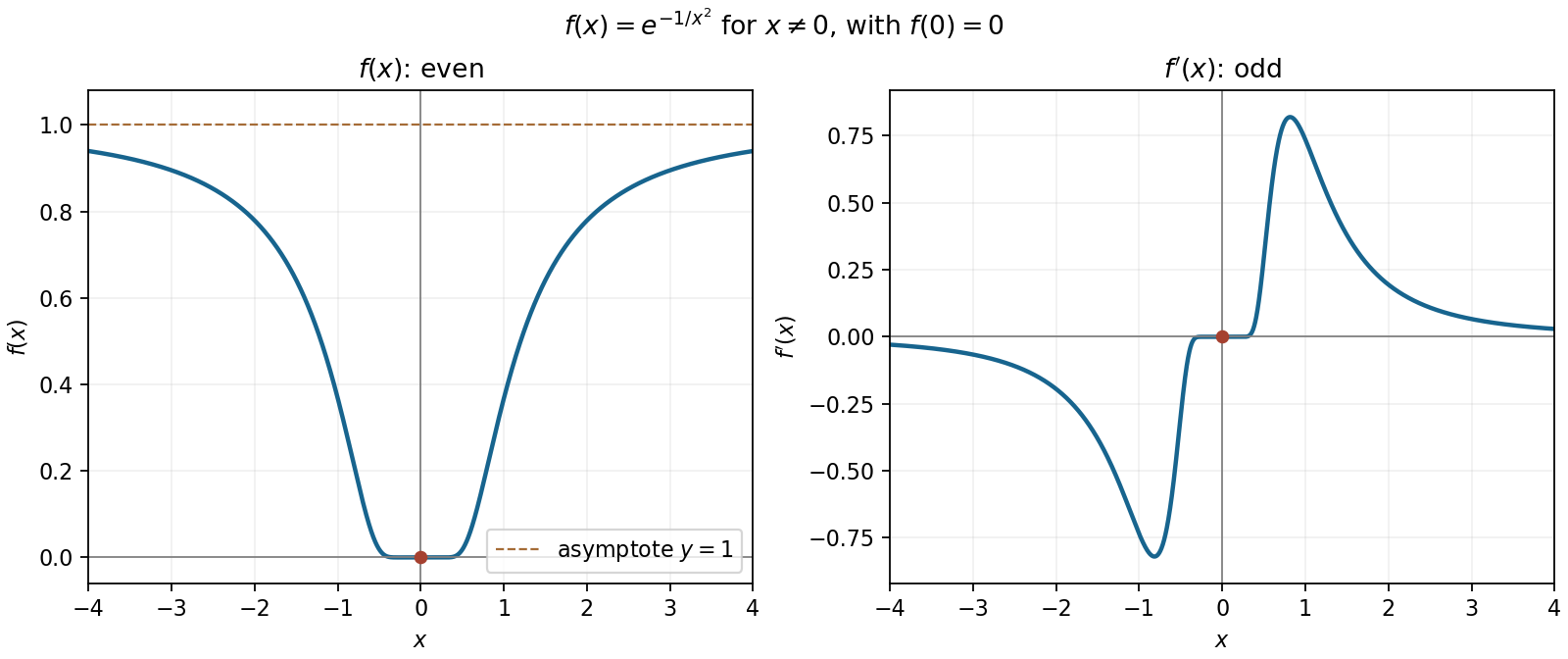
The flat function is an even function, has its unique zero and global minimum at the origin, and approaches the horizontal asymptote as . It decreases for negative and increases for positive , meeting the origin with a horizontal tangent line.
Its derivative is an odd function: off zero, with . It is negative to the left and positive to the right, tends to zero both at the origin and at infinity, and has one negative trough and one positive crest. Indeed away from zero, so the change in slope of occurs once on each side. The exact crest and trough coordinates are not needed for the sketch.

Articles by others on the same topic
There are currently no matching articles.