At a regular constrained stationary point, the Lagrange multiplier equations are , . Eliminating the multiplier givesThus the required Lagrange multiplier determinant condition in two variables isIf the constraint gradient vanishes, this determinant is zero automatically, although the regular multiplier theorem cannot be applied. The condition is necessary and is not sufficient to classify the constrained point. This addresses the original unnumbered task before part (a).
Maximizing the squared distance avoids differentiating a square root. The Lagrange multiplier equations for areAdding and subtracting the first two gives and . The feasible stationary points therefore lie on or . The first case gives and squared distance . The second gives and , with squared distance .
The ellipse is compact and its constraint gradient does not vanish on the curve, so an extremum exists among these points. A direct global check is , using . Equality occurs when . Consequently
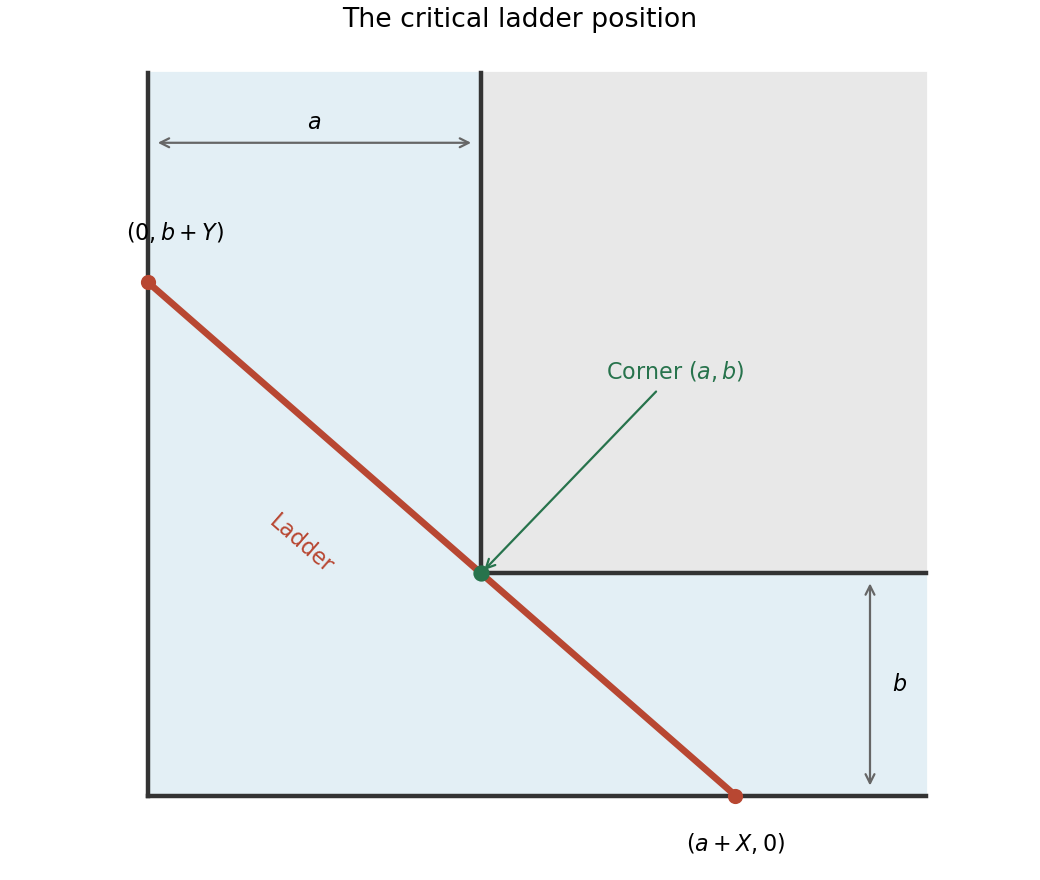
Assume positive corridor widths . Write the line through the two wall-contact endpoints in intercept form. Requiring it to pass through the inner corner givesIts squared length is . Apply Lagrange multipliers to this function subject to :Multiplying by and respectively eliminates the multiplier, giving . Substitute and multiply by :The branch is geometrically inadmissible. Thus and . If and , the two intercepts become and , soAlong in the positive quadrant, as or , and this is its only stationary point. It is therefore the minimum of the longest sticks that fit at each orientation. A stick being turned must pass through every intermediate orientation, so this narrowest clearance is precisely the maximum carryable length, rather than a maximum of . This is the ladder around a right-angled corner problem, with a zero-width stick and wall contact allowed as in the ideal geometry.

Articles by others on the same topic
There are currently no matching articles.