For , differentiate while keeping the other coordinate fixed in the Cartesian coordinate system:The origin is excluded from this polar coordinates chart.
Differentiate the angular relation locally, or use . Holding each other coordinate fixed givesThese are local partial derivatives on a consistent angular branch, independent of where its branch cut is placed.
Apply the multivariable chain rule to . Using the coordinate partial derivatives above givesEquivalently, and . Their coefficients vary with position and must also be differentiated when applying them twice.
Write and . The needed coefficient derivatives are , , and . Apply the product rule to both terms of and use the chain rule for the derivatives of . Collecting terms givesSimilarly, differentiating givesOn addition, both the mixed partial derivative terms and the first angular derivative terms cancel. Using , the Laplacian in polar coordinates is
In the positive quadrant, both components of the gradient are positive. Along the arrows point along ; near the horizontal axis they point mainly upwards, and near the vertical axis mainly rightwards. The level sets are the hyperbolas , including the coordinate axes for level zero. The gradient is orthogonal to each regular level set and points towards increasing values of .
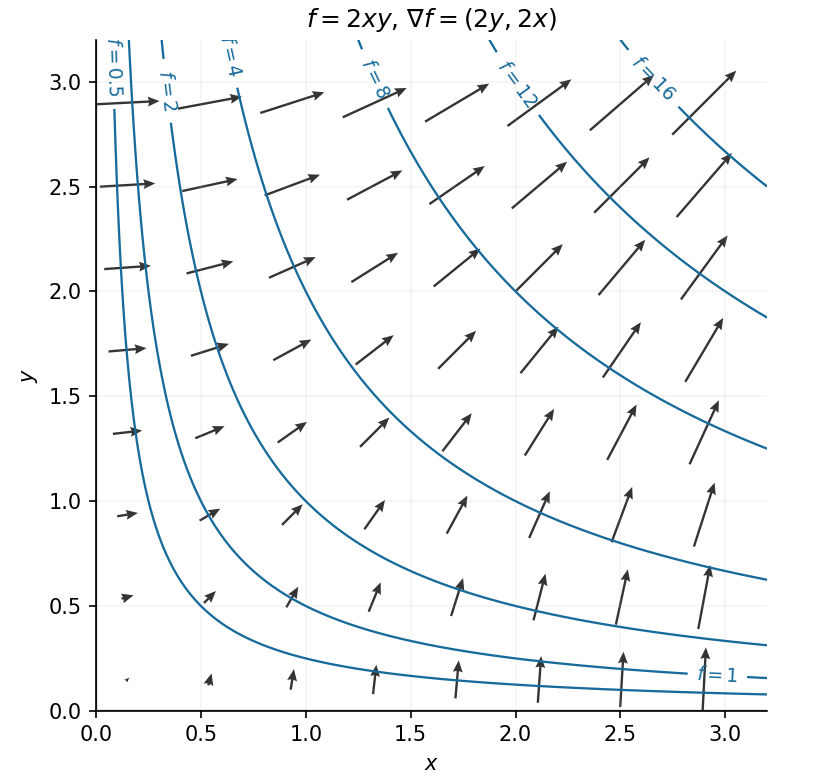

At , the gradient is . The requested direction must be normalized to the unit vector . The directional derivative is thereforeUsing without normalization would instead measure change per unit of a differently scaled path parameter.
Articles by others on the same topic
There are currently no matching articles.