Use the ordered displacement vector , and define by . For an unstretched spring, the extension to first order is the dot product of the relative displacement with its equilibrium unit vector. Summing its squared extensions gives the central spring stiffness matrix. The four side springs and two diagonal springs giveThereforeThe kinetic energy is , so a normal mode satisfies . Keeping the factor in the definition of fixes the normalization of and the resulting frequencies.
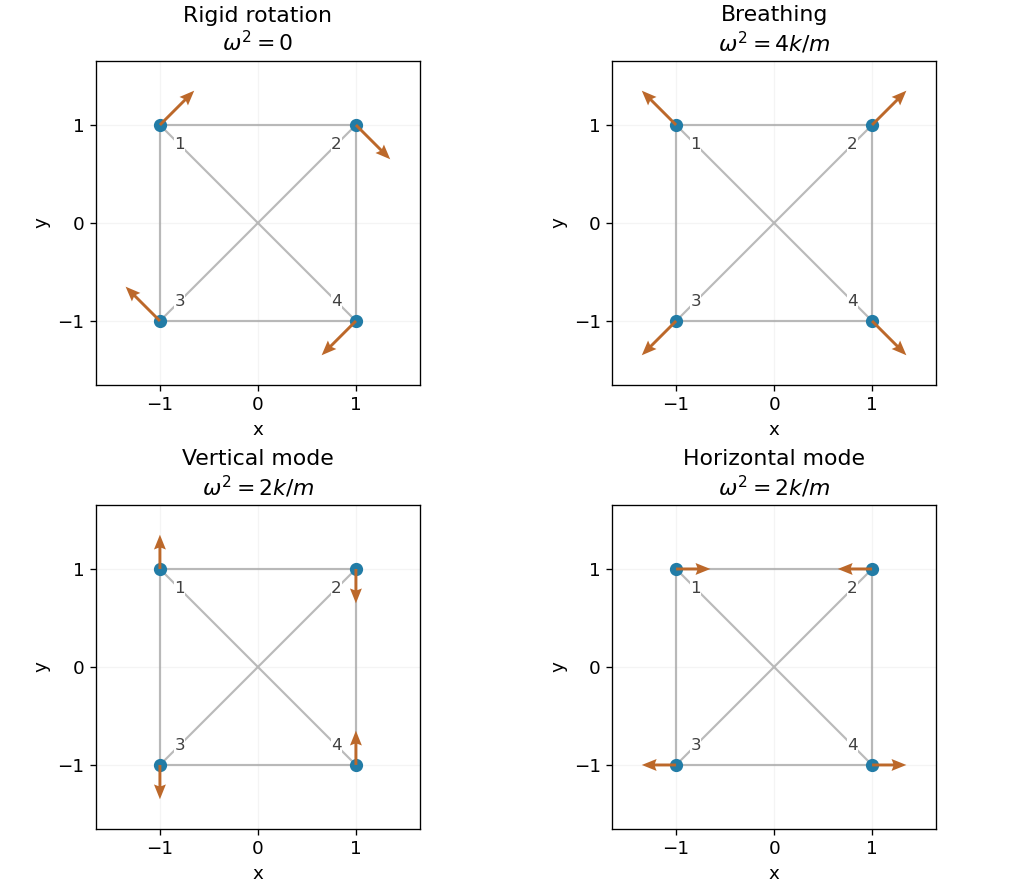
Rigid rotation, breathing and modes with reflection symmetry
. Original displacement diagrams. Grey lines show all six equilibrium springs; arrows show representative mode vectors. The rotation has zero frequency, the breathing mode has squared frequency 4k/m, and the two other modes have squared frequency 2k/m. Details.
The first two vectors displace every particle identically in the horizontal or vertical direction. Every relative displacement is zero, so every spring has zero extension to first order. The third vector is evaluated at the equilibrium points, which is an infinitesimal clockwise rotation. For any edge the relative displacement is perpendicular to that edge, again giving zero extension.
These are the rigid-motion zero modes of a spring framework: two translations and one infinitesimal rotation. Each has , so . In the linearized dynamics its amplitude has the form , expressing free rigid motion rather than a restoring oscillation. Exact finite rigid rotations also preserve every spring length; the mode vector is their first-order tangent.
In a breathing mode, each displacement is proportional to its equilibrium position. A representative vector isMultiplying by the stiffness matrix gives . ThusPositive and negative amplitudes are uniform expansion and contraction about the center.
For the proposed vector, the first horizontal component of is . Since the corresponding component of is zero, a normal mode requires . The vertical components then give . With an arbitrary nonzero overall amplitude, choose to obtainThe analogous pattern invariant under reflection across the vertical axis isDirect multiplication confirms . The two patterns give independent eigenvectors with the same eigenvalue, as expected from the square's rotation symmetry.
Articles by others on the same topic
There are currently no matching articles.