For a vacuum electric potential, put in Laplace's equation in spherical coordinates. Multiplication by separates the radial and angular terms. With separation constant and , the angular Legendre differential equation isRegularity at both polar axes selects nonnegative integers and the Legendre polynomials. The radial equation is , whose independent solutions are and . Hence the angularly regular axisymmetric vacuum solution isThe radial domain and its boundary conditions determine which terms are admissible.
For the given charge density, only is forced. Write . The interior radial Poisson equation is . The identity for the Poisson equation with a spherical harmonic source gives the particular solution , since the radial operator takes to four. Finiteness at zero and decay at infinity therefore giveContinuity of the electric potential and its radial derivative at requires and . Solving gives , , soAll other angular modes have zero coefficients after imposing regularity, matching and decay. At the origin the interior expression is , which extends with a continuous gradient and value zero. The angular charge density has no unique value exactly at that point; Poisson's equation holds classically for and as a weak solution through the origin. There is no additional point charge.
Expand the divergence of . The cross terms cancel, leaving . The divergence theorem gives Green's second identity,Use the Green function convention . Integrating over a bounded domain containing yields . Thus zero Neumann boundary data would be incompatible with this unit Dirac delta source. A suitable Neumann Green function with constant boundary flux instead has , where is the boundary area. Substituting , , givesThe last term is an undetermined constant. The data must obey the Neumann Poisson problem compatibility condition , obtained by integrating the original equation. Under this condition an additive constant in cancels from the first two terms.
For the upper half-space, reflect the source to . The method of images with equal-sign sources givesThe reflected singularity lies outside the domain; on the two normal derivatives cancel, so . Its total unit flux passes through a large hemisphere at infinity, where . This is why the bounded-domain condition on the boundary flux cannot be applied to the infinite plane alone.
With zero interior source and the given point boundary source, the boundary representation is . The terms at infinity vanish for this resulting field. ThereforeTo check the singular boundary condition, is the Poisson kernel for the upper half-space. Its integral over a horizontal plane is one and its mass concentrates at the origin as , giving in the distributional sense. This is the Neumann point source on a half-space boundary.
Choose the square root of one minus z squared with : explicitly with principal square roots. It is single valued and holomorphic away from the two specified exterior real branch cuts. If for , its boundary values areFor example, above the right cut approaches the negative real axis from below, selecting ; above the left cut approaches it from above, selecting . Continuing once around either branch point changes the sign, which explains the need for cuts.
Apply the residue theorem to on a large disk slit along both cuts, with small arcs excluding . The only enclosed pole is at zero, and its residue is . On the positively oriented boundary of the slit domain, the upper right lip runs from one to , and the lower right lip returns from to one. The jump in gives their combined integral as , where . The left lips similarly give after the substitution .
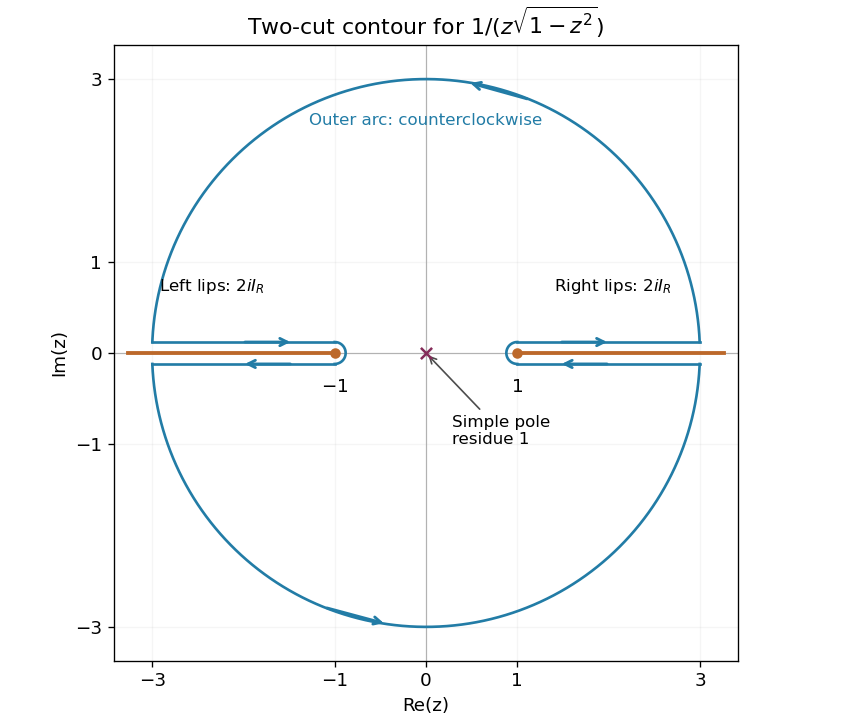

The small arcs contribute because the branch singularities have order . The large arc contributes because . Taking limits therefore yields , and henceThe real substitution independently reduces the integral to , confirming its value and sign.
Compute the complex derivative along horizontal and vertical increments. Along the real direction, ; along the imaginary direction, . Equality gives the Cauchy-Riemann equationsThe real and imaginary parts of a holomorphic function are smooth. Equality of their mixed partial derivatives then gives and , proving that both are harmonic functions.
For the first real part, and . The Cauchy-Riemann equations require and , so its harmonic conjugate is . ThereforeFor the second real part, is the real part of . Its harmonic conjugate is , givingThese are the most general answers on a connected open domain: the difference of two candidates has zero real part, so the Cauchy-Riemann equations make its imaginary part constant. The second function cannot extend holomorphically through zero.
The Laplace transform is wherever it converges. For sufficiently large , suitable exponential bounds justify integration by parts and differentiation under the integral sign, givingFor a nonnegative integer and real , substitute in the gamma integral. The result extends holomorphically to , givingThis also follows recursively from the second identity, starting with .
Put , and . For a solution with finite initial values and the required transform bounds, the transformed equation isThe initial-value terms cancel, leaving . On the real interval , a nonzero solution satisfiesIntegration gives . Inverting term by term yieldsTaking gives a nonzero solution, verified by direct substitution. It is , and the rational transform agrees with the general Laplace transform of a Laguerre polynomial. No claim about solutions with singular initial behavior is needed to produce this regular solution.
Under an orthogonal Cartesian change of axes , the vector components transform as , while and . Substitution givesThis is the rank-two Cartesian tensor transformation law. The nonzero assumption ensures that the denominator is positive. In matrix form is the orthogonal projection matrix onto the orthogonal complement of .
Contract with and use its squared Euclidean norm:Thus lies in the kernel of this orthogonal projection.
The orthogonality condition is , soEvery vector in the orthogonal complement is fixed by the orthogonal projection.
The Cartesian tensor law is . In every complete tensor contraction, summation over a transformed index contracts a pair of factors to a Kronecker delta. In detail,Thus all three are invariant under rotations. They are , and . For a real symmetric tensor, orthogonal diagonalization givesExpanding and using Newton's identities to recover the characteristic polynomial from traces of powers yieldsComparison identifies .
Use the ordered displacement vector , and define by . For an unstretched spring, the extension to first order is the dot product of the relative displacement with its equilibrium unit vector. Summing its squared extensions gives the central spring stiffness matrix. The four side springs and two diagonal springs giveThereforeThe kinetic energy is , so a normal mode satisfies . Keeping the factor in the definition of fixes the normalization of and the resulting frequencies.
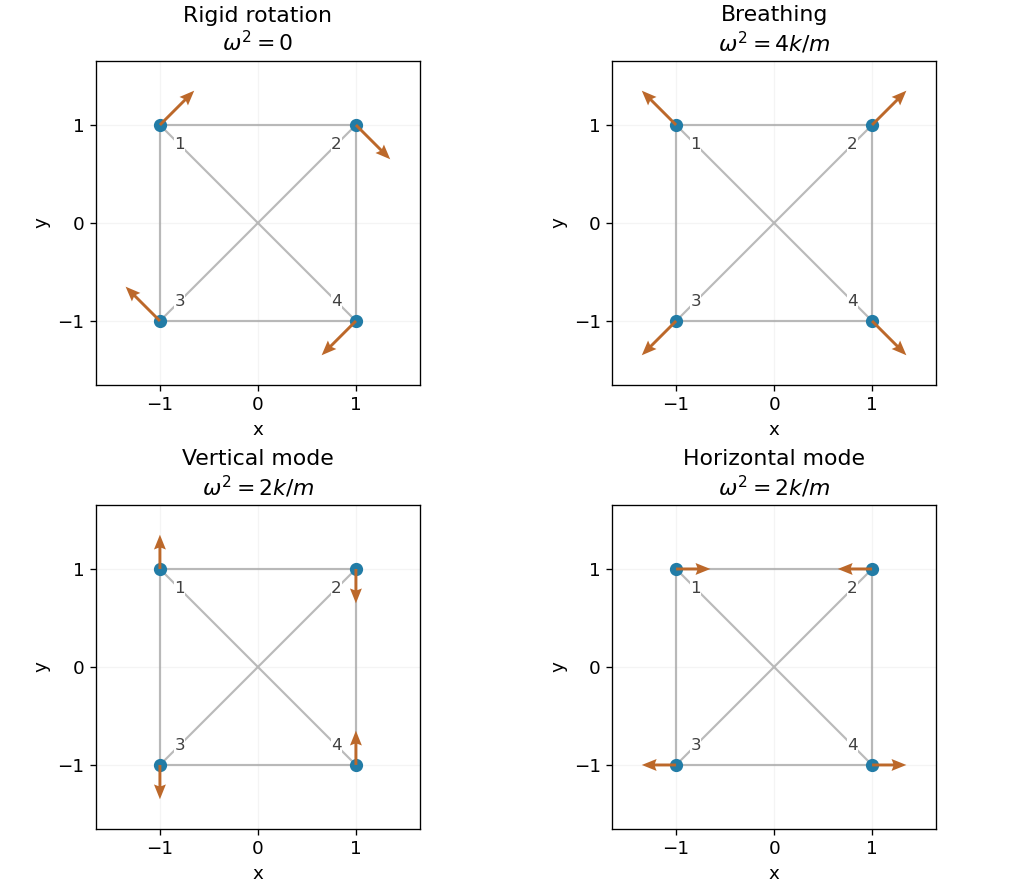
Rigid rotation, breathing and modes with reflection symmetry
. Original displacement diagrams. Grey lines show all six equilibrium springs; arrows show representative mode vectors. The rotation has zero frequency, the breathing mode has squared frequency 4k/m, and the two other modes have squared frequency 2k/m. Details.
The first two vectors displace every particle identically in the horizontal or vertical direction. Every relative displacement is zero, so every spring has zero extension to first order. The third vector is evaluated at the equilibrium points, which is an infinitesimal clockwise rotation. For any edge the relative displacement is perpendicular to that edge, again giving zero extension.
These are the rigid-motion zero modes of a spring framework: two translations and one infinitesimal rotation. Each has , so . In the linearized dynamics its amplitude has the form , expressing free rigid motion rather than a restoring oscillation. Exact finite rigid rotations also preserve every spring length; the mode vector is their first-order tangent.
In a breathing mode, each displacement is proportional to its equilibrium position. A representative vector isMultiplying by the stiffness matrix gives . ThusPositive and negative amplitudes are uniform expansion and contraction about the center.
For the proposed vector, the first horizontal component of is . Since the corresponding component of is zero, a normal mode requires . The vertical components then give . With an arbitrary nonzero overall amplitude, choose to obtainThe analogous pattern invariant under reflection across the vertical axis isDirect multiplication confirms . The two patterns give independent eigenvectors with the same eigenvalue, as expected from the square's rotation symmetry.
A group is a nonempty set with a closed binary operation that is associative, has an identity element, and gives every element an inverse element. A subgroup is a subset that is itself a group under the inherited operation. The left coset of represented by is ; right cosets are defined analogously. Left cosets partition a finite group, and is a bijection from to . Therefore , proving Lagrange's theorem and the required divisibility.
For the given matrices, put and . Since , the generators commute; , , and the generated elements areThey are distinct, and , with exponents reduced modulo four and two. The Cayley table isThe table proves closure and identifies as the identity. The inverse element of is , and associativity follows from matrix multiplication. Thus this is the direct product of cyclic groups of orders four and two, an abelian group of order eight.
Its subgroups are exactlyTo see the list is complete, Lagrange's theorem leaves orders one, two, four and eight. There are exactly three elements of order two, giving the three order-two subgroups. An order-four subgroup containing an element of order four must be one of the two cyclic groups displayed; without such an element it must be the four-element set of elements whose squares are . This is the enumeration in subgroups of C4 times C2.
For example choose . A complete set of cosets is . Since is Abelian, the left and right cosets coincide.
A group homomorphism preserves multiplication: . It sends the identity element to the identity and inverse elements to inverse elements. Its group kernel is . This contains and is closed under multiplication and inverse elements, so it is a subgroup. For and ,Thus ; applying the same argument with gives equality. Hence the group kernel is a normal subgroup.
Let with . The parity of a permutation defines the desired map from :The sign of a permutation is multiplicative, so parity adds modulo two under composition, exactly matching . Thus this is a group homomorphism; it is surjective because a transposition maps to . Its group kernel isThis is the alternating group on three objects, a normal subgroup of index two in .
Write the symmetry group of a square as , with a counterclockwise quarter-turn and reflection across the horizontal axis. The conjugacy classes of the symmetry group of a square areHere is the half-turn and the clockwise quarter-turn. The two members of the fourth class reflect across the horizontal and vertical axes. Those of the fifth reflect across and . The identity and half-turn are central elements, giving singleton classes. The relations , , and show that each displayed pair consists of conjugate elements. More generally, conjugating by changes to , and conjugating by changes to ; parity is preserved, so the two reflection pairs cannot merge.
In a one-dimensional representation, the relation forces the image of to equal its inverse. Thus and can be assigned independent signs . These four choices give four irreducible characters. The ordinary two-dimensional action on the plane gives one more character: a rotation through has trace , and a reflection has trace zero. Therefore the character table of the symmetry group of a square isFor instance the last row has squared character norm , so the planar representation is irreducible; its inner product with each one-dimensional row is zero. All five rows obey character orthogonality. Their squared dimensions sum to , so they exhaust the irreducible representations of this order-eight group.
Articles by others on the same topic
There are currently no matching articles.