The quadratic Lagrangian gives and . Thus the Euler-Lagrange equations areA nonzero mode vector has a common harmonic time factor and satisfies the generalized eigenvalue problem for small oscillations ; is its normal frequency. A zero-frequency mode instead admits a constant or linear time factor.
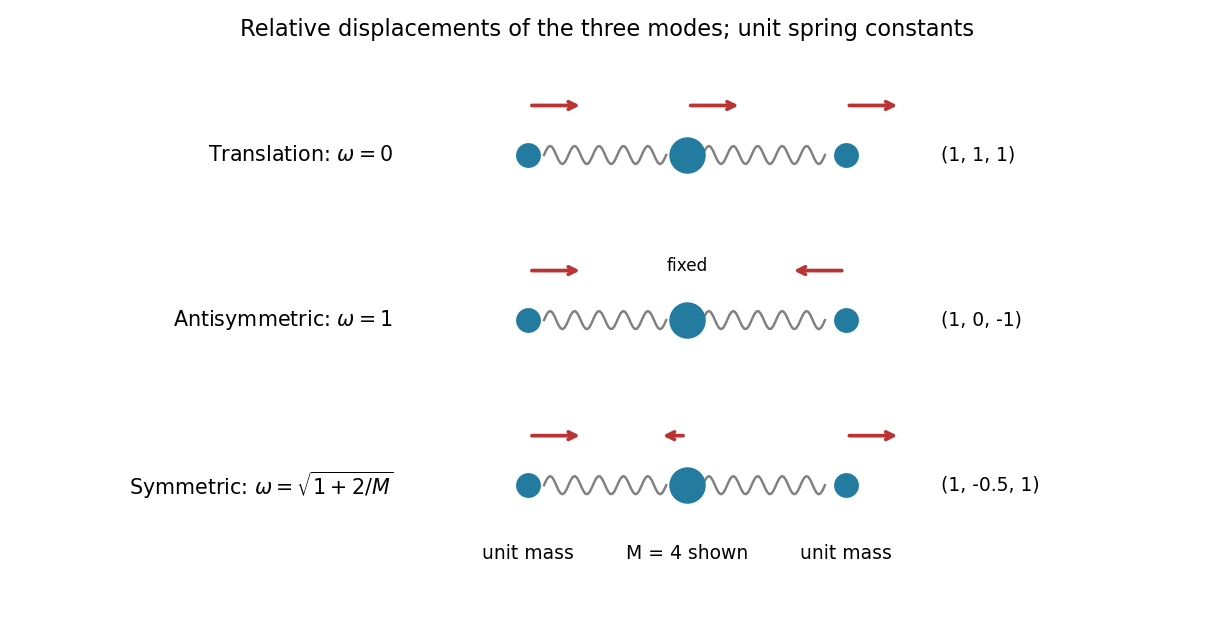
Measure the three coordinates as displacements from a configuration with both springs unstretched. The kinetic energy is , and the potential energy is . Expansion givesFor , direct substitution yields the three normal modes:The three vectors are independent and orthogonal in the mass inner product , so they exhaust the motion. Their squared mass norms are ; division by the corresponding square roots gives normalized modes. This is the unit-spring, unit-outer-mass case of the normal modes of three masses connected by two equal springs.
As , the central displacement in the symmetric oscillatory mode tends to zero and both nonzero frequencies tend to one. The two limiting shapes and span independent motions of the outer masses against an effectively fixed centre; each unit mass has its own unit spring frequency. The translational mode remains at zero frequency. Under a bounded kinetic-energy condition its common velocity tends to zero as , while a static common displacement is still an equilibrium shift. One must specify that energy condition before concluding that an arbitrary freely translating heavy mass remains stationary.

Articles by others on the same topic
There are currently no matching articles.