Let . The condition gives . On the outer coordinate surface , elimination of gives . On , the surface is the plane , with . Thus the closure of the body isIt is a solid circular cap bounded below by an elliptic paraboloid of revolution and above by the unit disk in . Its vertex is , its height is , and its rim is the circle . The symmetry axis is the axis. The coordinate surface maps to that axis rather than to an additional two-dimensional boundary. These are parabolic coordinates.
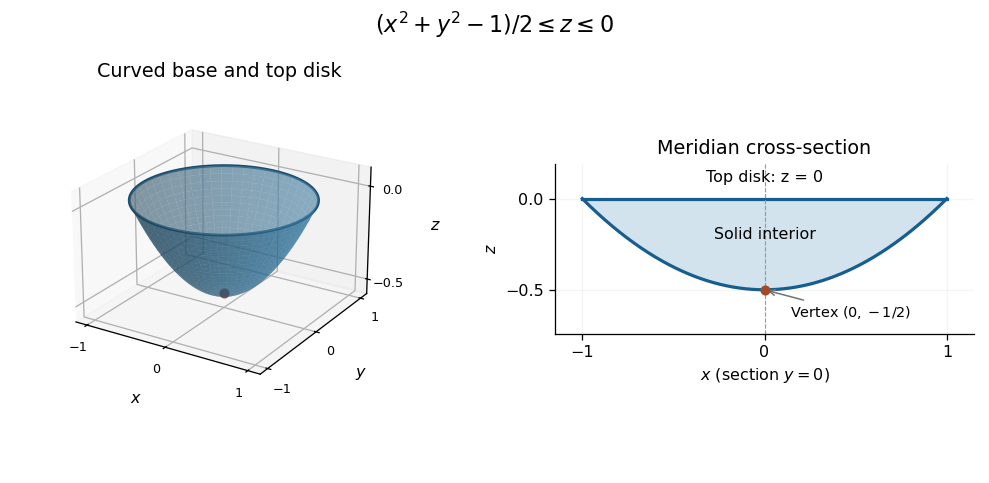

Differentiate the position vector with respect to the three coordinates to obtain the coordinate basis vectors:The chain rule gives . The scale factors of orthogonal coordinates are the corresponding norms:Direct dot products give , , and . Thus the parabolic coordinates are orthogonal wherever the coordinate vectors are nondegenerate. Their degeneracy on is the usual axis degeneracy of the azimuthal coordinate.
The Jacobian determinant is the oriented scalar triple product of the three coordinate basis vectors:Here , soThe sign is nonnegative on the stated range, and the absolute Jacobian determinant also equals as expected for orthogonal coordinates.
Since , its divergence is the Laplacian of :The divergence theorem changes the outward flux through the whole closed boundary into . Rotational symmetry makes the term vanish. With and the Jacobian determinant from part (c),Both the curved face and the top disk are included in this surface integral through the divergence theorem.
Articles by others on the same topic
There are currently no matching articles.