Choose a real unit eigenvector of the real symmetric matrix , with eigenvalue . Its orthogonal complement is an invariant subspace: for any with ,The restriction of to this -dimensional space is again real and symmetric. Applying the same argument inductively produces an orthonormal basis of real eigenvectors. The base case is immediate. This proves the spectral theorem for real symmetric matrices without assuming that distinct eigenvalues are available.
One can also check that eigenvectors with different eigenvalues are automatically orthogonal: . Within a repeated eigenspace, the Gram-Schmidt process preserves the eigenvector property. Thus repeated eigenvalues cause no obstruction, and .
The quadratic form is for the real symmetric matrixThe axis has eigenvalue . On the plane, the characteristic polynomial isThus the orthogonal diagonalization from part (a) yieldsFor later use, one possible orthonormal basis isThen , , . This explicit choice also confirms that the Euclidean norm is preserved: .
In the orthonormal basis of part (b), the three quadric surfaces have the following forms. For ,a two-sheeted hyperboloid with axis , vertices , and one sheet on each side of the plane . For ,an elliptic cone with vertex at the origin and the same axis. For ,a one-sheet hyperboloid with axis and a waist ellipse at , whose semiaxes are along and along . The sections at fixed enlarge away from the waist.
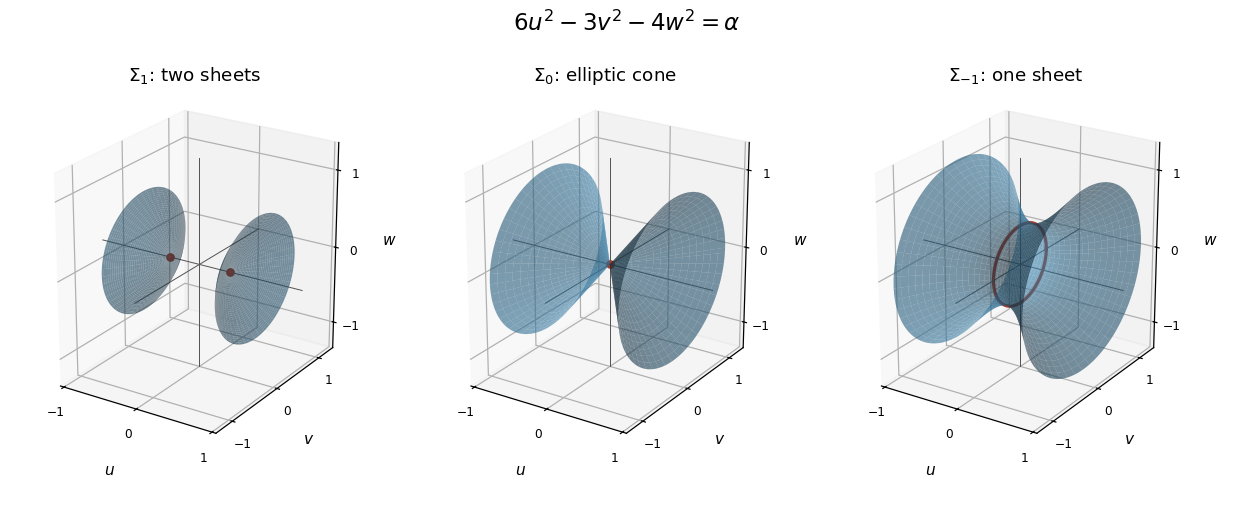
The two-sheeted hyperboloid, elliptic cone and one-sheet hyperboloid in separate orthonormal coordinate frames
. Details. 
The orthogonal change of coordinates preserves distance to the origin. On the required quadric surface,Thus the squared distance is at least . Equality holds precisely when , and the constraint then gives . Using from part (b), the nearest points in the original coordinates areSubstitution checks the constraint directly: . The inequality proves these are global nearest points, rather than merely stationary candidates.
Articles by others on the same topic
There are currently no matching articles.