One standard form of Cauchy's residue theorem is the following. Let be a positively oriented contour that is a simple closed curve, and let be a holomorphic function on an open set containing and its interior except for finitely many interior isolated singularities . There are no singularities on . ThenThe residue is the coefficient of in the Laurent series at . Each interior isolated singularity contributes once because the winding number of this positively oriented contour about each such point is one. Reversing the orientation of a contour reverses the sign. This form of Cauchy's residue theorem applies to the rectangle below.
Start with the exponential function definition of the hyperbolic sine and use Euler's formula:Identifying the hyperbolic sine and hyperbolic cosine in the final line gives
The two terms in the preceding formula are the real part and imaginary part. Their squared sum is the squared complex modulus:Here follows directly from the exponential function definitions. The hyperbolic sine modulus identity therefore yieldsEquality holds exactly when , that is, when is an integer multiple of . The lower bound is uniform in , which will control whole vertical sides of the contour rather than just their endpoints.
The equation requires . Write , with real . Comparing real parts and imaginary parts using part (b)(i) givesIf , the second equality would require , impossible because . Thus , forcing andNow , so . The hyperbolic cosine is even and is a strictly increasing function on , hence . Conversely, substituting these values gives , so every value found does satisfy the original equation. Therefore the complete set is
Put and . Traverse the rectangle with positive orientation of a contour, taking . Part (i) shows that the only enclosed poles of areThey are simple poles becauseThe residue formula for a quotient at a simple denominator zero givesTheir imaginary terms cancel and their residues sum to . Thus Cauchy's residue theorem gives
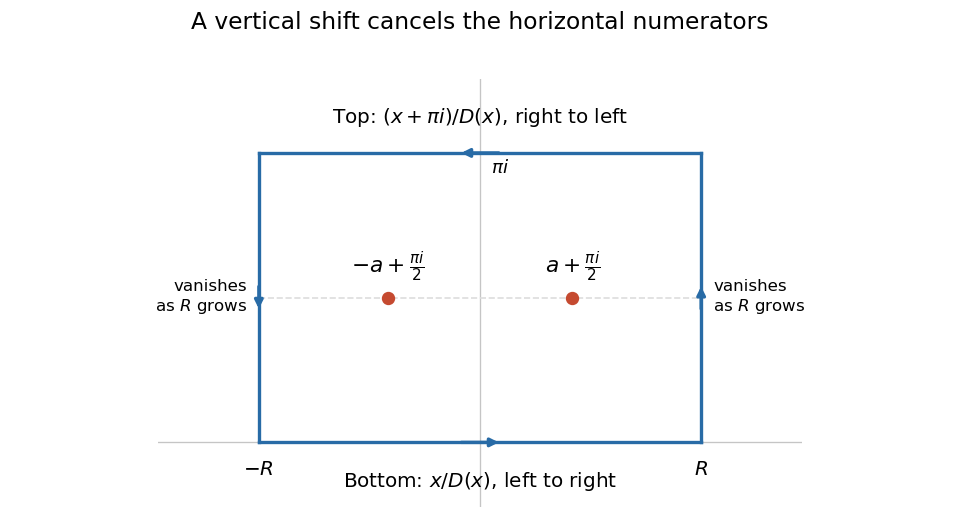

The choice of numerator makes the horizontal sides useful. The hyperbolic sine satisfies , so . Consequently the lower and upper contour integrals, with their actual orientations, add toIt remains to justify discarding both vertical sides. On either side , , the reverse triangle inequality and part (b)(ii) implyThis lower bound is positive for sufficiently large . Also and each vertical side has length . The estimation lemma bounds the absolute value of the sum of the vertical contributions byThe real improper integral converges absolutely, since its integrand is continuous on the real axis and decays like at infinity. Combining all four sides and taking givesThereforeAn independent real-variable check uses the hyperbolic tangent substitution : the integral becomes . Its antiderivative uses the inverse hyperbolic tangent, giving . As , this tends to , agreeing with and checking the factor of two.
Articles by others on the same topic
There are currently no matching articles.