Finite numerical aperture and diffraction remove high spatial frequencies from a mask image. Neighboring features modify the aerial intensity, and the photoresist threshold turns this blurred intensity into biased edges, shortened lines and rounded corners. optical proximity correction deliberately predistorts the mask: line-end extensions and small serifs can compensate for local loss of exposure, while other edges are moved back where exposure spreads too far. The correction is calibrated for illumination, resist and focus; it does not restore arbitrarily high lost spatial frequencies.
double patterning separates a dense target pattern into two sparser patterns, each printable within the single-exposure process window. Two exposures with an intervening pattern-fixing or transfer step combine their features on the wafer. For regular lines, alternating line assignment can halve the final pitch while each exposure retains a larger pitch. optical proximity correction corrects local image bias; double patterning divides the density burden between exposures. Overlay error and the minimum printable isolated feature still constrain the result. Simply exposing the same unmodified resist twice without an appropriate process separation does not give the same independent thresholding.
Treat the letter-shaped regions as openings to be etched, using positive-tone resist; the clear mask areas therefore correspond to those openings. Label the two L features from left to right. An alternating assignment is mask A: H, , O; mask B: E, . Each full letter remains on one mask, avoiding unnecessary stitch boundaries across its stems. Nearest-neighbor interletter gaps now occur between different exposures, rather than having to be resolved within one exposure. Verify that each individual letter's internal spaces are still printable; without dimensions, this partition is a process proposal rather than proof of a particular numerical minimum linewidth.
A robust sequence is litho-etch-litho-etch double patterning into a durable hard mask. Deposit an oxide hard mask on silicon; expose and develop mask A and transfer those openings through the hard mask. Strip resist, apply fresh resist, align and expose mask B, then transfer its openings into the same hard mask, the second resist covering mask-A openings during that second oxide transfer. Remove resist and perform one final deep silicon etch through the union of the openings. An inductively coupled deep reactive-ion etching process with alternating fluorine etching and sidewall passivation gives much more vertical, high-aspect-ratio features than an isotropic etch. Mask thickness and etch selectivity must survive the required depth. Control sidewall scalloping, aspect-ratio-dependent etch rate, charging, microloading and the combined overlay/etch-bias budget.
A spacer-based process can produce very fine regular pitches, but arbitrary letter junctions and terminations require additional cut/block patterning; it is not automatically a two-mask solution for this target. Use two independently transferred sparse masks, then a selective directional deep etch. The schematic gives the assignment and a generic corner-correction example without reproducing the supplied pattern.
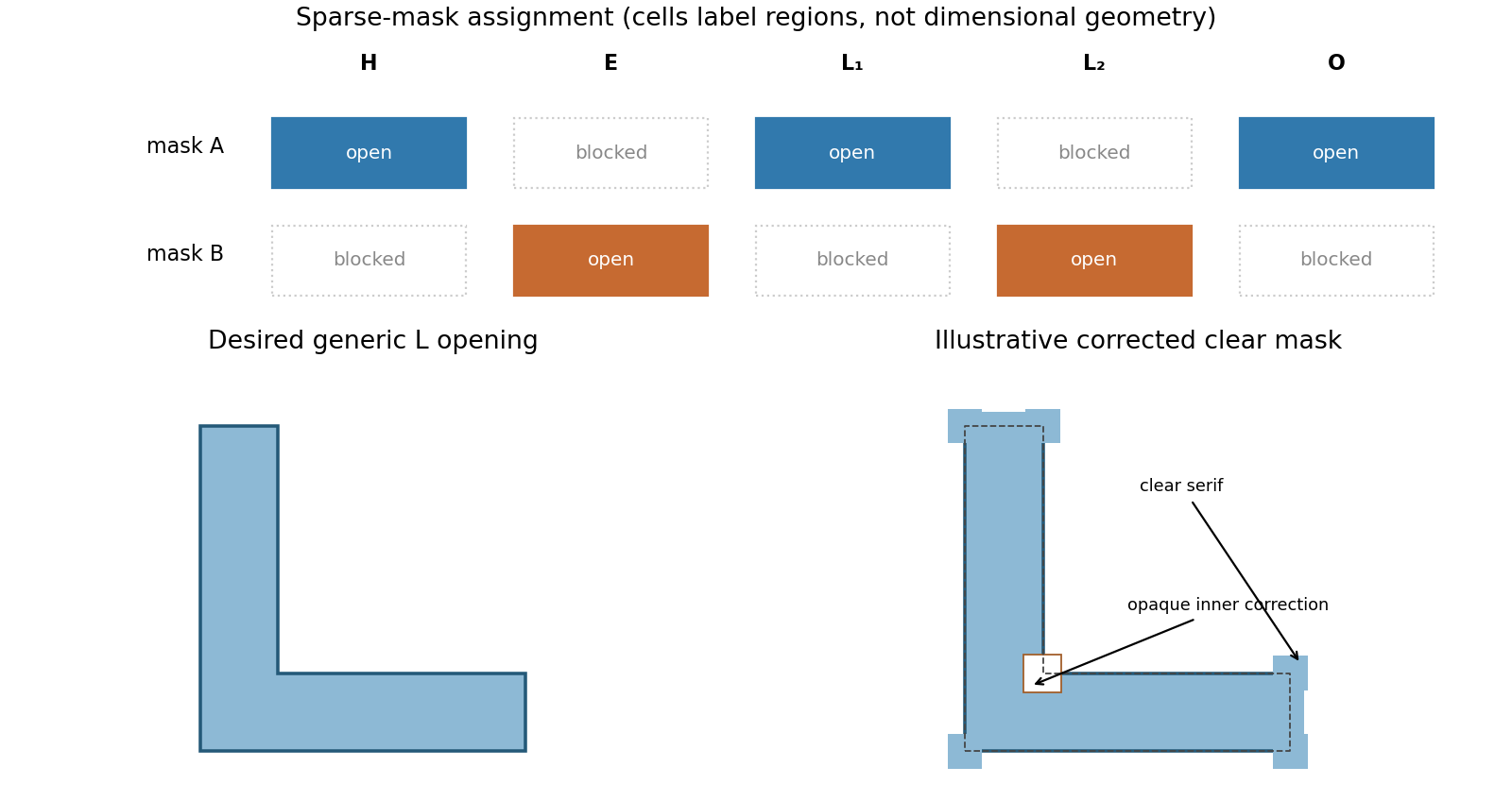
Alternating mask assignment and original L-corner optical proximity correction
. Details. 
For a positive-tone opening, place small clear serifs beyond convex outer corners and extend the ends of the L arms to compensate for line-end shortening. Adjust the concave inner corner with a local inward boundary correction or opaque notch where excess exposure would otherwise round/fill it. The diagram exaggerates these additions and the inner correction for visibility; their dimensions are subresolution corrections, not intended printed protrusions. In an opposite mask/resist polarity the clear/opaque roles reverse. An L with corrected ends, outer-corner serifs and an independently corrected inner corner is the appropriate mask concept. The particular bias must be fitted to the aerial image plus resist threshold over the required focus/exposure window. A printed test L, measured at the inner and outer corners, is more informative than assuming any decorative serif produces an exact L.
Articles by others on the same topic
There are currently no matching articles.