For identical spherical drops, total oil volume and interfacial area satisfyTaking to mean the oil fraction of the final emulsion, gives . Thus and . This corresponds to about drops.
There is a wording convention worth making explicit: if the oil addition instead means times the initial water volume, then , and . These differ only in the stated volume-fraction convention. The calculation uses the oil–water interface and neglects the container and air interfaces.
An amphiphile adsorbs at the oil–water interface, reducing the interfacial tension. At fixed drop radius and oil volume, therefore falls with increasing concentration and tends toward a plateau once the interface is nearly saturated and further amphiphile mostly enters micelles. For an approximately ideal dilute nonionic surfactant, the Gibbs adsorption equation connects the fall in interfacial tension to positive surface excess . Ionic systems require the appropriate counterion activities.
The critical micelle concentration gives the familiar break in a tension-versus-log-concentration curve, rather than a fall to zero interfacial energy. If mixing creates a different droplet size distribution as amphiphile is added, area also changes; a tension reduction alone does not determine the total interfacial energy. The plotted prediction holds area fixed.
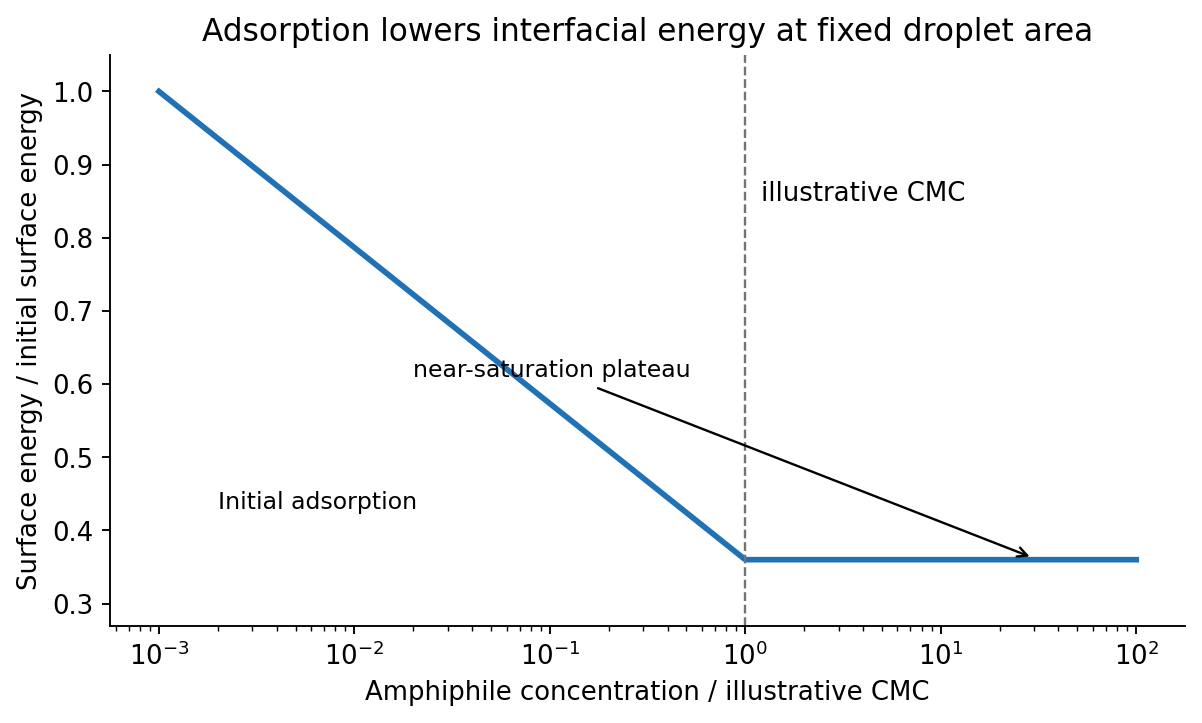
Original fixed-area emulsion-energy schematic showing adsorption-driven decrease and an illustrative micellization plateau
. Details. 
A Pickering emulsion is stabilized by particles adsorbed at the liquid–liquid interface. A partially wetting sphere removes a patch of that interface. The smaller detachment barrier into either bulk phase is approximatelywhere is the three-phase contact angle. At approximately neutral wetting, , the stated particle radius givesat . Such a large attachment energy makes thermal detachment unlikely. A sufficiently covered interface resists drop coalescence, and a water-wet particle preference supports an oil-in-water dispersion. However, radius alone does not guarantee stabilization: completely water-wet or oil-wet particles have a vanishing attachment barrier in this model, and sufficient particle coverage is necessary. Sedimentation and droplet ripening are separate failure modes. The classical particle-stabilized-emulsion experiments provide the historical basis of the terminology.[ref]
CXCVI.—Emulsions by Spencer Umfreville Pickering. Journal of the Chemical Society, Transactions 91 (1907), pp. 2001–2021
Articles by others on the same topic
There are currently no matching articles.