For identical spherical drops, total oil volume and interfacial area satisfyTaking to mean the oil fraction of the final emulsion, gives . Thus and . This corresponds to about drops.
There is a wording convention worth making explicit: if the oil addition instead means times the initial water volume, then , and . These differ only in the stated volume-fraction convention. The calculation uses the oil–water interface and neglects the container and air interfaces.
An amphiphile adsorbs at the oil–water interface, reducing the interfacial tension. At fixed drop radius and oil volume, therefore falls with increasing concentration and tends toward a plateau once the interface is nearly saturated and further amphiphile mostly enters micelles. For an approximately ideal dilute nonionic surfactant, the Gibbs adsorption equation connects the fall in interfacial tension to positive surface excess . Ionic systems require the appropriate counterion activities.
The critical micelle concentration gives the familiar break in a tension-versus-log-concentration curve, rather than a fall to zero interfacial energy. If mixing creates a different droplet size distribution as amphiphile is added, area also changes; a tension reduction alone does not determine the total interfacial energy. The plotted prediction holds area fixed.
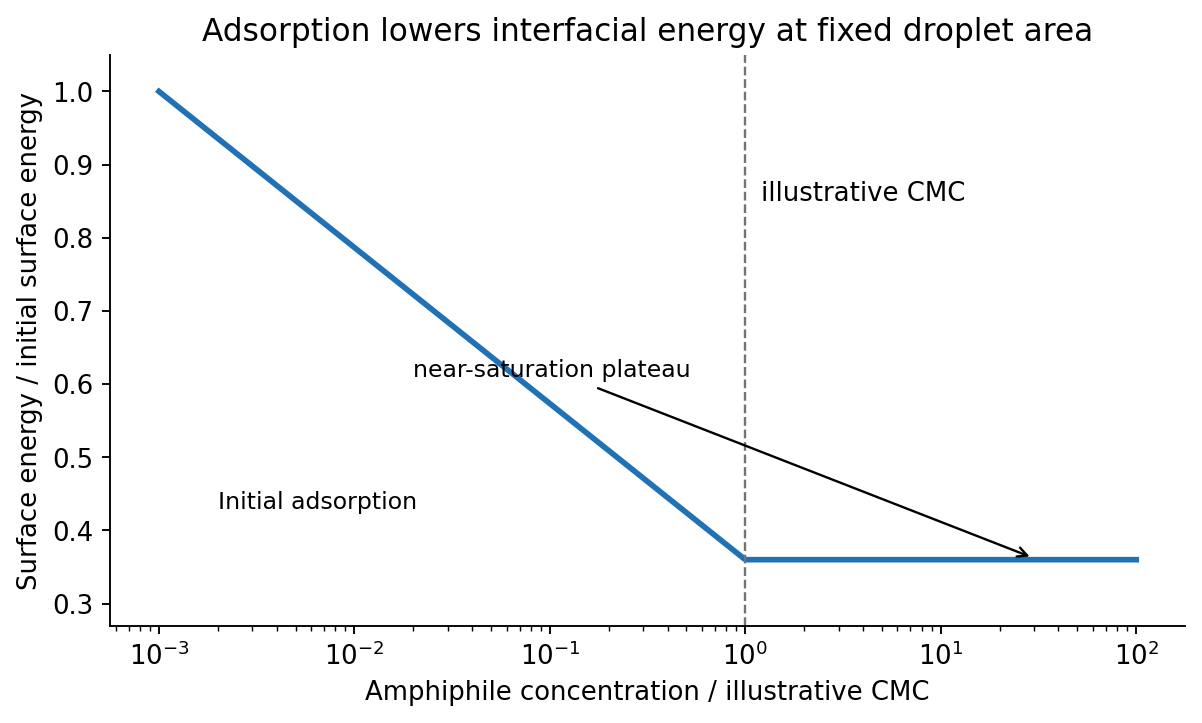
Original fixed-area emulsion-energy schematic showing adsorption-driven decrease and an illustrative micellization plateau
. Details. 
A Pickering emulsion is stabilized by particles adsorbed at the liquid–liquid interface. A partially wetting sphere removes a patch of that interface. The smaller detachment barrier into either bulk phase is approximatelywhere is the three-phase contact angle. At approximately neutral wetting, , the stated particle radius givesat . Such a large attachment energy makes thermal detachment unlikely. A sufficiently covered interface resists drop coalescence, and a water-wet particle preference supports an oil-in-water dispersion. However, radius alone does not guarantee stabilization: completely water-wet or oil-wet particles have a vanishing attachment barrier in this model, and sufficient particle coverage is necessary. Sedimentation and droplet ripening are separate failure modes. The classical particle-stabilized-emulsion experiments provide the historical basis of the terminology.[ref]
CXCVI.—Emulsions by Spencer Umfreville Pickering. Journal of the Chemical Society, Transactions 91 (1907), pp. 2001–2021
Balance upward surface-tension force against the weight of the liquid column. The capillary action isWith perfect wetting, , , and , . The diameter, not the radius, is . This neglects the small meniscus-volume correction, gas-density buoyancy and contact-angle hysteresis.
For two equal spheres, the Derjaguin approximation uses . A planar nonretarded Van der Waals force interaction has energy per area , soThe force is attractive, with magnitude , taking separation increase as positive. Using the sphere–plane value of would overestimate it by a factor of two. The gap is much smaller than either radius, as required. Treat the supplied Hamaker constant as the effective one for the intervening medium; roughness, solvation and molecular-scale contact can modify a literal experiment.
The change from a positive surface potential to a negative potential outside the compact layer is consistent with specific phosphate adsorption that overcompensates the positive oxide charge. The negative compact-layer charge then has a diffuse excess of positive counterions. This charge reversal is an interfacial-chemistry interpretation, not something a single monotone double-layer profile with an unchanged positive boundary charge could generate by screening alone. Surface potential and zeta potential at a slip plane are distinct observables.
The Stern model separates the specifically adsorbed compact layer from a diffuse layer. In a spherical diffuse layer, a Poisson-Boltzmann equation description isAt sufficiently small , the Debye–Hückel approximation gives . If is the outer compact-layer radius, its decaying solution isFor a locally flat surface, the geometric factor tends to unity. Thus the far-field negative potential approaches zero from below over the Debye–Hückel screening length. Neither nor is safely in the low-potential linear regime at room temperature, so the simple exponential is a far-field approximation, not a globally valid fit. The phosphate layer requires adsorption chemistry or an equivalent specified boundary model.
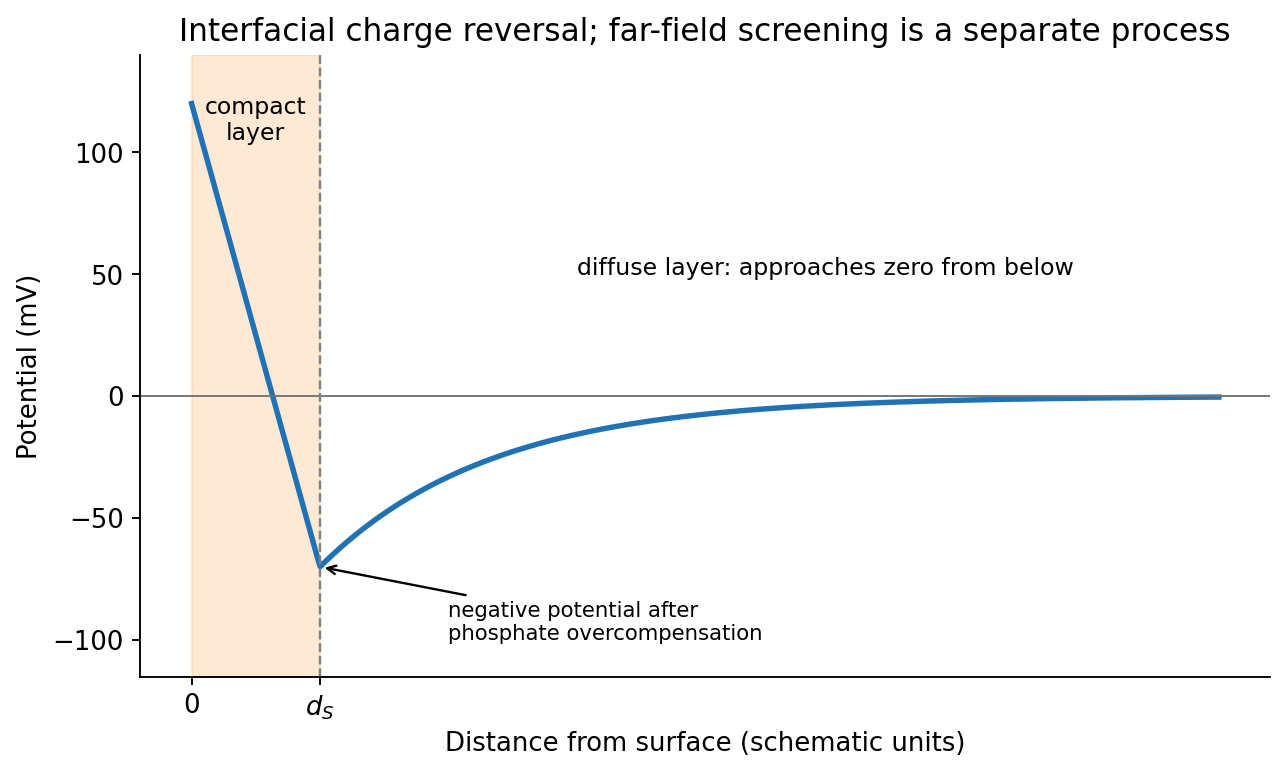
Original illustrative compact-layer charge reversal followed by a negative screened far-field potential
. Details. 
For an ideal dilute electrolyte with molar ionic strength , measured in , the Debye–Hückel screening length isTaking water's relative permittivity as approximately at , for NaCl. Therefore . This is an exponential screening length, not a hard outer edge of the diffuse layer. The factor of converts molarity into .
A formula-unit concentration of fully dissociated gives trivalent cations and chloride:At unchanged temperature and permittivity, the Debye–Hückel screening length scales as , giving . It falls by a factor , not by three. This is a formal screening estimate: at this ionic strength, trivalent-ion activity, finite ion size, hydrolysis and specific adsorption make the ideal dilute model quantitatively limited.
Articles by others on the same topic
There are currently no matching articles.