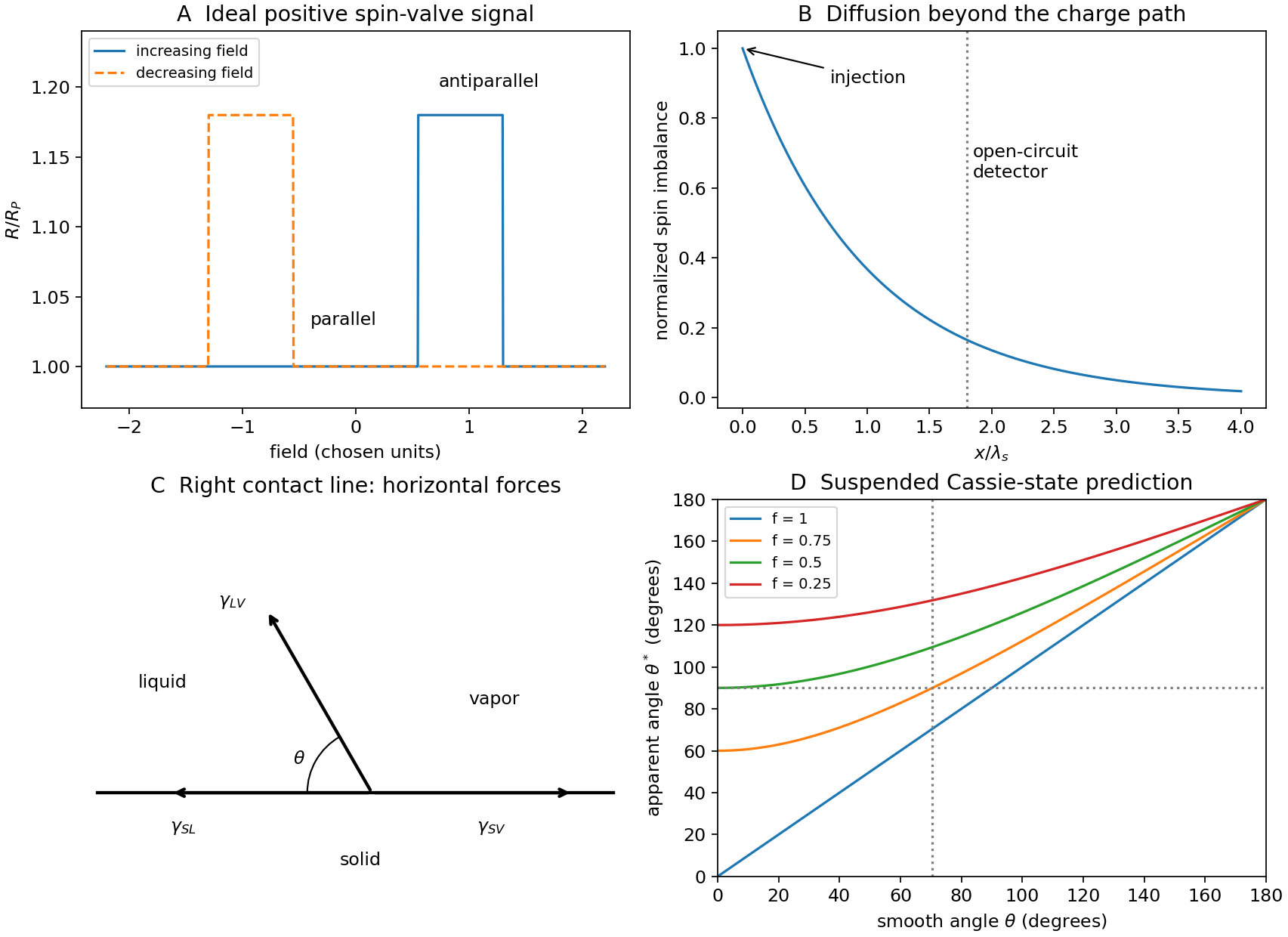
Sweep the in-plane magnetic field approximately along the wires' easy axes. At large negative field, both magnetizations are parallel. If the wires reverse at different positive coercive fields, an antiparallel interval separates this state from the final parallel positive-field state. In the usual positive giant magnetoresistance case, the antiparallel interval has higher resistance; the reverse sweep gives a mirrored interval and a hysteresis loop.
An ideal angular model isSpin-dependent injection and scattering favor transmission through similarly aligned electrodes. The two-current resistor model represents this using unequal majority- and minority-spin resistances. Both layers can reverse, hence pseudo spin valve, rather than an absolutely pinned reference layer.
The different thicknesses can produce different switching properties, but thickness alone does not identify which electrode reverses first. Measure their coercive fields. The local resistance also contains Cu, contact and Py anisotropic magnetoresistance contributions. Rotation scans and individual-wire controls distinguish them. Py/Cu experiments showed that local contact-related signals can exceed the spin-valve contribution, motivating nonlocal detection.[ref]
Spin injection and spin accumulation in all-metal mesoscopic spin valves by F. J. Jedema and others. 2003, abstract and local/nonlocal measurement comparison

Measure nonlocal alignment-dependent resistance in otherwise comparable devices with several injector–detector spacings . Steady spin accumulation obeys a diffusion–relaxation equation,In a weakly invasive detector limit, ; a semilog plot gives slope . With transparent Py/Cu interfaces, fit a spin-resistance model including contact absorption and wire cross-section rather than assuming that every amplitude reduction is a bulk Cu loss.
Keep Cu processing, cross-section and temperature fixed, characterize contact resistances, reverse injector current and subtract alignment-independent offsets. Repeat at different temperatures to assess interface and bulk contributions. A Hanle spin-precession measurement provides an independent check of spin relaxation, with diffusion times and electrode rotation included in its model.
Spin-polarized injection produces different spin-resolved electrochemical potentials in Cu, . Their imbalance diffuses beyond the charge-current path. Oppositely directed spin-resolved currents can cancel in net charge while transporting spin.
The second Py contact is a spin-selective voltage probe. In a weakly invasive model,Its open-circuit potential adjusts until the total detector charge current vanishes. That potential changes when the detector magnetization reverses relative to the injected spins. Zero detector charge current does not imply zero spin imbalance or zero measured voltage.
Reverse injector current and each electrode's alignment to test the predicted signal symmetries. Remove spin-independent thermoelectric offsets and stray-field Hall contributions. A nonzero voltage alone would not prove spin accumulation.[ref]
Spin injection and spin accumulation in all-metal mesoscopic spin valves by F. J. Jedema and others. 2003, nonlocal detection and separation from contact-related magnetoresistance
Articles by others on the same topic
There are currently no matching articles.