For one homogeneous thermoelectric material, the dimensional thermoelectric figure of merit isThe dimensionless quantity is . The Seebeck coefficient measures the open-circuit voltage response to a temperature difference and reflects the energy asymmetry of charge-carrier transport. The electrical conductivity depends on carrier density and mobility and sets electrical loss; . The thermal conductivity is , with contributions from carriers and phonons, and represents unwanted heat leakage.
Increasing carrier concentration usually raises while reducing once transport becomes strongly degenerate. The electronic part of also tends to rise, approximately through the Wiedemann-Franz law where applicable. This competition produces an intermediate optimum, commonly in heavily doped semiconductors, rather than in a very resistive insulator or an ordinary high-carrier-density metal. The optimum depends on band structure and scattering; the schematic is not a universal measured concentration curve.
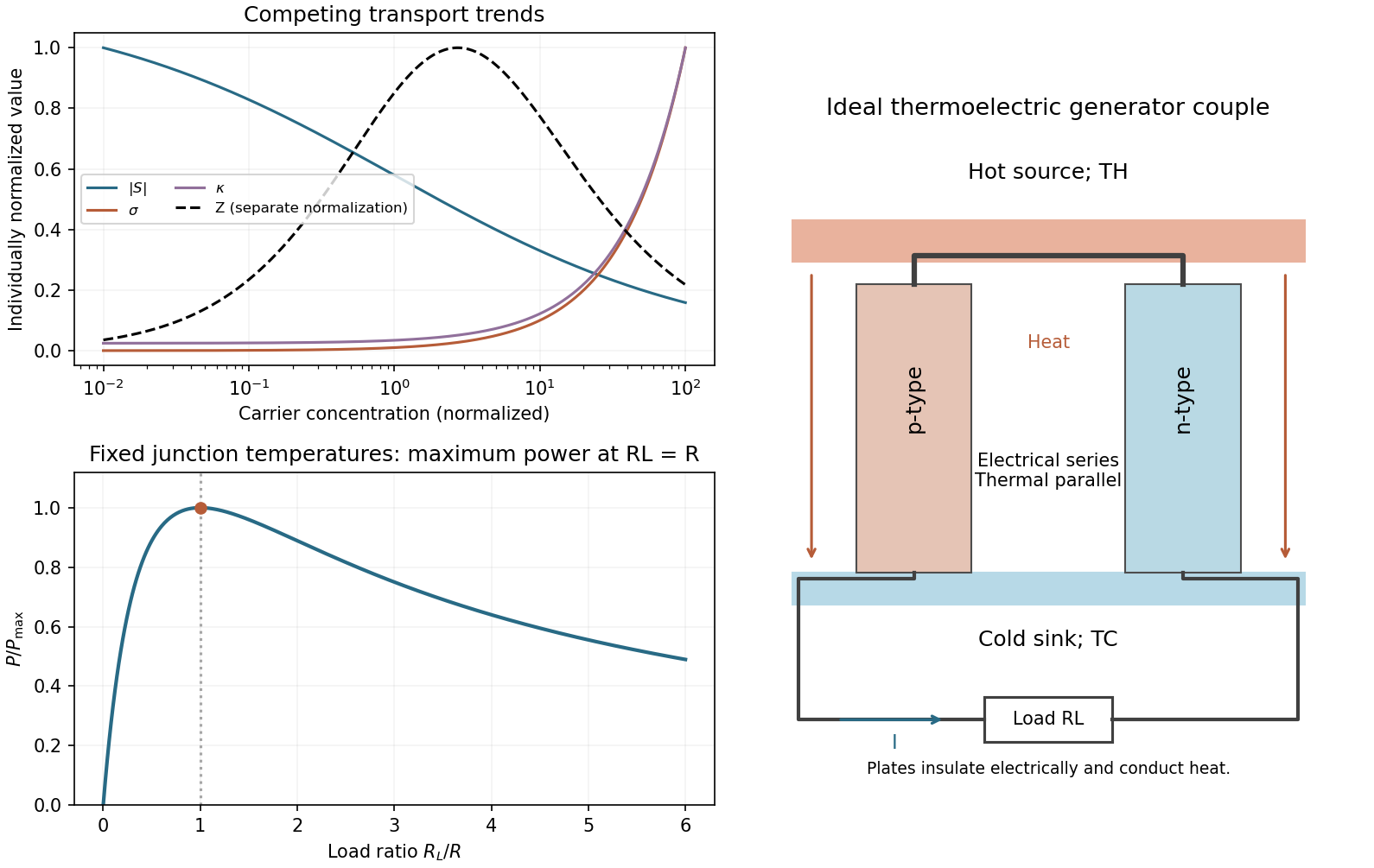
Thermoelectric carrier trade-offs, a generator couple and load matching
. Original normalized carrier-property curves, a circuit schematic and the calculated dimensionless load-power curve. The carrier curves illustrate competing trends and do not assert material-specific measurements. Details.
A generator couple has a p-type and an n-type thermoelement joined electrically at the hot face, with their other ends connected through a load at the cold face. The legs are electrically in series and thermally in parallel. Electrically insulating, thermally conducting plates couple them to the hot source and cold sink; metal interconnects carry current. The Seebeck effect provides an open-circuit electromotive force , where the magnitude of is the difference between the two leg Seebeck coefficients.
For fixed junction temperatures, constant properties and internal resistance ,Differentiate with respect to load resistance:The derivative changes from positive to negative at , soThe load voltage is then half the open-circuit voltage. The heat source and sink must sustain the temperature difference; an isolated hot object cools as energy is extracted. Maximum power and maximum conversion efficiency are different operating points: the efficiency-optimal load is generally larger than .
For the thermoelectric couple figure of merit, the coefficient denotes a pair difference, whereas the table gives one value each for resistivity and thermal conductivity without saying whether they are per-leg or effective pair values. To keep the factors consistent, first take both legs to have the listed and , and equal as stated. ThenThis is identical to treating each symmetric leg as having Seebeck-coefficient magnitude . The mean temperature is , giving .
If the examination instead intends its and as already combined effective pair coefficients in and , the alternative convention gives , with . That convention must be declared; using the full pair Seebeck difference with individual-leg while omitting both factors of two would overestimate the device figure of merit by four.
Use absolute temperatures , and . With the explicit identical-per-leg interpretation from the preceding part,and the stated ideal efficiency expression givesWith the alternative already-combined pair convention, instead gives . Both lie below the Carnot efficiency . These are constant-property ideal conversion efficiencies, neglecting contact resistance, parasitic heat paths and temperature dependence. They are not the efficiency specifically at the maximum-power load.
The temperature difference is , so the pair open-circuit voltage isFor two identical legs with the stated per-leg geometry,At matched load ,The load voltage is , and multiplying it by the current reproduces the power. If instead denotes an already combined pair resistivity, , giving and . These alternatives follow the same convention distinction as the figure-of-merit calculation; they should not be mixed.
For identical couples connected electrically in series, the open-circuit voltage is and the internal resistance is . At the module's matched load ,Maintaining the stated temperature difference across every couple therefore requiresunder the identical-per-leg interpretation. Sixty-four ideal couples supply about ; sixty-three supply about . The alternative already-combined pair-resistance convention gives 32 couples, each producing approximately .
The module is thermally parallel: adding couples increases the heat flow that must be supplied and rejected. The count assumes that source and sink keep the actual leg junctions at the stated temperatures and that interconnect losses are negligible. Connecting the couples does not multiply the maintained temperature difference.
Nanowires can increase by reducing lattice heat conduction more strongly than they degrade useful electronic transport. A wire diameter comparable to important phonon mean free paths introduces boundary scattering and reduces the lattice part of thermal conductivity. Interfaces, surface roughness and suitable nanostructure can suppress long-mean-free-path phonons while preserving shorter-mean-free-path carrier transport.
Electronic confinement or energy-dependent scattering can also change the Seebeck coefficient and thermoelectric power factor, but neither improvement is automatic. Surface depletion, disorder and contact resistance may instead reduce electrical conductivity; a smaller wire is not necessarily better. The necessary comparison is the complete ratio over the operating temperature range. The experimentally established benefit of nanostructuring is especially clear when it suppresses phonon heat conduction while retaining a useful power factor.[ref]
High-Thermoelectric Performance of Nanostructured Bismuth Antimony Telluride Bulk Alloys by Bed Poudel and others. 2008, nanostructured-alloy thermal-conductivity and figure-of-merit measurements
Articles by others on the same topic
There are currently no matching articles.