There is a -channel Z boson contribution and a crossed, -channel W boson contribution. The latter pairs the incoming electron neutrino with the outgoing electron, and the incoming electron with the outgoing electron neutrino. Both contribute coherently to the same elastic final state.
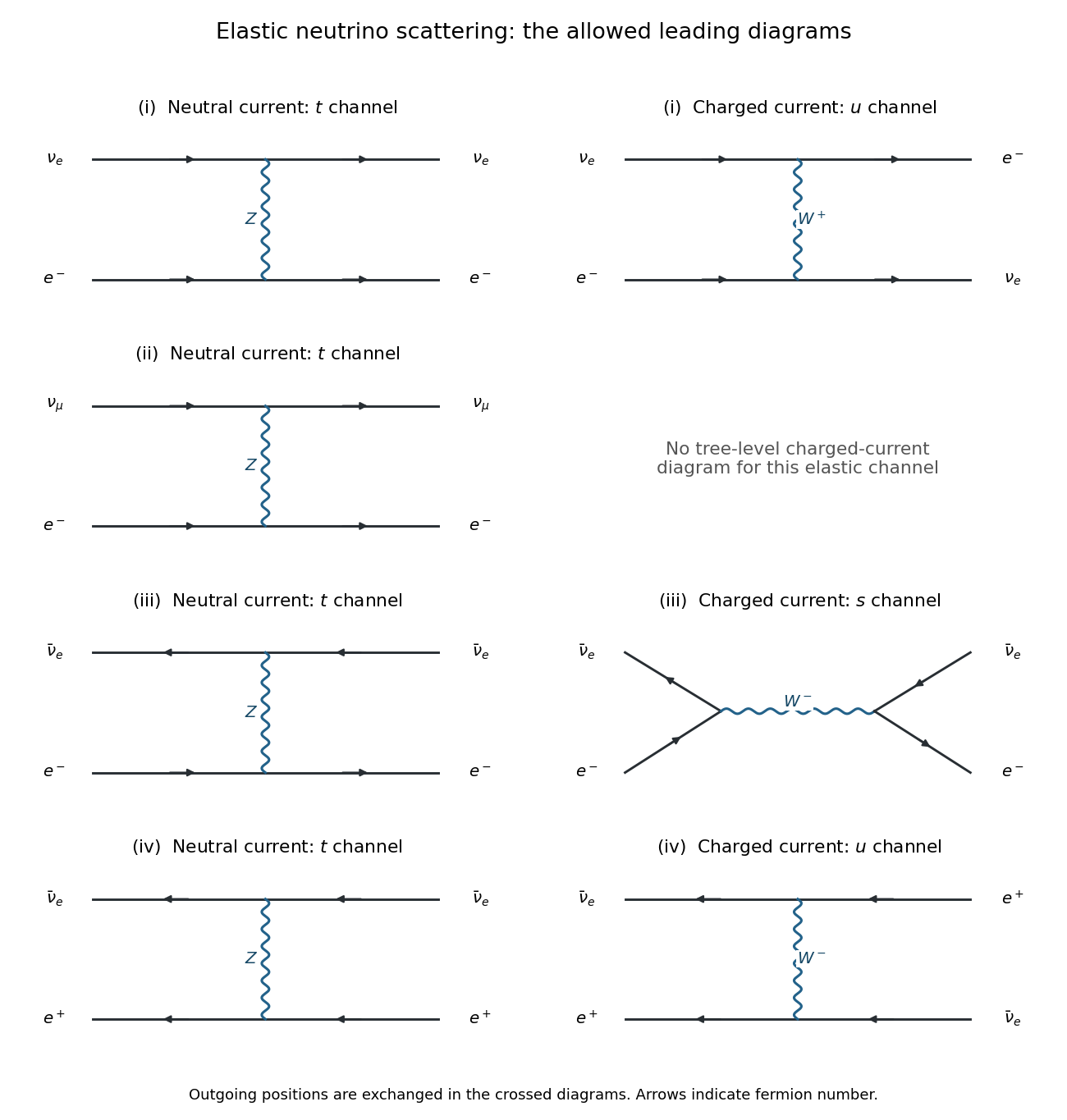

For a concrete comparison, take unpolarized targets, the same Mandelstam invariant in all four reactions, and . In a stationary-electron experiment this includes with . Define , using the weak mixing angle, and . The weak neutral current has chiral couplings , ; the weak charged current shifts by one. ConsequentlyThe factor comes from integrating the opposite-chirality angular weight: in the massless limit . Thus the relative rate depends on the chiral couplings and their interference, rather than simply on the number of diagrams.
Only -channel Z boson exchange contributes at leading order. A W boson would connect to , rather than to , and therefore does not supply this elastic channel. With the assumptions and normalization of part (i),For the illustrative value , the dimensionless factors in parts (i) and (ii) are and . The electron-flavor reaction is therefore about times as large in this limit. This uses the weak flavour selection in neutrino-electron scattering, not a hypothetical flavor-changing neutral vertex.
Both -channel Z boson exchange and -channel annihilation occur. Replacing the incident neutrino by an antineutrino interchanges the two chiral angular weights. In the same contact-interaction regime,At the factor is , between parts (i) and (ii). The comparison is energy dependent outside this regime: near , the annihilation channel has a W boson resonance, and the low-energy formula is inapplicable.
This is the charge-and-parity-conjugate reaction of part (i). There are -channel Z boson and crossed W boson contributions, with all fermion arrows reversed relative to part (i). For matched unpolarized kinematics and negligible CP violation,Combining all four results in the regime specified in part (i),In particular, conjugating both initial particles restores the part-(i) rate; conjugating the neutrino alone does not. Initial spin polarization and energies near a weak-boson mass require a separate comparison.
Articles by others on the same topic
There are currently no matching articles.