Source bundle pages 134–138. The paper cover establishes 2022; the attachment filename uses 2021. All times in the kaon calculations are proper times, unless a laboratory conversion is explicitly made. The CP symmetry approximation is used where the paper identifies the physical short- and long-lived states with kaon CP eigenstates.
With the valence quark assignments and , neutral kaon mixing changes strangeness by two units. A representative leading Standard Model contribution is a box Feynman diagram with two W bosons and two internal up-type quarks:The two lines exchange the two W bosons. There are four weak charged current interaction vertices, so the scattering amplitude is fourth order in the weak gauge coupling, or second order in the Fermi constant. The full result sums the internal quark flavors with their Cabibbo-Kobayashi-Maskawa matrix factors; one box alone illustrates the mechanism.
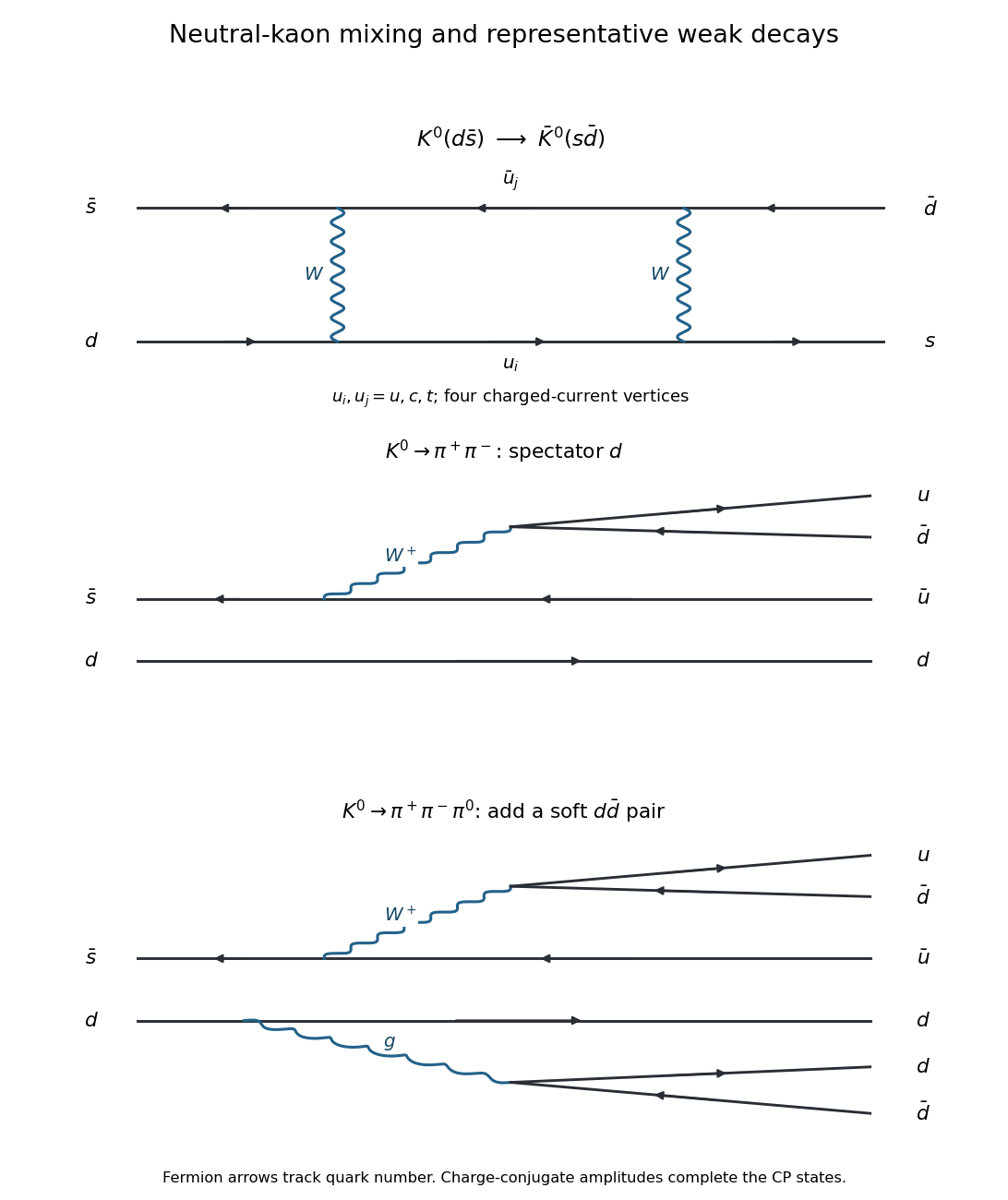
A kaon is a pseudoscalar meson, with intrinsic parity . At rest, . Combining this with the specified CP eigenvalues givesEquivalently, in the exchange-positive CP convention for neutral kaon mixing fixed by the question, and . This sign is a convention for the flavor states; the specified CP eigenvalues and physical predictions must be kept consistent with it.
For two spin-zero pions, conservation of total angular momentum fixes the relative orbital angular momentum to zero. The resulting or state has CP . The lowest partial waves of and have CP . Thus the dominant nonleptonic assignments in the CP symmetry approximation areThe two-pion mode has substantially more available kinetic energy and larger Lorentz-invariant phase space; the three-pion mode has an additional final particle and lies closer to its decay threshold. This helps explain why the CP-odd state has the longer mean lifetime. The actual mean lifetimes also depend on the decay amplitudes and on semileptonic channels, so counting final particles alone is not a quantitative prediction.
The middle panel of the figure in part (a) shows , , with the as a spectator quark. The outgoing and form and . In the bottom panel, an additional gluon produces , supplying the neutral pion component for . The charge-conjugate diagrams supply the other component of each of the kaon CP eigenstates. The drawn gluon splitting represents nonperturbative hadronization, rather than a quantitatively reliable perturbative prediction at the kaon scale.
These multiplicities describe the dominant low-orbital angular momentum modes, not an absolute rule for every three-pion configuration. In , odd orbital angular momentum values of the charged pair and of its motion relative to can couple to total zero and give CP , but are strongly suppressed near decay threshold. Physical also occurs through CP violation.
Put . In natural units, a stationary target proton and a beam proton of total energy have the Mandelstam invariantAt fixed-target production threshold the final particles have zero relative momentum in their centre-of-mass frame, so . Restoring , the total beam energy and its kinetic energy areUsing rounded masses in , , gives and .
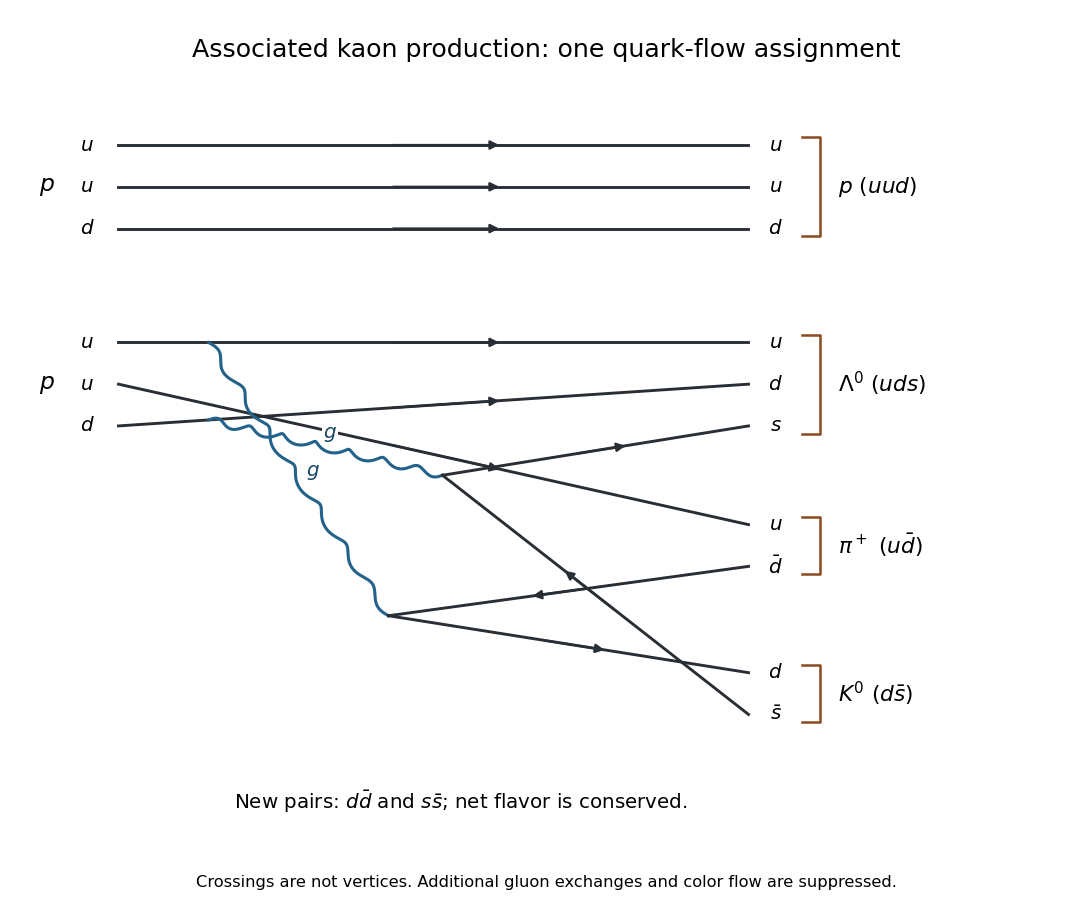
One possible strong interaction quark-line flavour rearrangement isIt needs newly created and pairs, with no net change of any quark flavor. For example, keep the first as the outgoing proton; allocate the second incoming and the new to , the remaining incoming and new to , and the new to . Two gluon splittings illustrate this flow. This is a possible hadronization topology, not a unique perturbative description of the proton collision.
After several short mean lifetimes, the surviving coherent beam is approximately . In ordinary matter the forward scattering amplitudes of and differ. For example, the in a neutral antikaon can enter a strange baryon through strong absorption; the opposite strangeness assignment has different available channels. If their forward transmission amplitudes through a thin block are and , respectively, thenThus the transmitted forward beam contains a regenerated short-lived component, with prompt two-pion decays after the block. Differential absorption changes the intensities as well as the relative phase. Scattered particles outside the forward beam can provide an incoherent component. This neutral kaon regeneration does not require CP violation: the material itself distinguishes matter and antimatter.
For a narrow unstable state, the effective Hamiltonian has the complex eigenvalue . With natural units and , its Schrödinger equation givesThe first factor is the ordinary energy phase; squaring the second gives the exponential decay of the survival probability, . This assumes the approximately constant decay rate regime; exact very early and very late behavior need not be exponential.
Writing the surviving state as , invert the two kaon CP eigenstates definitions:Here is the proper time. For a relativistic beam of fixed Lorentz factor , substitute ; in ordinary units the mass phase is .
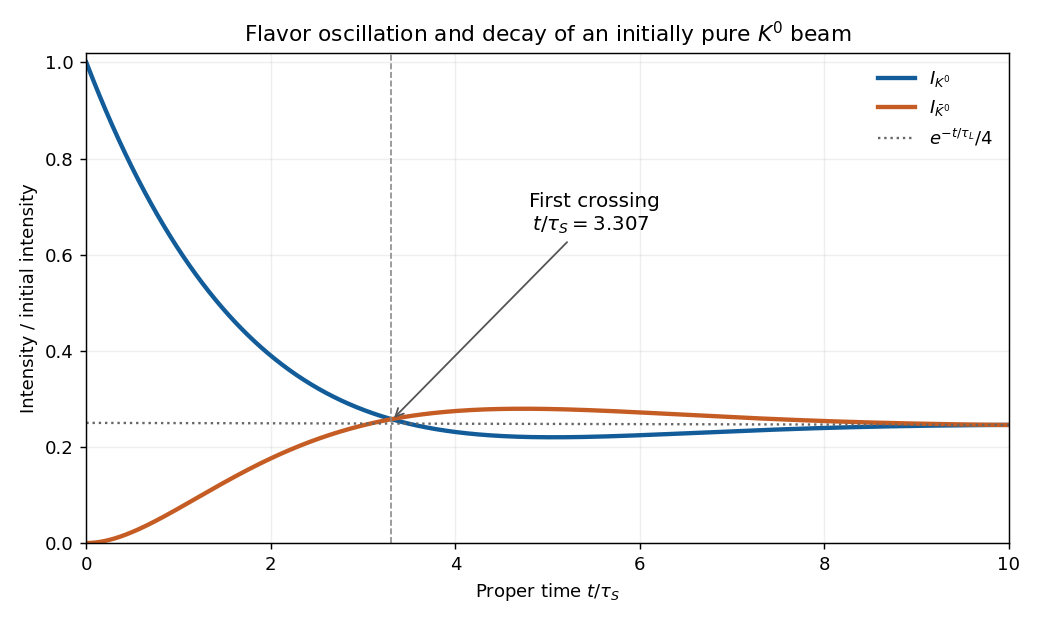
Normalize the incident intensity to one. Since , the initial probability amplitudes are . Define . The flavor probability amplitudes are and . Their absolute squares arewhere in natural units. Thus for both, , andMultiplying all three coefficients by the incident intensity gives any other normalization. Crucially, is time dependent. The printed template cannot hold with all of constant. For example, a nonzero constant would leave an undamped oscillation at arbitrarily late times, even after both unstable components have decayed.
In seconds, . With , the supplied mass difference and mean lifetimes giveInitially the intensities are one and zero. Their sum is , so these are unconditioned survival intensities, not probabilities conditioned on survival. The curves first meet at . Thereafter the neutral antikaon component briefly exceeds the component, before the interference dies away and both approach the surviving long-lived intensity .
In Fermi's golden rule, is a transition decay rate, measured in inverse time; is the reduced Planck constant; is the transition matrix element of the interaction part of the Hamiltonian; and is the final density of states per unit energy, evaluated subject to conservation of energy. Final spin and other discrete labels must be summed, with initial labels averaged when the preparation requires it. If varies across the final phase space, denotes the corresponding integral rather than a product of constants.
A convention warning: many quantum field theory texts use for an energy decay width. That convention is ; the formula as printed uses the rate convention.
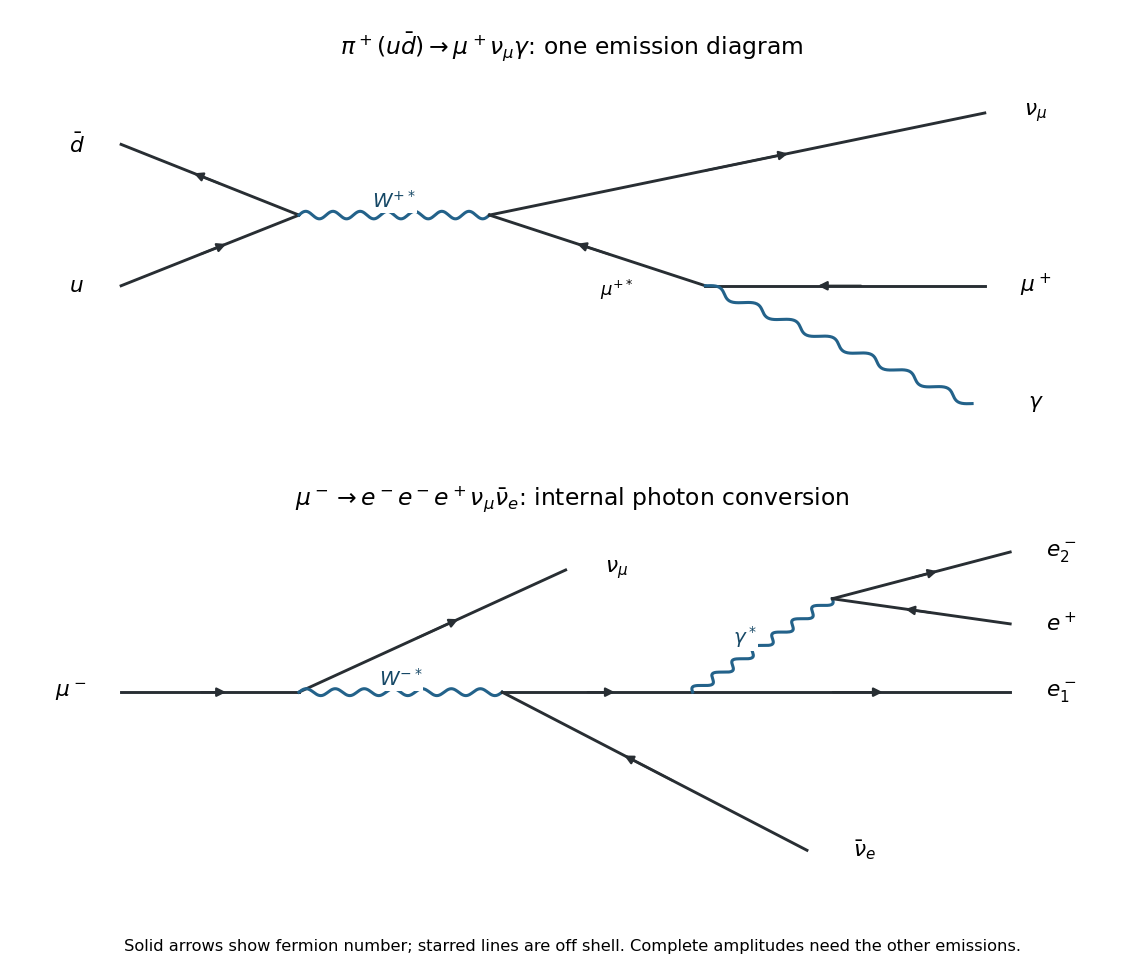
A representative Feynman diagram annihilates into , producing and an off-shell ; the charged antilepton emits a photon and becomes the outgoing . The top panel below shows this contribution. A complete gauge-invariant decay amplitude includes radiation from the charged hadronic side, together with structure-dependent terms. The physical separation into inner bremsstrahlung, structure-dependent radiation, and their interference is explicit in the standard radiative pion decay description.[ref]
Radiative pion and kaon decay form factors in the 2025 Review of Particle Physics. Section 62.1, equations (62.1)–(62.4): decomposition into inner bremsstrahlung, structure-dependent radiation and interference
Here is an explicit finite model of phase space alone, with its assumptions exposed. Neglect the neutrino mass, treat the photon as massless, and replace the spin-summed invariant decay amplitudes by constants over the available Lorentz-invariant phase space. Write , , , and use natural units. The three-body phase space with one massive daughter follows by factoring through an intermediate invariant squared mass :The two-body comparison has . Since , assuming givesHere is a dimensionless constant encapsulating the assumed matrix element ratio, and is the fine-structure constant. If the two-body mode dominates, this ratio approximates the radiative branching fraction. Near , , displaying the extra phase space suppression.
This model is not a prediction of a physical uncut radiative branching fraction. Actual inner bremsstrahlung has a soft-photon singularity, so a count of events with a separately observed photon requires a positive photon energy cut. To see both the missing input and the mass dependence explicitly, the leading soft-photon result for isThe coefficient follows from the radiation factor : angular integration gives , where , and the soft energy integral is . Thus a finite physical number cannot be deduced from the two masses and phase space alone. The infrared divergence cancels only when the corresponding unresolved real radiation and virtual radiative corrections are combined in an inclusive observable.
For a three-body leptonic decay through the Fermi interaction, neglecting daughter masses and radiative corrections, lepton universality givesin natural units. Therefore scaling the muon decay rate by predicts only one leptonic channel, not the total tau lepton decay rate.
The tau lepton has two allowed charged-lepton channels, and , as well as hadronic channels from . Each allowed quark channel has three color charge choices and its Cabibbo-Kobayashi-Maskawa matrix factor. Charm production is kinematically inaccessible in a physical hadronic final state at this mass. Treating the inclusive hadronic channels by a simple quark-hadron duality estimate,Thus, using and ,Finite daughter masses, hadronic decay thresholds and resonances, Quantum chromodynamics radiative corrections, and electroweak radiative corrections refine this estimate. The threefold color multiplicity in a decay width and extra decay channels are the main correction to naive fifth-power scaling.
Feynman diagrams organize the perturbative calculation of the matrix element in Fermi's golden rule. Each external line labels an incoming or outgoing particle state; each internal line contributes a propagator for a generally off-shell intermediate field; and each interaction vertex contributes a coupling and the appropriate spin, momentum and internal-symmetry structure. All indistinguishable allowed diagrams must be summed as probability amplitudes before taking the absolute square, so their interference contributes to the rate.
In the radiative pion decay diagram in part (b), solid arrowed lines are fermions; the wavy line joining the hadronic and leptonic vertices is a W boson propagator; and the wavy outgoing line is an external photon. Arrows track fermion number, so an outgoing antimuon has an arrow towards its production vertex. Each vertex conserves four-momentum; an internal propagator need not satisfy the on-shell energy–momentum relation. A closed loop Feynman diagram additionally requires an integration over an internal four-momentum.
The final Lorentz-invariant phase space, conservation Dirac delta functions, and the initial-state normalization or incident flux turn the squared scattering amplitude into a decay rate or cross section. A diagram supplies the dynamics; it is not itself the final density of states.
The following are the leading quantum electrodynamics diagrams. Solid arrows indicate fermion-number flow, and wavy lines indicate photons. The heavy source line represents a charged nucleus; its recoil allows four-momentum conservation.
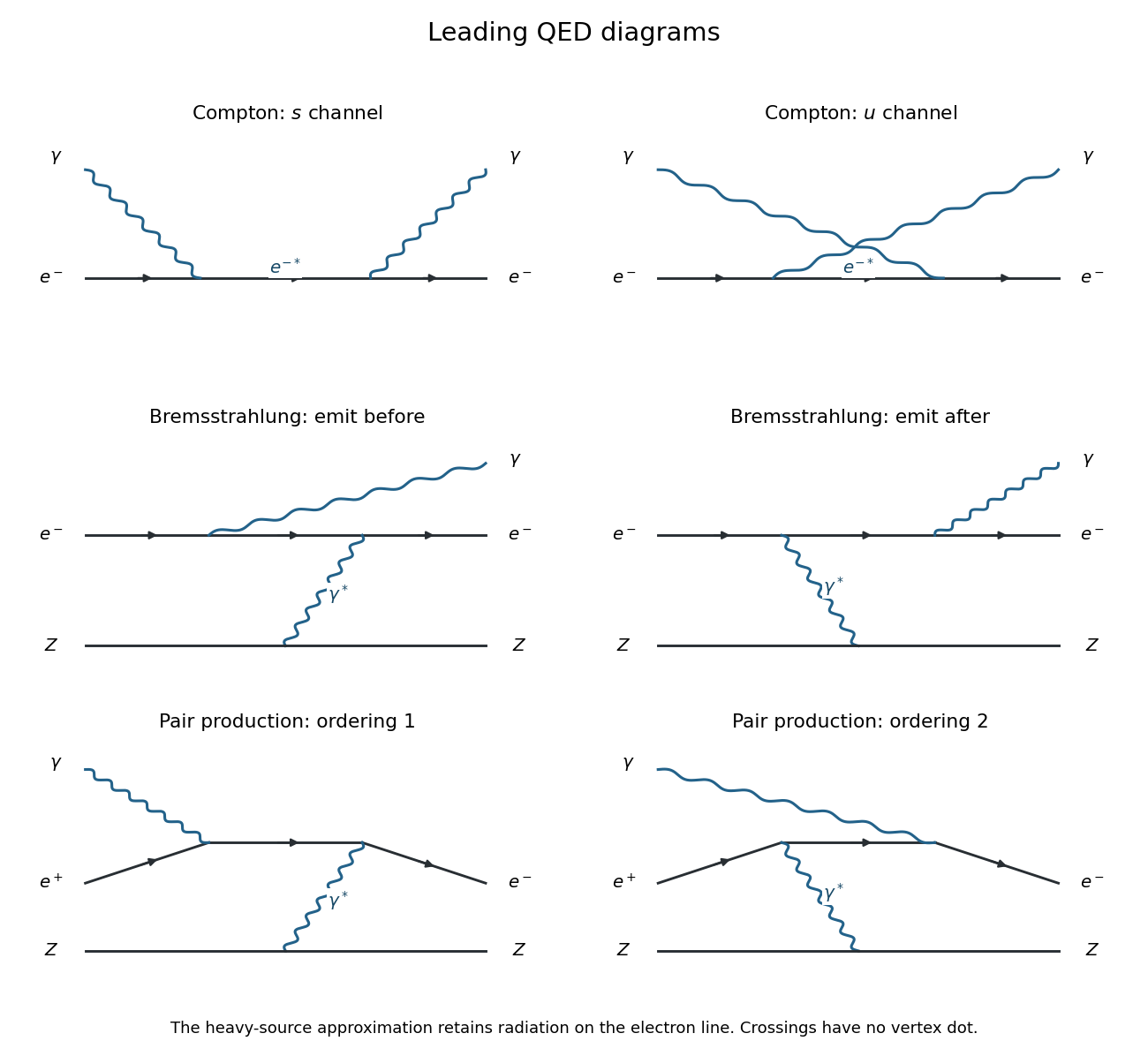
For Compton scattering, , there are two diagrams: absorption of the incident photon followed along the electron line by emission of the outgoing photon, and the opposite ordering. These are the - and -channel electron propagators. Both scattering amplitudes are order .
For bremsstrahlung, , a virtual photon transfers momentum between the electron and the source. The real photon is emitted before or after this interaction along the electron line. These two dominant external-field diagrams have scattering amplitudes of order . A full finite-mass charged-target calculation also includes radiation from the target; it is suppressed in the heavy stationary-source approximation used here.
For nuclear-field pair production, , crossing the preceding diagrams gives two order- contributions, with the incoming real photon and the exchanged virtual photon in either order along the pair's fermion line. An isolated real photon cannot produce a massive pair in vacuum: its invariant squared mass is zero, whereas the pair has invariant squared mass at least . The source absorbs recoil momentum.
There is a -channel Z boson contribution and a crossed, -channel W boson contribution. The latter pairs the incoming electron neutrino with the outgoing electron, and the incoming electron with the outgoing electron neutrino. Both contribute coherently to the same elastic final state.
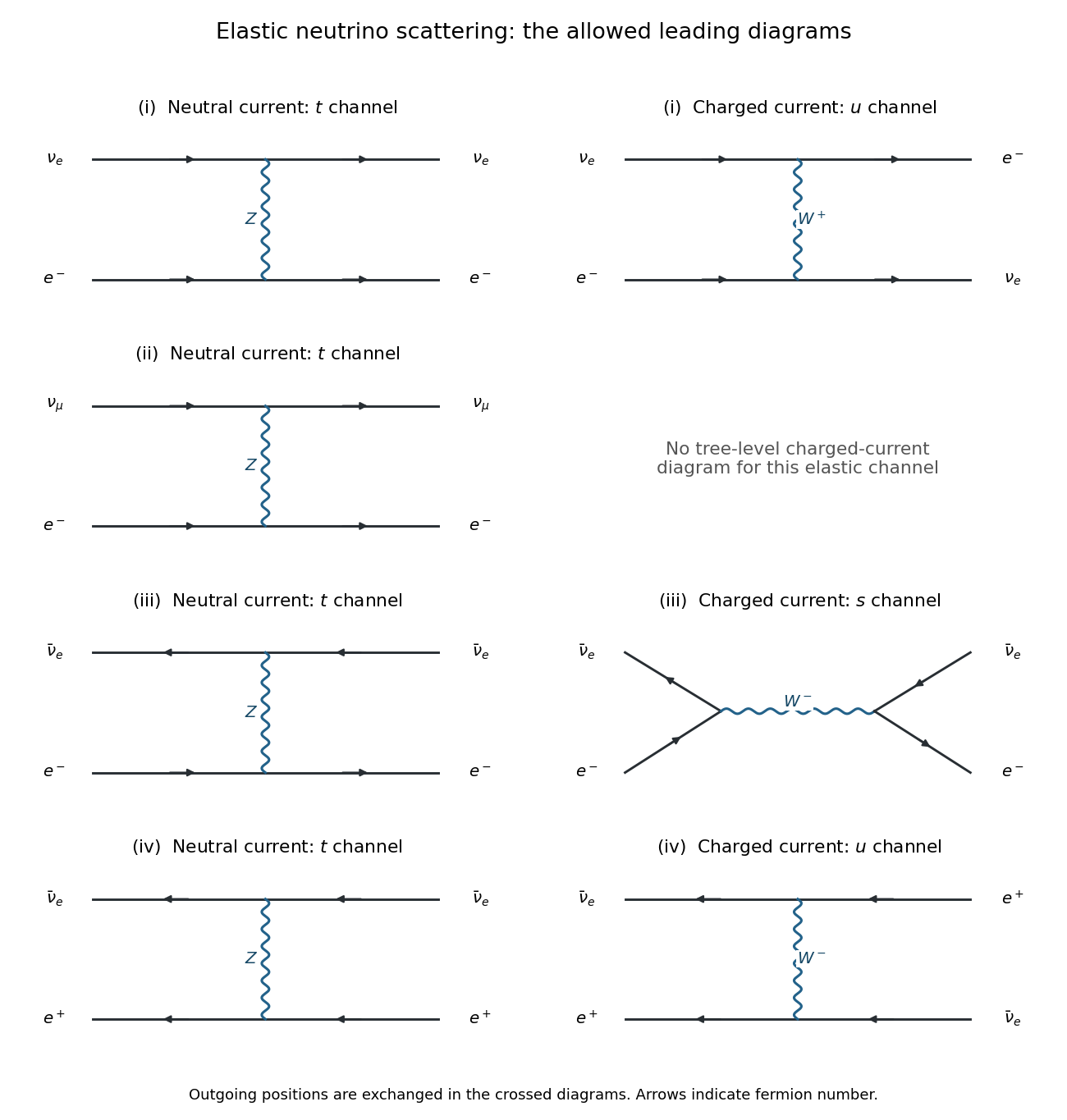


For a concrete comparison, take unpolarized targets, the same Mandelstam invariant in all four reactions, and . In a stationary-electron experiment this includes with . Define , using the weak mixing angle, and . The weak neutral current has chiral couplings , ; the weak charged current shifts by one. ConsequentlyThe factor comes from integrating the opposite-chirality angular weight: in the massless limit . Thus the relative rate depends on the chiral couplings and their interference, rather than simply on the number of diagrams.
Only -channel Z boson exchange contributes at leading order. A W boson would connect to , rather than to , and therefore does not supply this elastic channel. With the assumptions and normalization of part (i),For the illustrative value , the dimensionless factors in parts (i) and (ii) are and . The electron-flavor reaction is therefore about times as large in this limit. This uses the weak flavour selection in neutrino-electron scattering, not a hypothetical flavor-changing neutral vertex.
Both -channel Z boson exchange and -channel annihilation occur. Replacing the incident neutrino by an antineutrino interchanges the two chiral angular weights. In the same contact-interaction regime,At the factor is , between parts (i) and (ii). The comparison is energy dependent outside this regime: near , the annihilation channel has a W boson resonance, and the low-energy formula is inapplicable.
This is the charge-and-parity-conjugate reaction of part (i). There are -channel Z boson and crossed W boson contributions, with all fermion arrows reversed relative to part (i). For matched unpolarized kinematics and negligible CP violation,Combining all four results in the regime specified in part (i),In particular, conjugating both initial particles restores the part-(i) rate; conjugating the neutrino alone does not. Initial spin polarization and energies near a weak-boson mass require a separate comparison.
The decay is allowed in the Standard Model. Begin with ordinary muon decay, , . The outgoing electron can emit a virtual photon that converts to . The bottom panel of the figure in part (b) shows one representative diagram. Radiation from other charged lines and exchange of the identical final electrons complete the decay amplitude.
The final total electric charge is . Its electron-family lepton number is , and its muon-family lepton number is , matching the initial muon. The extra pair therefore violates no relevant Standard Model selection rule. It is also kinematically allowed since . The virtual pair costs two electromagnetic vertices: the decay amplitude is order , and the decay rate is suppressed by roughly two powers of the fine-structure constant, with additional phase space and logarithmic factors.
Let and denote neutral atomic rest masses for the appropriate parent and daughter, and initially neglect electronic binding energy corrections and daughter excitation. The Q values areFor beta-minus decay, the daughter nucleus has one extra positive charge. Its neutral atom contains one more electron than the neutral parent, cancelling the emitted electron's rest mass in the atomic accounting. For beta-plus decay, the neutral parent contains one more electron than the neutral daughter; together with the emitted Positron, this gives the subtraction. Thus beta-plus decay requires an atomic mass difference exceeding , whereas electron capture need not.
For electron capture, the captured bound electron is already included in . Capture from a shell leaving an atomic hole of excitation energy , and a nuclear excited state of energy , gives approximatelyThe hole's energy later appears as atomic radiation or Auger electrons. Subtract for either beta decay as well. Exact endpoints also depend on daughter ionization and small atomic binding energy changes; the boxed expressions are the conventional leading atomic-mass formulas.
For a parent at rest, momentum conservation gives equal and opposite daughter and alpha particle momenta. In the nonrelativistic recoil approximation,Approximating nuclear masses by their mass numbers, and , givesThe printed phrase “atomic number ” must here mean mass number. Atomic number alone does not determine the recoil fraction. For example, and have the same atomic number , but the approximate fractions are and , respectively.
For completeness, exact relativistic two-body decay kinematics giveswhere . Expanding for recovers the recoil-sharing expression.
Model alpha decay as a preformed alpha particle making repeated escape attempts from a short-range nuclear potential well, then undergoing quantum tunnelling through the external Coulomb potential. Write the daughter atomic number as , the nuclear radius as , and the relative reduced mass as . For zero orbital angular momentum, the WKB approximation givesSet and . ThenWhen , the leading term isHere is the alpha preformation probability and the attempt frequency. The stated proportionality retains only the dominant barrier exponent. It assumes a thick classically forbidden barrier, nonrelativistic relative motion, a spherical unscreened external Coulomb potential, and slowly varying prefactors. Finite , changes in alpha preformation probability, and a centrifugal barrier for nonzero orbital angular momentum produce significant corrections. The precise charge in the barrier is ; using the parent charge is an approximation for large . The measured alpha particle speed approximates only when daughter recoil is negligible.
For a closed unit-branching radioactive decay chain, the rate equations areThe first gives . Multiply the second by its integrating factor :Integrate from zero to . For ,soThe coefficients can individually be negative; the physical population is nonnegative because the production integral is nonnegative. For equal nuclear decay constants , the finite limit isA sum of two constant-coefficient copies of the same exponential function cannot represent this limit; the factor is essential.
For , differentiate the distinct-nuclear decay constant result:Equating the production and loss terms gives , henceFor positive nuclear decay constants and , this is positive regardless of their ordering. Initially , while at late times; the stationary point is the unique maximum. At that time . If the nuclear decay constants are equal, differentiating gives , also the continuous limit of the expression above.
A stable terminal product obeys . Conservation of the number of chain members gives when . Therefore, for distinct nuclear decay constants,Set for an initially absent terminal product. For equal nuclear decay constants,Both expressions have because the intermediate population initially vanishes; their leading growth is . For positive nuclear decay constants, increases monotonically to .
Each quark has baryon number , and each antiquark has baryon number . A strange quark has strangeness , a strange antiquark has strangeness , and the light have zero strangeness. The isospin projections of are , with the opposite values for their antiquarks. ThusFor three valence quarks, and . The baryon octet is reproduced by the following quark model assignments:
Consequently the top-left and top-right states in the source diagram are . Here the source's label means the unknown particle at the top right; the conventional symbol elsewhere in this solution denotes flavor hypercharge.
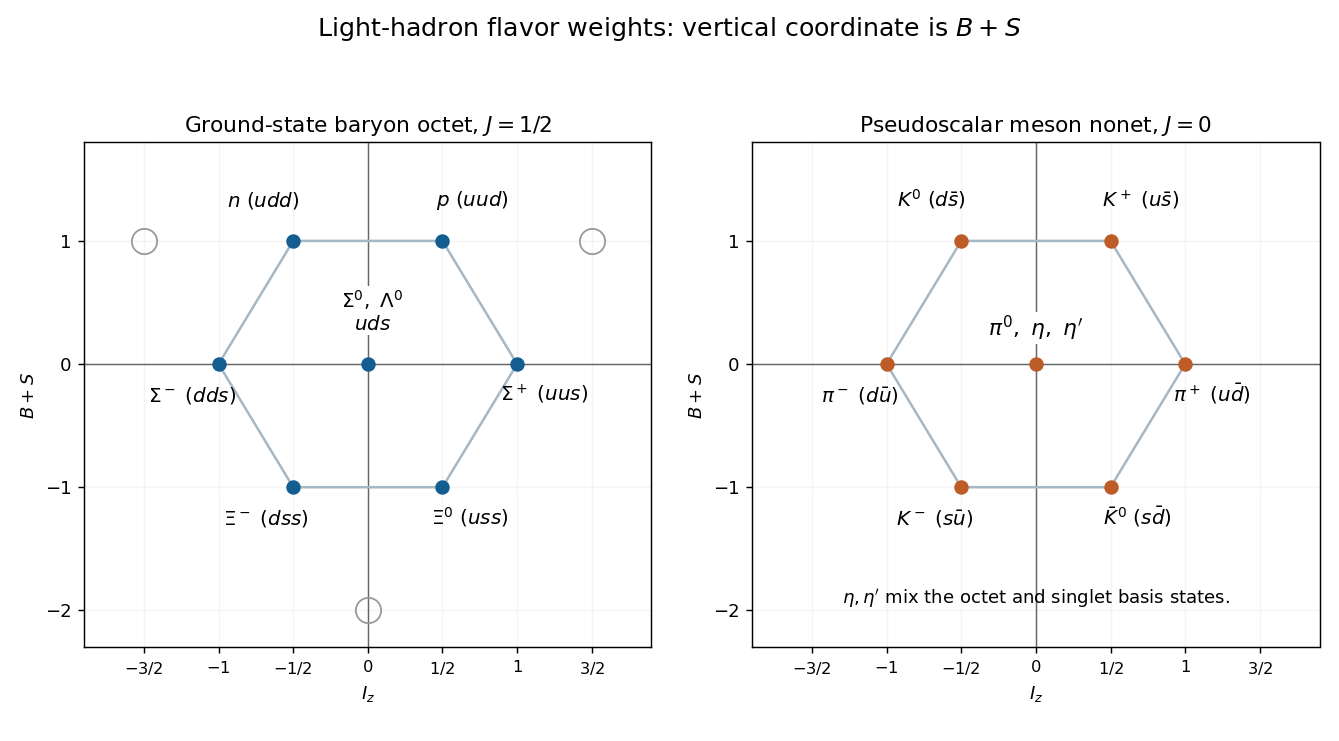
Original baryon-octet and pseudoscalar-meson-nonet weight diagrams in the full hypercharge convention
. Details. 
The diagram refers to ground state, , color singlet baryons. Their spatial wavefunction is symmetric and their color wavefunction is antisymmetric. The Pauli exclusion principle therefore requires a symmetric combined spin-and-flavor wavefunction. One cannot independently attach every three-spin coupling to each flavor assignment.
For three spin- particles, there are formally two ways to couple to total spin . In the ground state quark model these are tied to the corresponding mixed-symmetry flavor functions. Their required symmetric combination yields one physical spin- flavor octet, not two independent species at each peripheral weight. In spin-flavor symmetry notation,under flavor and spin . Thus there is one peripheral species in the baryon octet, each still possessing its two ordinary spin projections. The two abstract flavor-octet copies in do not double the physical ground state octet.
At the dotted positions, the flavor content would be , or . These flavor wavefunctions are completely symmetric. The spin wavefunction must then also be completely symmetric, which means total spin , not . The corresponding baryon decuplet states are , and . This exclusion is for the stated ground state spin- multiplet; it is not an exclusion of all excited baryons at those weights.
Both central baryons have valence quarks , baryon number , strangeness and isospin projection zero. Their total isospins differ:The flavor part is symmetric for the Sigma baryon and antisymmetric for the Lambda baryon. In the usual ground state coupling, the associated pair has spin one for and spin zero for , with the strange quark giving total spin in both cases. Distinct total isospin makes these orthogonal states despite their coincident position in the weight diagram.
Measured half-integer spin and fermionic behavior rule out a simple quark-antiquark pair: two spin- constituents have integer total spin, and adding integer orbital angular momentum does not change that. Their measured baryon number , inferred through production and conservation bookkeeping, corresponds to . Their pattern of electric charges, strangeness and isospin then agrees with three light valence quarks.
Baryon magnetic moments provide a more detailed check. The additive quark model gives, for example,Approximately equal up and down constituent masses give , hence , close to the measured ratio of about .
These observations support three valence quarks; they do not prove the absence of extra quark-antiquark pairs. For instance, also has and can have half-integer spin. Ordinary Quantum chromodynamics baryons also contain sea pairs and gluons. The stronger interpretation that the measurements exclude every antiquark component is therefore false.
Write the charge in units of as . The proton and neutron have and , so their measured charges imply and . Thus , :This is the Gell-Mann--Nishijima formula, with the full flavor hypercharge . Applying the quark baryon number and the isospin and strangeness assignments from part (a),Physical electric charges are these numbers multiplied by the positive elementary charge .
The observed dominant two-body transition is . Both baryons have valence quarks and the same strangeness; an electromagnetic interaction transition is therefore possible. Their mass difference is only about , below the lightest pion mass, so no additional on-shell strongly interacting particle fits. A photon is neutral and massless, and can carry the required angular momentum through a magnetic dipole transition between the two positive-parity spin- states. A single neutrino would violate lepton number and would not give the required fermion parity.
At rest, four-momentum conservation gives and . ThusThe result is slightly below because the Lambda baryon recoils; rounded masses give about .
The channels and are actually kinematically open: their total rest energies are about and , below . Their suppression is therefore not a decay threshold prohibition. Each changes strangeness from to zero and so requires a weak interaction. The much faster allowed electromagnetic transition makes such weak branching fractions extremely small. “Not observed” should be understood as overwhelming electromagnetic competition, not an exact ban in the Standard Model. The photon identification likewise uses the known low-energy spectrum and dominant transition mechanism, not neutrality alone.
A ground state spin-zero meson is a color singlet with and constituent spin zero, hence a pseudoscalar meson. The nine flavor combinations form . Here , so the vertical coordinate equals strangeness. The six peripheral weights in the right panel of the figure in part (a) are
At the center, all have . A useful orthonormal flavor basis isThe neutral pion has ; and have . The Eta octet state belongs to the octet, while is the flavor singlet. The physical eta and eta prime mesons are predominantly mixtures of these two isoscalar basis states,Unequal quark masses and the chiral anomaly prevent exact flavor symmetry and a degenerate nonet. The three central physical species are consequently , rather than three separately observable pure diagonal flavor pairs. Small isospin-breaking admixtures are neglected here.
Articles by others on the same topic
There are currently no matching articles.