In Fermi's golden rule, is a transition decay rate, measured in inverse time; is the reduced Planck constant; is the transition matrix element of the interaction part of the Hamiltonian; and is the final density of states per unit energy, evaluated subject to conservation of energy. Final spin and other discrete labels must be summed, with initial labels averaged when the preparation requires it. If varies across the final phase space, denotes the corresponding integral rather than a product of constants.
A convention warning: many quantum field theory texts use for an energy decay width. That convention is ; the formula as printed uses the rate convention.
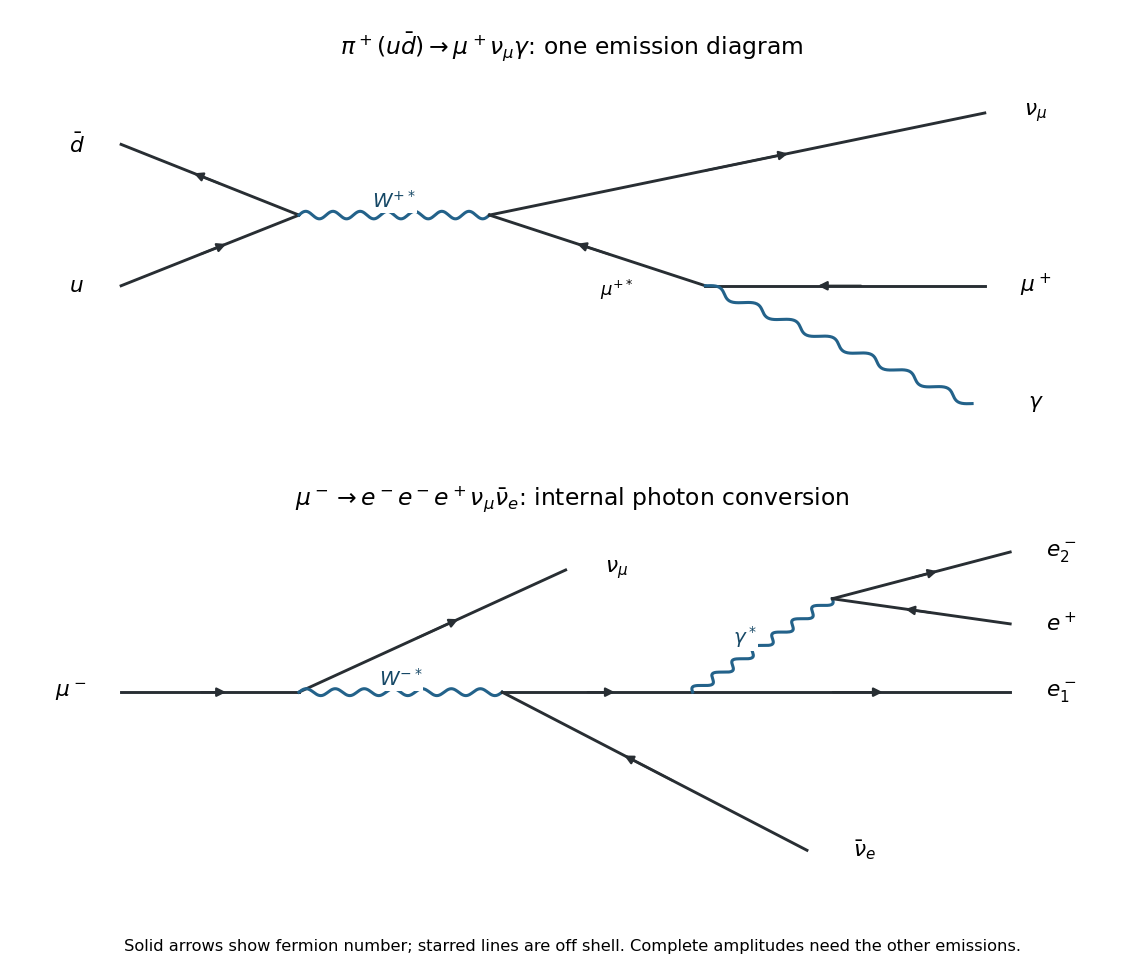
A representative Feynman diagram annihilates into , producing and an off-shell ; the charged antilepton emits a photon and becomes the outgoing . The top panel below shows this contribution. A complete gauge-invariant decay amplitude includes radiation from the charged hadronic side, together with structure-dependent terms. The physical separation into inner bremsstrahlung, structure-dependent radiation, and their interference is explicit in the standard radiative pion decay description.[ref]
Radiative pion and kaon decay form factors in the 2025 Review of Particle Physics. Section 62.1, equations (62.1)–(62.4): decomposition into inner bremsstrahlung, structure-dependent radiation and interference
Here is an explicit finite model of phase space alone, with its assumptions exposed. Neglect the neutrino mass, treat the photon as massless, and replace the spin-summed invariant decay amplitudes by constants over the available Lorentz-invariant phase space. Write , , , and use natural units. The three-body phase space with one massive daughter follows by factoring through an intermediate invariant squared mass :The two-body comparison has . Since , assuming givesHere is a dimensionless constant encapsulating the assumed matrix element ratio, and is the fine-structure constant. If the two-body mode dominates, this ratio approximates the radiative branching fraction. Near , , displaying the extra phase space suppression.
This model is not a prediction of a physical uncut radiative branching fraction. Actual inner bremsstrahlung has a soft-photon singularity, so a count of events with a separately observed photon requires a positive photon energy cut. To see both the missing input and the mass dependence explicitly, the leading soft-photon result for isThe coefficient follows from the radiation factor : angular integration gives , where , and the soft energy integral is . Thus a finite physical number cannot be deduced from the two masses and phase space alone. The infrared divergence cancels only when the corresponding unresolved real radiation and virtual radiative corrections are combined in an inclusive observable.
For a three-body leptonic decay through the Fermi interaction, neglecting daughter masses and radiative corrections, lepton universality givesin natural units. Therefore scaling the muon decay rate by predicts only one leptonic channel, not the total tau lepton decay rate.
The tau lepton has two allowed charged-lepton channels, and , as well as hadronic channels from . Each allowed quark channel has three color charge choices and its Cabibbo-Kobayashi-Maskawa matrix factor. Charm production is kinematically inaccessible in a physical hadronic final state at this mass. Treating the inclusive hadronic channels by a simple quark-hadron duality estimate,Thus, using and ,Finite daughter masses, hadronic decay thresholds and resonances, Quantum chromodynamics radiative corrections, and electroweak radiative corrections refine this estimate. The threefold color multiplicity in a decay width and extra decay channels are the main correction to naive fifth-power scaling.
Feynman diagrams organize the perturbative calculation of the matrix element in Fermi's golden rule. Each external line labels an incoming or outgoing particle state; each internal line contributes a propagator for a generally off-shell intermediate field; and each interaction vertex contributes a coupling and the appropriate spin, momentum and internal-symmetry structure. All indistinguishable allowed diagrams must be summed as probability amplitudes before taking the absolute square, so their interference contributes to the rate.
In the radiative pion decay diagram in part (b), solid arrowed lines are fermions; the wavy line joining the hadronic and leptonic vertices is a W boson propagator; and the wavy outgoing line is an external photon. Arrows track fermion number, so an outgoing antimuon has an arrow towards its production vertex. Each vertex conserves four-momentum; an internal propagator need not satisfy the on-shell energy–momentum relation. A closed loop Feynman diagram additionally requires an integration over an internal four-momentum.
The final Lorentz-invariant phase space, conservation Dirac delta functions, and the initial-state normalization or incident flux turn the squared scattering amplitude into a decay rate or cross section. A diagram supplies the dynamics; it is not itself the final density of states.
The following are the leading quantum electrodynamics diagrams. Solid arrows indicate fermion-number flow, and wavy lines indicate photons. The heavy source line represents a charged nucleus; its recoil allows four-momentum conservation.
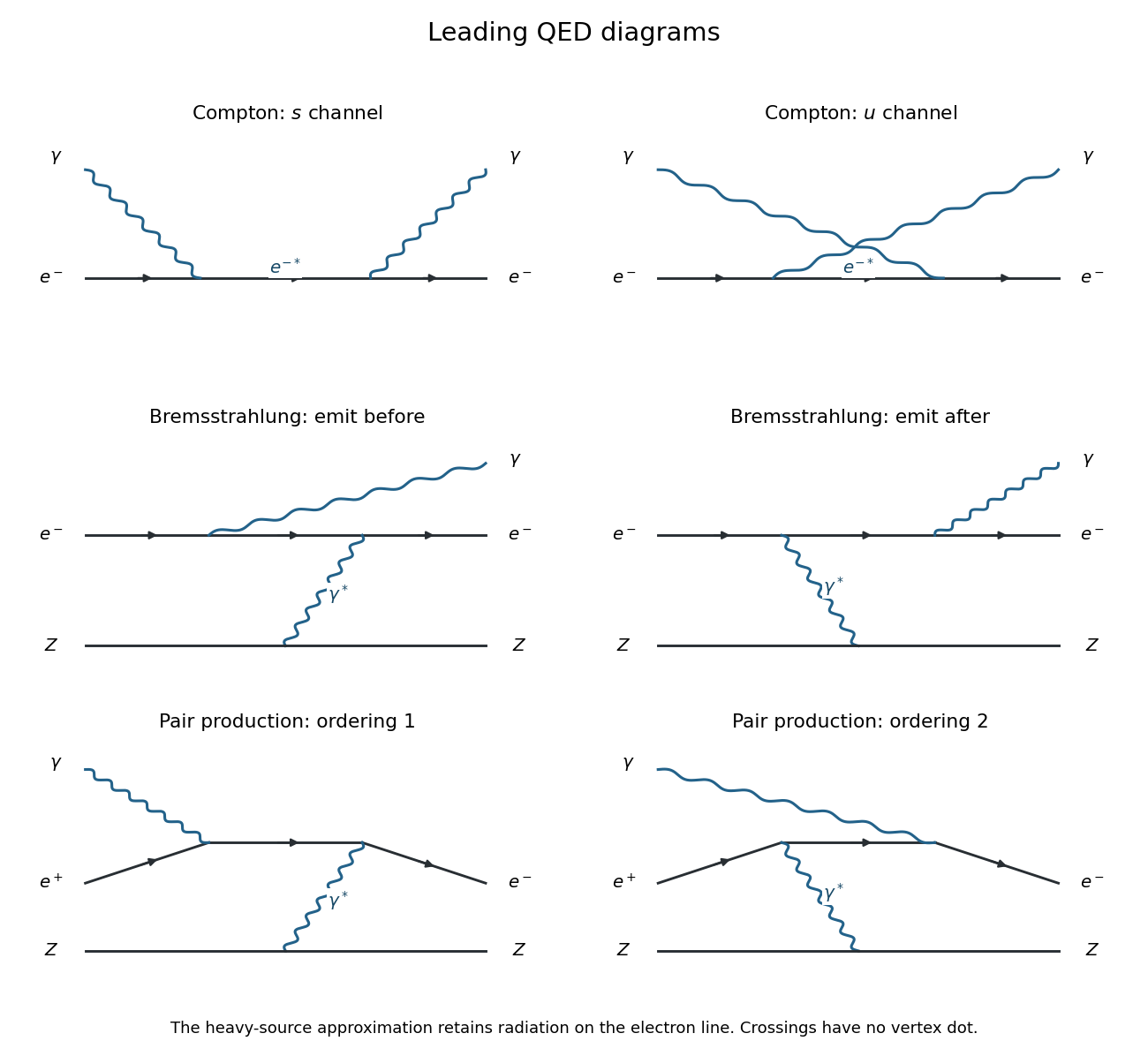
For Compton scattering, , there are two diagrams: absorption of the incident photon followed along the electron line by emission of the outgoing photon, and the opposite ordering. These are the - and -channel electron propagators. Both scattering amplitudes are order .
For bremsstrahlung, , a virtual photon transfers momentum between the electron and the source. The real photon is emitted before or after this interaction along the electron line. These two dominant external-field diagrams have scattering amplitudes of order . A full finite-mass charged-target calculation also includes radiation from the target; it is suppressed in the heavy stationary-source approximation used here.
For nuclear-field pair production, , crossing the preceding diagrams gives two order- contributions, with the incoming real photon and the exchanged virtual photon in either order along the pair's fermion line. An isolated real photon cannot produce a massive pair in vacuum: its invariant squared mass is zero, whereas the pair has invariant squared mass at least . The source absorbs recoil momentum.
There is a -channel Z boson contribution and a crossed, -channel W boson contribution. The latter pairs the incoming electron neutrino with the outgoing electron, and the incoming electron with the outgoing electron neutrino. Both contribute coherently to the same elastic final state.
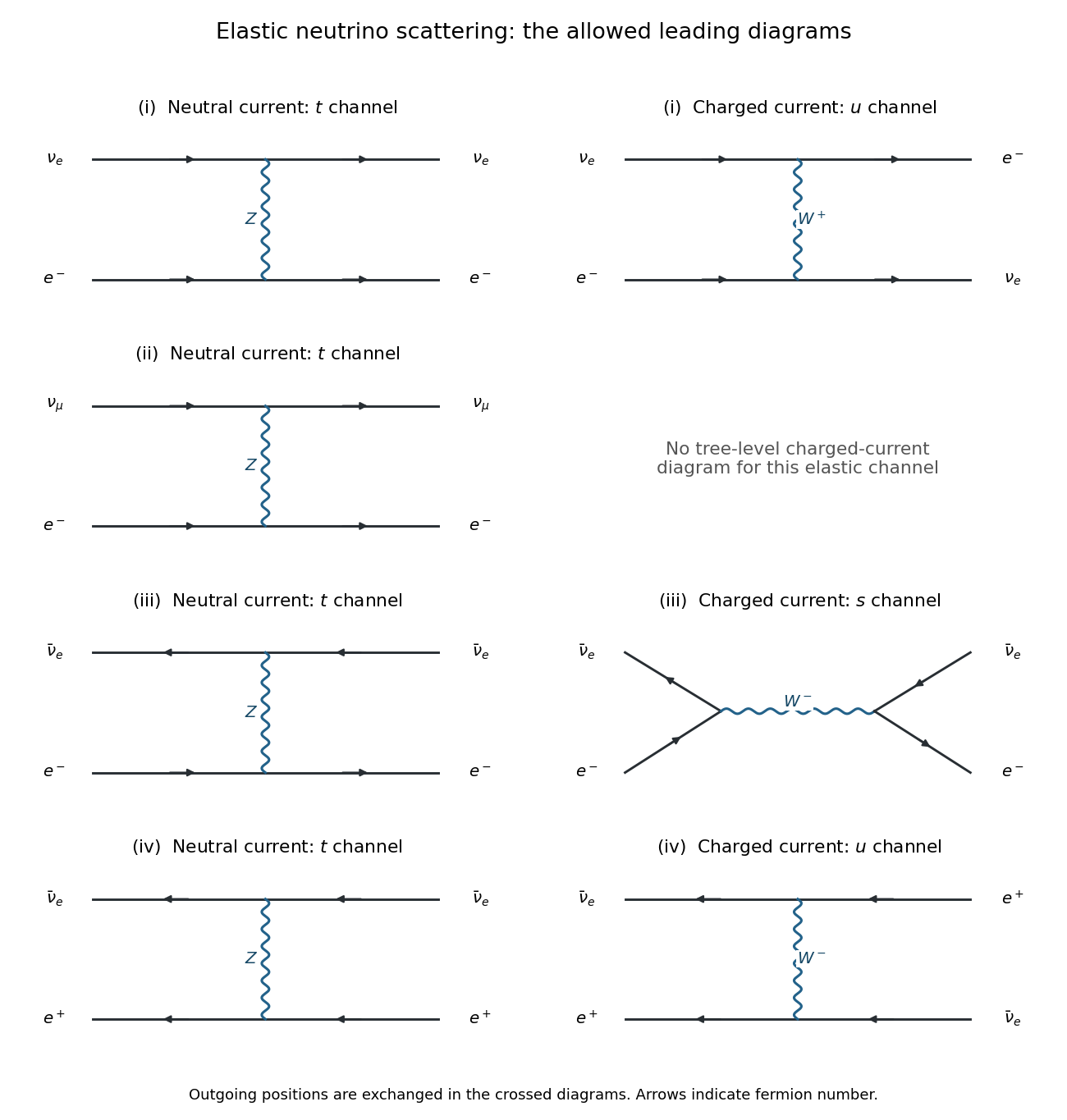


For a concrete comparison, take unpolarized targets, the same Mandelstam invariant in all four reactions, and . In a stationary-electron experiment this includes with . Define , using the weak mixing angle, and . The weak neutral current has chiral couplings , ; the weak charged current shifts by one. ConsequentlyThe factor comes from integrating the opposite-chirality angular weight: in the massless limit . Thus the relative rate depends on the chiral couplings and their interference, rather than simply on the number of diagrams.
Only -channel Z boson exchange contributes at leading order. A W boson would connect to , rather than to , and therefore does not supply this elastic channel. With the assumptions and normalization of part (i),For the illustrative value , the dimensionless factors in parts (i) and (ii) are and . The electron-flavor reaction is therefore about times as large in this limit. This uses the weak flavour selection in neutrino-electron scattering, not a hypothetical flavor-changing neutral vertex.
Both -channel Z boson exchange and -channel annihilation occur. Replacing the incident neutrino by an antineutrino interchanges the two chiral angular weights. In the same contact-interaction regime,At the factor is , between parts (i) and (ii). The comparison is energy dependent outside this regime: near , the annihilation channel has a W boson resonance, and the low-energy formula is inapplicable.
This is the charge-and-parity-conjugate reaction of part (i). There are -channel Z boson and crossed W boson contributions, with all fermion arrows reversed relative to part (i). For matched unpolarized kinematics and negligible CP violation,Combining all four results in the regime specified in part (i),In particular, conjugating both initial particles restores the part-(i) rate; conjugating the neutrino alone does not. Initial spin polarization and energies near a weak-boson mass require a separate comparison.
The decay is allowed in the Standard Model. Begin with ordinary muon decay, , . The outgoing electron can emit a virtual photon that converts to . The bottom panel of the figure in part (b) shows one representative diagram. Radiation from other charged lines and exchange of the identical final electrons complete the decay amplitude.
The final total electric charge is . Its electron-family lepton number is , and its muon-family lepton number is , matching the initial muon. The extra pair therefore violates no relevant Standard Model selection rule. It is also kinematically allowed since . The virtual pair costs two electromagnetic vertices: the decay amplitude is order , and the decay rate is suppressed by roughly two powers of the fine-structure constant, with additional phase space and logarithmic factors.
Articles by others on the same topic
There are currently no matching articles.