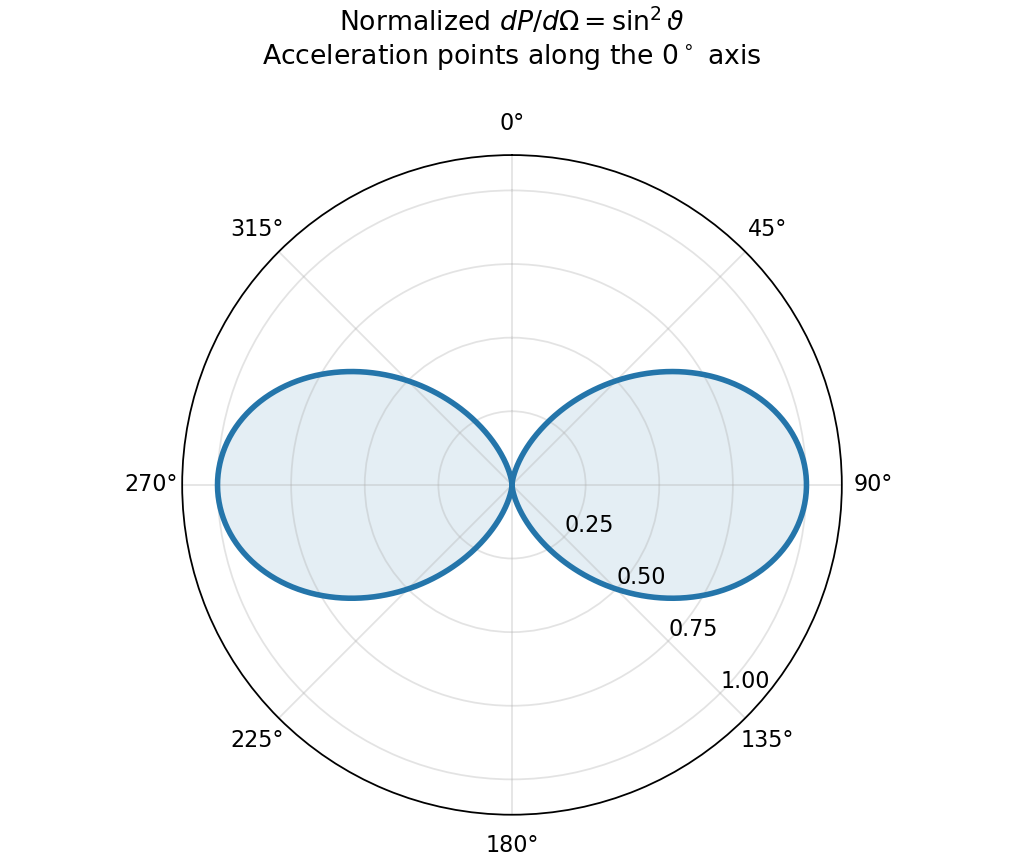
An accelerating point charge has a transverse radiation field in addition to its near field. At nonrelativistic speed and large distance ,The acceleration is evaluated at retarded time. Radiation fields decay as , so their outward energy flux integrated over a sphere is independent of radius; the near electric field instead decays as . The radiation vanishes along the acceleration and is strongest perpendicular to it.[ref]
The Feynman Lectures on Physics, Volume I by Richard Feynman and others. §28–2, Eqs. (28.5)–(28.6): transverse acceleration field and inverse-distance radiation
Using the Poynting vector givesThe integral uses . This is the Larmor formula. A harmonically accelerated charge with peak acceleration has mean power ; external work supplies this radiated energy in steady operation. Uniform inertial motion does not radiate.

Articles by others on the same topic
There are currently no matching articles.