The London penetration depth measures the density-to-mass ratio of carriers participating in superconducting screening. With electron-counted density and the stipulated bare electron mass ,Using , , and givesThis is the requested conduction-electron density within the assumed local London equation model. More precisely, it is the superconducting carrier density from London screening; identifying it with all conduction Electrons assumes that they participate in screening at the measurement temperature. No temperature-dependent normal-carrier fraction is supplied.
If the condensate is instead counted as Cooper pairs, the pair mass is and charge magnitude is , giving pair density . Keeping Electron and pair counting consistent avoids a spurious factor of two.
At normal incidence, continuity of tangential wave phase makes both internal wavevectors normal to the parallel faces. For the ordinary wave in a uniaxial optical medium, the electric field is an eigenpolarization of the permittivity tensor, so . ThusIts energy path is also normal to the faces. The extraordinary wave differs because but need not be perpendicular to . In a nonmagnetic crystal, and is perpendicular to . The vectors lie in the same meridional plane, with and . Therefore the electric-displacement angle from birefringent walk-off equals the angular separation between and .
The observed lateral separation is accumulated over thickness , so . With and ,The two emergent rays are parallel because their outgoing wavevectors are both normal to the faces in air; their internal energy paths can nevertheless be displaced by birefringent walk-off. The angle quoted is the positive angle between the field vectors, so the unspecified lateral direction does not affect its value. The unpolarized light excites both eigenpolarizations; it does not require their energy paths to coincide.
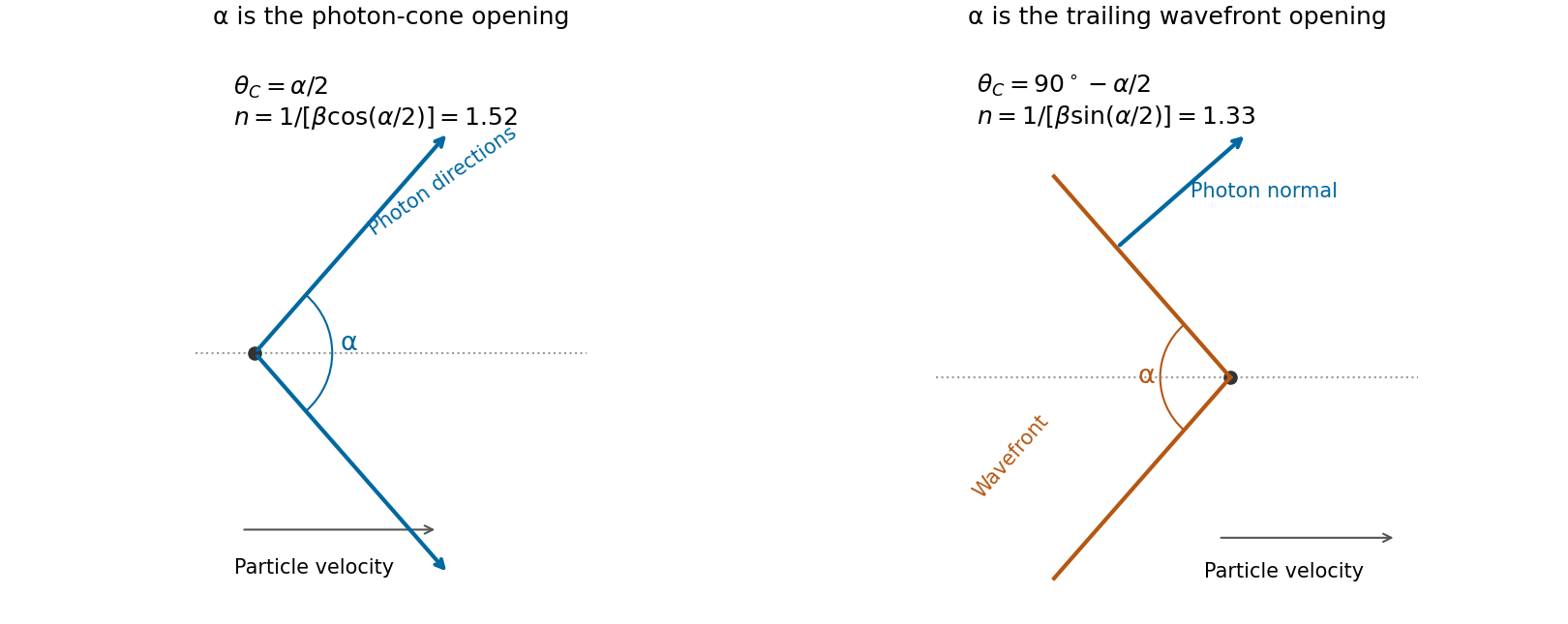
First obtain the particle speed from kinetic energy rather than treating as its total energy. With Electron rest energy ,For Cherenkov radiation, the photon propagation direction makes angle to the particle trajectory, with . The speed correction is negligible at three significant digits, but the Cherenkov photon-cone and wavefront-cone angles must be distinguished.
If the given opening is the full cone of photon directions, . The result isIf instead denotes the full opening of the conical wavefront, its half-angle is complementary to the photon direction: . That convention givesThe original PDF supplies no cone diagram or definition distinguishing these geometries. Thus the literal full photon-cone interpretation gives , while follows from the wavefront interpretation. It would be incorrect to interchange sine and cosine without stating which cone is meant.

Articles by others on the same topic
There are currently no matching articles.