For a material fluid volume, mass conservation yields . Constant mass density reduces this to . For inviscid flow, the Cauchy stress tensor is ; its net surface force is the volume integral of by the divergence theorem. Newton's second law for each material volume therefore gives . Since , these are exactly the two stated equations.
In two dimensions they readDifferentiate the second momentum equation in and subtract the derivative of the first. The pressure terms cancel. For , collecting terms givesIncompressibility removes the last term, givingThus each fluid parcel retains its scalar vorticity as it moves. In particular an initially irrotational flow remains irrotational in this smooth two-dimensional inviscid evolution. There is no vortex stretching in this two-dimensional setting.
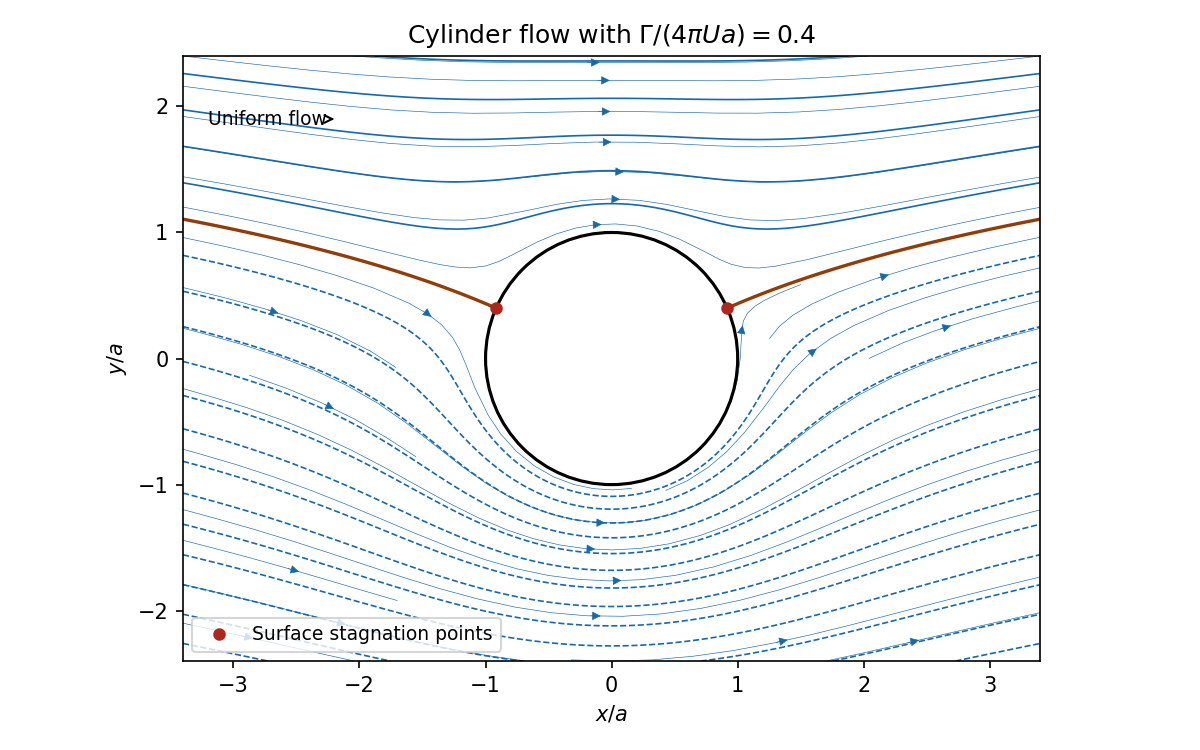
Write the complex potential of a two-dimensional potential flow as . Its complex velocity is . Hereso the far-field motion has velocity and speed . In polar coordinates the stream function, shifted by a harmless constant, isIt is zero on , proving the cylinder is a streamline.
Stagnation points are zeros of , hence roots of . Put . The two roots areBoth have modulus and are distinct. Their angles satisfy , namely and . The tangential velocity on the cylinder is , confirming the same zeros. Streamlines are level curves of ; the positive circulation places both stagnation points on the upper side and increases the flow speed below the cylinder.

Articles by others on the same topic
There are currently no matching articles.