Use the right-action convention printed in the paper: and . The orbit of a group action and stabilizer areThe identity belongs to , products of elements of fix , and implies . Thus is a subgroup. For ,proving .
The rotational action on the eight vertices of a cube is transitive. Model the vertices as . For any desired sign triple, choose a permutation whose parity makes the corresponding signed permutation matrix have determinant one; it maps to that vertex and preserves the cube. A rotation fixing a vertex fixes the axis through that vertex, the centre and the opposite vertex. It cyclically permutes the three incident edges, giving precisely rotations by . Thus the stabilizer is cyclic of order three.
An element is algebraic over when some nonzero polynomial in vanishes at it. Its minimal polynomial is the monic polynomial of least positive degree with this property; scaling a least-degree nonzero vanishing polynomial makes it monic.
If are two such polynomials, they have the same least degree. Their difference has smaller degree because both are monic, and it also vanishes at . Minimality forces the difference to be zero. Hence the monic minimal polynomial is unique.
Divide by in the polynomial ring over the field: , where or . If , then , and minimality forces . Conversely a multiple of vanishes at . ThereforeThis includes the zero polynomial.
If with both factors of positive degree, evaluation gives . Since is a field, one factor vanishes at , contrary to the minimal degree of . Thus is an irreducible polynomial over .
For the final unnumbered request, satisfies . The monic quadratic has no rational root, since its discriminant is . It is therefore an irreducible polynomial over , and
Euler's criterion isIt applies also when . In particular, for a nonzero residue the power is one or minus one according as the residue is a square or a nonsquare.
For distinct odd primes , quadratic reciprocity statesThus the two symbols agree unless both primes are three modulo four, in which case they have opposite signs.
Euler's criterion implies multiplicativity of the symbol on nonzero residues and gives . Apply quadratic reciprocity with the odd prime 3:The only nonzero square modulo three is one. Since ,
A set is null when for every it can be covered by countably many open intervals whose lengths sum to less than . Equivalently its Lebesgue outer measure is zero. This definition does not presuppose measurability of .
Let be null. Given , cover by intervals of total length less than , for . The union of all these interval families is countable, covers , and has total length less than . Thus the countable union is null.
Take the middle-thirds Cantor set . Its th stage is the union of closed intervals of length , and contains . Their total length is ; slightly enlarging them to open intervals gives covers of arbitrarily small total length. Therefore is null.
For uncountability map every binary sequence to . If two sequences first differ at index , their image difference in absolute value is at least . Thus the map is injective. The set of binary sequences is uncountable by Cantor's diagonal argument, so is uncountable.
Since on , substitute to obtainThe functions are measurable, so this proves Lebesgue integrability. Also gives . Hence is integrable on as well.
A useful differentiation theorem says: if is integrable in , differentiable in for almost every , and on a neighborhood of each parameter value the derivative is bounded in absolute value by one integrable function of , then the integral is differentiable and its derivative is the integral of . The proof applies dominated convergence to difference quotients, bounded by that same majorant by the mean value theorem.
Fix and choose . For ,The first part is integrable by part (i). The second is integrable by the permitted hypothesis for ; alternatively exponential decay dominates its polynomial and logarithmic factors. The theorem therefore applies locally at every , giving
A topology on contains , is closed under arbitrary unions and under finite intersections. The cofinite family has these properties: a nonempty union contains one cofinite member and therefore has finite complement; the complement of a finite intersection is a finite union of finite sets. The empty union and the sets are included explicitly.
Any two nonempty open sets intersect, because their intersection has finite complement in the infinite set . Thus no two disjoint nonempty open sets can separate , proving connectedness. For compactness, take any open cover and choose a nonempty member . Only finitely many points lie outside . Choose one covering member for each of those points. Together with these give a finite subcover. Thus is compact.
Continuity means that the inverse image of every open subset of is open in . If and is an open neighborhood of , then is an open neighborhood of , so it meets . Thus meets . The closure characterization givesIf is empty the assertion is immediate. Otherwise, if is bounded, choose a centre and with for all . The closed ball is closed because . It therefore contains . Hence the closure of a bounded set is bounded. Empty sets cause no exception. If is bounded, its closure is bounded by this result, and the displayed inclusion makes bounded too.
The total derivative is a linear map such thatIt is unique: the difference of two such linear maps, evaluated on , must vanish on every fixed vector after division by and passage to the limit.
The directional derivative in the specified vector direction isThe equality follows from the total-derivative remainder estimate; for the zero direction the result is zero. The convention keeps the supplied vector and does not replace it by a unit vector.
The th column of the matrix of in the standard bases is . Its th component is , found by taking increments . Thus the matrix of the total derivative is the Jacobian matrix, with entry equal to .
Applying the chain rule to both inverse identities givesFor the unnumbered calculation, the requested point is . The Jacobian there isTo apply its inverse to , solve , . Subtraction gives , and henceFor precision, the displayed example maps bijectively onto , rather than the entire positive quadrant. Indeed writing , the equations are with . This left side decreases continuously from to zero, giving exactly one if and only if , after which is unique. Its Jacobian never vanishes, so the inverse is differentiable on . The requested point lies in , making the calculation well-defined.
For fixed endpoint values, the Euler-Lagrange equation isIt follows by differentiating the functional along with , integrating the term by parts and applying the fundamental lemma of the calculus of variations.
For this quadratic integrand it becomes . If , write ; the condition at zero gives , and that at requires . Consequently is the only extremal when is not an integer. If is a positive integer, all extremals areThe integer case must be handled separately: with both endpoints zero has only . If negative real is allowed, the hyperbolic-function solutions also yield only zero under these endpoints. These statements concern stationary functions; no minimum is assumed.
Polar coordinates give speed squared , so unit mass has kinetic energy . The radial force is , giving after choosing the additive constant zero. Therefore is the stated expression.
The two Euler-Lagrange equations areThe second gives conservation of angular momentum . The mechanical energy isDirect differentiation expresses its derivative asThus energy is conserved for the motion wherever .
The time-independent Schrödinger equation isPut . For , differentiation gives . Substitution cancels the terms in and leaves .
The Gaussian integral gives . Hence a normalized wave function isMultiplication by any constant of modulus one gives the same quantum state. The position probability density is . Its first moment vanishes by oddness. Integration by parts gives , with the boundary term zero. Therefore
For a material fluid volume, mass conservation yields . Constant mass density reduces this to . For inviscid flow, the Cauchy stress tensor is ; its net surface force is the volume integral of by the divergence theorem. Newton's second law for each material volume therefore gives . Since , these are exactly the two stated equations.
In two dimensions they readDifferentiate the second momentum equation in and subtract the derivative of the first. The pressure terms cancel. For , collecting terms givesIncompressibility removes the last term, givingThus each fluid parcel retains its scalar vorticity as it moves. In particular an initially irrotational flow remains irrotational in this smooth two-dimensional inviscid evolution. There is no vortex stretching in this two-dimensional setting.
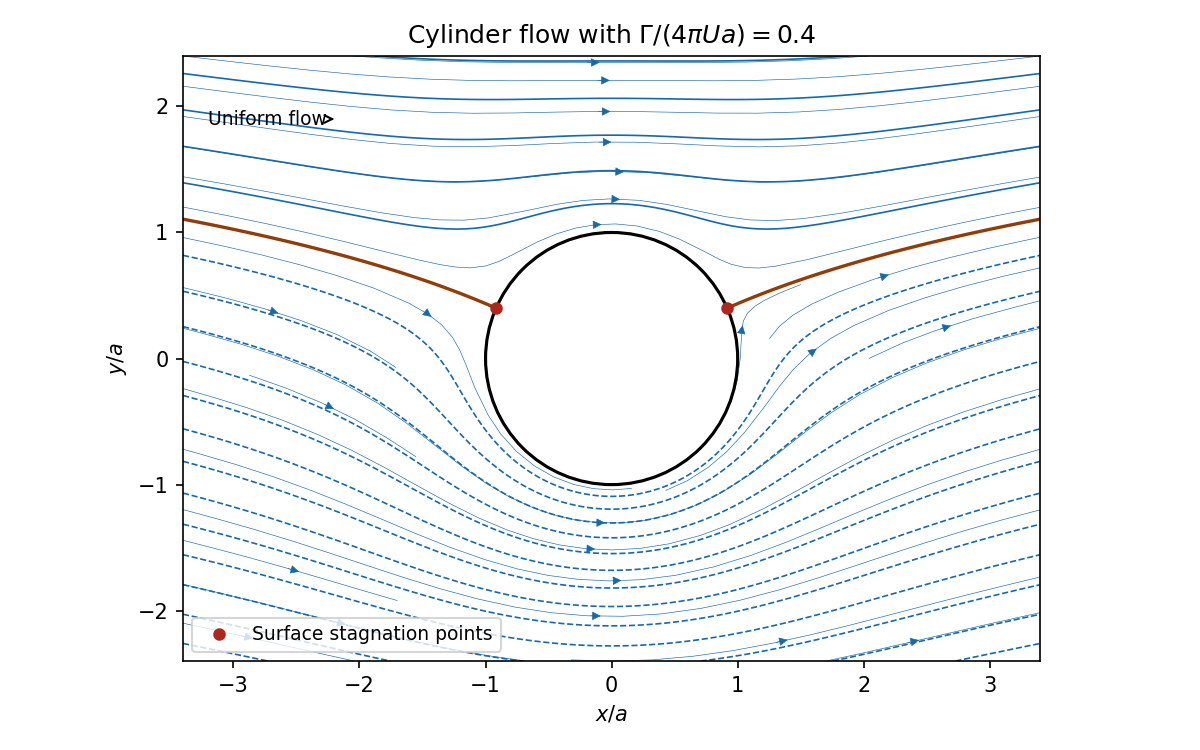
Write the complex potential of a two-dimensional potential flow as . Its complex velocity is . Hereso the far-field motion has velocity and speed . In polar coordinates the stream function, shifted by a harmless constant, isIt is zero on , proving the cylinder is a streamline.
Stagnation points are zeros of , hence roots of . Put . The two roots areBoth have modulus and are distinct. Their angles satisfy , namely and . The tangential velocity on the cylinder is , confirming the same zeros. Streamlines are level curves of ; the positive circulation places both stagnation points on the upper side and increases the flow speed below the cylinder.

The moment-generating function is where finite. For independent , independence factors the expectation, giving wherever both factors are finite.
For the given probability density function and , put to obtainHere , obtained by repeated integration by parts. For the defining integral diverges.
Each has moment-generating function , so independence givesThe uniqueness theorem for moment-generating functions applies when the functions are finite on a neighborhood of zero. Hence the sum has the same distribution as , a Gamma distribution of shape and rate one, with the displayed probability density function in the source.
States communicate when each is accessible from the other: and for some nonnegative integers . The communicating classes areIndeed and move only between themselves; links the second class, but it has exits to and no return from the closed classes; state 6 is absorbing.
Let be the probability of ever reaching 6 from state . Then , , and first-step conditioning givesThus and , giving . Therefore
Under independence, the cell probability is the product of its row and column probabilities. Estimate these by the sample proportions. If are row and column totals and is the grand total, the fitted expected count isHere the row totals are , the column totals , and . For example , rounding to 82.73 as printed. The other entries follow identically.
Pearson's statistic isFor independent observations under the independence null hypothesis, its large-sample null distribution is approximately with statistical degrees of freedom. The fitted row and column probabilities account for the reduction in statistical degrees of freedom. All expected counts exceed five, so the usual approximation has adequate expected cell sizes here. Reject independence when the statistic exceeds the corresponding upper-tail critical value.
There are six statistical degrees of freedom, so the supplied 1% critical value is . Since , reject independence at the 1% significance level. The data give strong evidence of an association between the two consumption classifications in this group of participants.
A confidence interval procedure produces random endpoints such that , under the model. In everyday terms, repeating the same sampling and interval construction many times would give intervals containing the true mean in about of repetitions.
For , define the sample mean and the sample variance . For independent observations from a normal distribution with , the standard sampling results areThe first follows from the independent normal sample mean and sample variance. Let be the positive Student quantile. Symmetry gives the central confidence intervalIts width is , so
For a complex matrix , Gershgorin's theorem puts every eigenvalue in the union of the row discs , where . To prove it, choose an eigenvector for an eigenvalue and an index maximizing . Its th equation givesDivision proves .
The usual counting refinement says that a connected component made of discs contains exactly eigenvalues, with algebraic multiplicity. For completeness, deform the matrix from its diagonal part to the original by multiplying all off-diagonal entries by . Its discs have radii and stay inside the original discs. Continuous variation of the roots of the characteristic polynomial keeps the number inside any contour separating one original component from the others constant. At , the diagonal entries give exactly roots there, proving the refinement.
For the application put . The matrix isIts three row discs have positive real centres and leftmost real coordinatesAll are strictly positive, so zero lies in none of the discs. It cannot be an eigenvalue. Thus is nonsingular for every real .
Suppose an approximation has an error expansion with . With refinement factor , combining the two approximations eliminates the leading term:If further expansion terms are known, repeat the elimination at their successive powers. For an even-power trapezium expansion and repeated halving, this gives the Romberg recurrence , starting from .
For the stated cubic the one-panel trapezium value is . The two-panel value isThe leading power is two, so one extrapolation step givesThis equals the exact integral ; for a cubic the trapezium error has only the leading term, which this combination removes exactly.
Articles by others on the same topic
There are currently no matching articles.