Use the convention , with . ThenIndeed , giving velocity components . The streamlines are the level sets of the stream function:For these are rectangular hyperbolas, restricted to . The level consists of the vertical axis and the wall . Directly on the wall the normal velocity is , so it is a streamline. The arrows point down toward the wall and then away from the stagnation point along the wall.
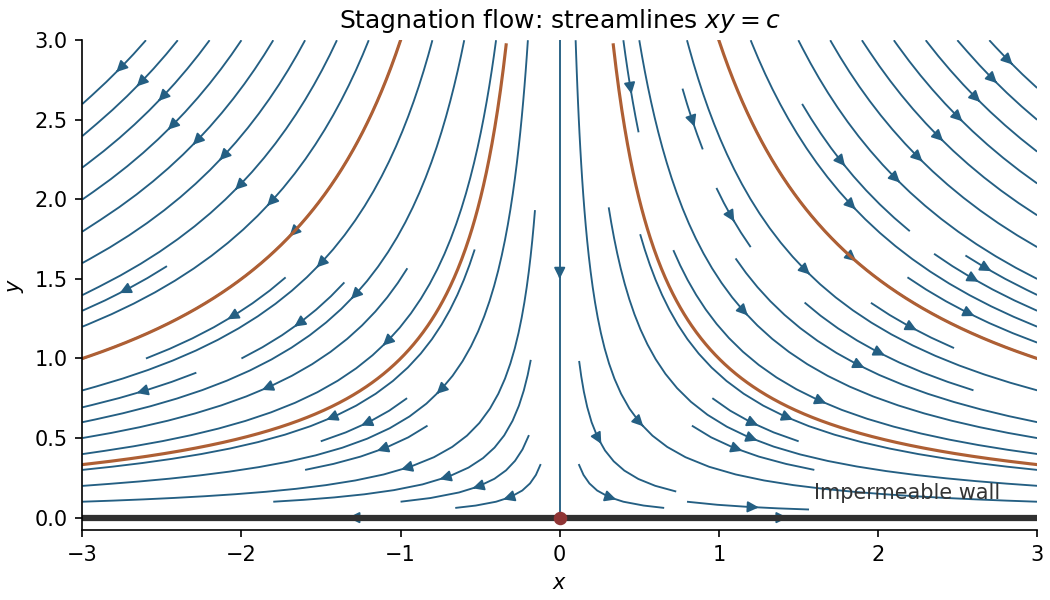

A point vortex of circulation at contributes the complex potential of a two-dimensional potential flow with the stated convention. The method of images places a vortex of the opposite circulation at below the wall, outside the fluid domain. Superposition with the stagnation flow givesFor real , the distances and agree. The two vortex contributions to the stream function are and , which cancel. The background stream function is also zero there, so remains an impermeable streamline. The image changes the boundary condition without introducing another singularity in the upper fluid region.
For a point vortex in stagnation flow beside a wall, a freely moving point vortex is transported by the regular velocity due to the background and its image, excluding its own singular velocity. Differentiate the potential and evaluate that regular part at :Thus the equations of motion areWriting , differentiate the proposed path function:HenceFor initial position , an explicit check is and . Their substitution makes the linear terms in cancel in the path function and also shows that the vortex stays above the wall at every finite time.
Articles by others on the same topic
There are currently no matching articles.