Source: Mathematics Part A release, member
FOI-20210708-1 - Data/4303 (1).pdf, dated 20 June 2012. All nineteen questions and all fifty-nine printed source leaf parts are answered below.Bounded exact-paper checks found no matching advertisement of worked answers. The department's release policy establishes even-year releases back at least to 2016 without specifically confirming this paper; the answer archive requires Oxford SSO. No source parts are skipped.
The degree of a field extension is the dimension of the larger field, regarded as a vector space over the smaller field:The scalar multiplication is the multiplication of restricted to scalars in . A finite extension has finite dimension; otherwise the degree is infinite.
The notation means that is the smallest subfield containing both and , namely the simple field extension generated by . Its elements can be expressed as rational functions in with coefficients in and nonzero denominator.
Write . The element is a root of , so its minimal polynomial over has degree at most two. Since , that degree cannot be one. The degree of the simple field extension equals the degree of the minimal polynomial, givingIn particular form an -basis, so every element is uniquely . This argument also works in characteristic two; separability is not needed for this part.
Choose . Since , the linearly independent elements form a basis of over . Thus there are with . The assumption on the characteristic of a field allows division by two. SetCompleting the square givesAlso , since otherwise would lie in . Because and , these generated subfields agree. The basis representation shows , henceThe square-root generator is obtained by translating an arbitrary generator to remove the linear term of its quadratic relation.
A left group action of on a set is a map , written , satisfyingfor every and , where is the identity element of . In particular each acts by a bijection, whose inverse is the action of .
Given a group action, define . Each is a permutation, since is its inverse. The action law gives, for every ,Thus .
Conversely, given a group homomorphism , put . Since a homomorphism sends the identity to the identity permutation, . AlsoThese are exactly the two group action axioms, so the construction defines the required action.
The three nonzero vectors in are , and . An invertible linear map permutes this three-element set, so part (b) gives a group homomorphismIf a matrix acts trivially on all three vectors, it fixes both basis vectors , so it is the identity matrix. Thus the kernel of a group homomorphism is trivial and is injective.
To count the domain, its first column may be any of the three nonzero vectors. The second column must be outside the two-element span of the first, leaving two choices. HenceAn injection between these finite sets of equal size is surjective, proving
For a positive integer , Euler's totient function counts the integers in a complete residue system that are coprime to :For this is equally the count with . The convention gives .
Let . The map sends to itself becauseApplying it twice returns , so it is a bijection. Reindexing the finite sum by this bijection givesThere is no need to assume that every residue belongs to a pair of distinct elements; the reindexing also handles the fixed point when .
Write . Adding the two equal sums from part (b), and using , givesThereforeEquivalently, the average of the positive reduced residues is , a consequence of their symmetry under reflection about that midpoint.
The positive integers below coprime to areThere are eight, so . Their sum can be grouped into four pairs summing to :This agrees with the formula.
A sigma-algebra on contains , is closed under complements relative to , and is closed under countable unions. Consequently it contains the empty set and is closed under countable intersections. A measure space is a triple with a map satisfying and countable additivity on pairwise disjoint measurable sets.
For the increasing sequence, set and for . These measurable sets are disjoint, their union is , and . Thus countable additivity and finite additivity giveThe identity permits the value infinity; it uses no subtraction of infinite measures. This is continuity from below of a measure.
For a decreasing sequence, the analogous assertion is not always true. On with the counting measure, take . Then , so , whereas for every and their limit is infinity.
A sufficient extra condition for continuity from above of a measure is . Indeed increases to , and the increasing-sequence result givesMore generally it suffices that one of the has finite measure. The missing finiteness assumption is exactly what the counterexample violates.
On any bounded parameter interval , the derivative of the integrand has the integrable majorantThe dominated convergence theorem therefore justifies differentiation under the integral sign at every real , givingUse integration by parts in this absolutely convergent integral, with . Both boundary terms vanish, since the sine is zero at and the Gaussian tends to zero at infinity. HenceIt follows that , or equivalently . This identity holds on all of , including zero. With the supplied Gaussian integral value,The fourth power comes from the printed phase ; the parameter has been differentiated with that phase throughout.
The map is -Lipschitz continuous whenThe same finite Lipschitz constant must work for all pairs of points.
The map is uniformly continuous when, for every , there is a such thatThe choice of may depend on but must be independent of the locations of and .
Given , choose . If , the Lipschitz condition yieldsThis single works for every pair, proving the map is uniformly continuous:
The distance to a set is finite and nonnegative because is nonempty. For and every , the triangle inequality givesTaking the infimum over yields . Interchanging and gives the opposite inequality. Together these implyThus the distance to a set is -Lipschitz continuous. No closedness, compactness or attainment of the infimum was used.
For fixed , the function on is continuous, indeed -Lipschitz continuous by the reverse triangle inequality. A continuous real-valued function on a nonempty compact space attains its minimum by the extreme value theorem. Hence some satisfiesThe metric is symmetric, so this is also . Compactness supplies attainment of the infimum.
A basis of a topology is a family of open subsets such that every open set is a union of members of . Equivalently, for every and , some satisfiesThe empty open set is represented by the empty union.
Define to be all unions of members of , including the empty union. Then and the covering assumption gives . Arbitrary unions of such sets are again unions of basis members.
For two members and , distribute intersection over union:Each intersection is a union of members of by the second assumption, so . Repeating gives closure under all finite intersections. These are precisely the topology axioms. Every belongs to , and every set in is a union of such members by construction. Thus
The product topology on has as a basis all open rectanglesThus a subset is open precisely when, around every , there are open and with . These rectangles cover the product, and their pairwise intersections are rectangles because . Hence they define a topology by part (b).
This is equivalently the coarsest topology making the two coordinate projection maps continuous: the preimages of factor-open sets are the open strips and , whose finite intersections are the basis rectangles.
Let and be countable bases of the two factors. The familyis countable, since the Cartesian product of two countable sets is countable. It is a basis of a topology for the product topology: given a product-open neighbourhood of , choose a contained open rectangle , then basis members with and . Their product contains and is contained in the original neighbourhood. ThereforeIn standard terminology, a finite product of second-countable spaces is second-countable.
The function is continuously differentiable when all its first partial derivatives exist on and are continuous there. Equivalently, has a Fréchet derivative at every point and the map is continuous. For a scalar-valued function,On the open domain, continuous first partial derivatives ensure that this linear expression is the total derivative.
For differentiable maps with compatible domains, the multivariable chain rule isIn Jacobian matrix notation this is matrix multiplication. In particular, if both maps are continuously differentiable, the composition is continuously differentiable. Componentwise,
Let . This is a linear map, hence smooth; composing it with the given function proves that is continuously differentiable by the chain rule. Write for the first partial derivatives, evaluated at . ThenAdding these identities givesGeometrically, , so is constant along every line in the diagonal direction; its derivative in that direction must vanish.
An embedded -dimensional submanifold is locally a coordinate -plane: for every , there are open neighbourhoods , and a diffeomorphism withFor the present setting, and its inverse are continuously differentiable; in the smooth convention both are smooth.
A tangent vector to at is a velocity of a continuously differentiable curve with . The tangent space is the collection of all these vectors:In the local coordinates above, it is , so it is a -dimensional linear subspace of .
The regular level set theorem says that for a map , if has rank on , then is an -dimensional submanifold andHere and the given rank condition makes the zero set a two-dimensional submanifold. It is nonempty because . Part (c) givesConsequentlyThere is also a direct curve proof: , so the entire line through in this direction lies in . Its velocity at zero is exactly the required tangent vector.
For variations vanishing at the endpoints, the Euler-Lagrange equations areDifferentiate the stated energy expression using the chain rule. The acceleration terms cancel, leavingAlong a stationary trajectory the two brackets vanish. Thus , and in the absence of explicit time dependence .
In plane polar coordinates, the squared speed is , so the kinetic energy is . An inverse-square central gravitational force has potential energy proportional to . With the sign convention printed in this paper, write , givingFor attraction to a star of mass , this convention has . Keeping real and signed is essential; no sign is changed in differentiating the printed functional.
Since , , and , the equations of motion areThe second equation gives the conserved angular momentum ; equivalently . The autonomous-functional identity gives a second conserved quantity,This is the total mechanical energy; for attractive gravity the potential contribution is negative because .
Away from a collision, let and . The Lagrangian isDifferentiating with respect to and gives and . ThereforeThe other coordinates give and . Substituting these into the Euler-Lagrange equations yields equal and opposite central forces:Adding the equations shows that the derivative of the total linear momentum is zero, so is constant. For the total angular momentum, the terms vanish, givingThus both stated vectors are conserved quantities.
The total energy is also constant. Define . Since ,Hence . The explicit cancellation establishes energy conservation for an arbitrary smooth separation-dependent potential, throughout any collision-free trajectory.
The interior time-independent Schrödinger equation for a free particle isConfinement by the rectangular infinite well imposes Dirichlet boundary conditions: at and . The wave function is square-integrable and may be normalized to unit probability on the rectangle.
Separation of variables gives products of the one-dimensional well states,The Hamiltonian is the sum of the independent and kinetic-energy operators, so the one-dimensional energies add. Put . ThenFor , increasing gives . The smallest energy with is also , attained at ; all give larger energies. Thus the ground and first three distinct excited energy levels areThe largest listed energy therefore has energy-level degeneracy , since the two product eigenfunctions are linearly independent and no other pair solves .
For a steady flow the local time derivative in the Euler equations vanishes. The vector identityreduces to a gradient when the vorticity is zero. With constant density and gravity , the momentum equation becomesThus on each connected flow region,This is Bernoulli's theorem for a steady irrotational flow: irrotationality makes the same constant apply throughout a connected region, rather than only along an individual streamline.
This is a Rankine vortex. Write . Inside the core the velocity is , soThis is the core value obtained from the inner formula; outside, the given irrotationality makes the vorticity zero. For nonzero , the sharp boundary has different one-sided velocity gradients, so a single classical vorticity is not defined exactly on that edge; the inner trace is the boxed value and the outer trace is zero.
Inside the core, direct differentiation gives . The steady Euler equations therefore give and . Integrating,Outside, , so part (a) givesMatching pressure at the core edge yields . Hence the complete pressure field, up to one additive constant , isBoth the velocity and pressure are continuous at . The inside expression has been derived from the momentum equation because the core is rotational.
The Free surface of a Rankine vortex follows from setting its pressure constant. At a free surface with constant pressure , solve the two pressure expressions from part (b) for . With , this givesSubstituting recovers the required Cartesian form. The two values coincide at , and both radial slopes there equal . The surface is parabolic in the core and approaches height as ; at the centre its depression below is .
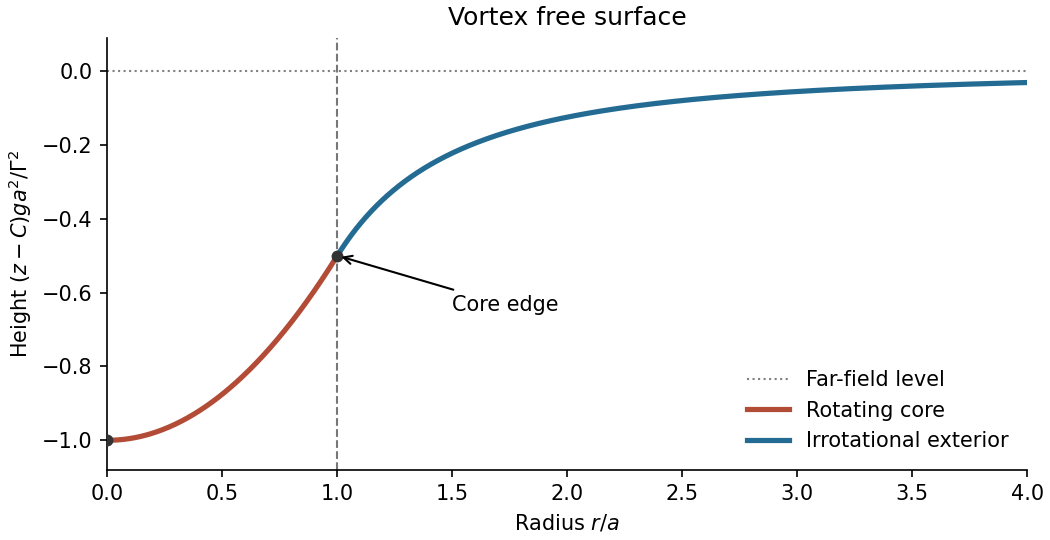
Free surface through the vortex core and irrotational exterior
. Details. Use the convention , with . ThenIndeed , giving velocity components . The streamlines are the level sets of the stream function:For these are rectangular hyperbolas, restricted to . The level consists of the vertical axis and the wall . Directly on the wall the normal velocity is , so it is a streamline. The arrows point down toward the wall and then away from the stagnation point along the wall.
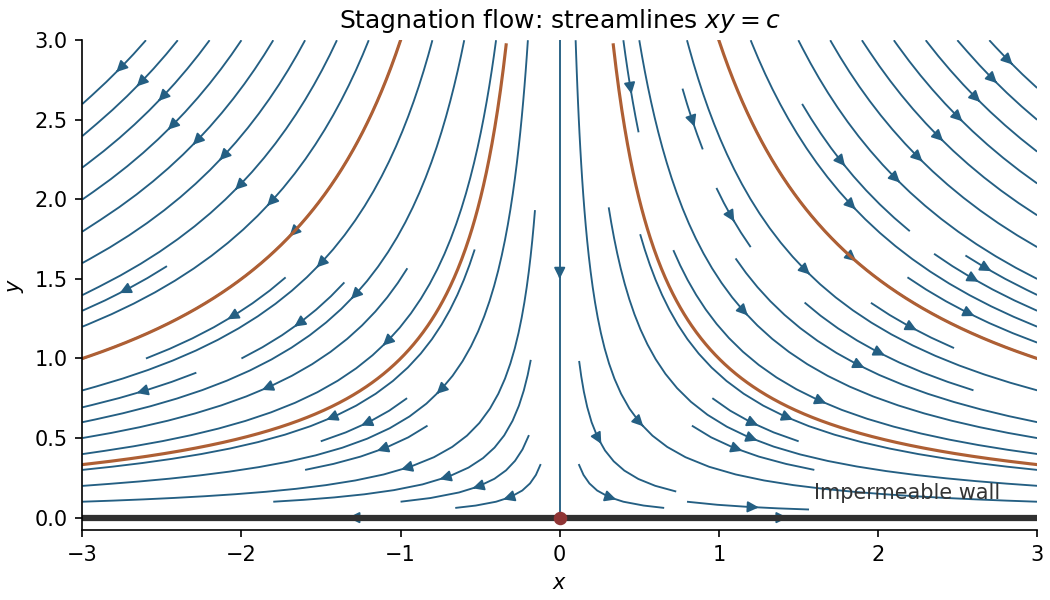


A point vortex of circulation at contributes the complex potential of a two-dimensional potential flow with the stated convention. The method of images places a vortex of the opposite circulation at below the wall, outside the fluid domain. Superposition with the stagnation flow givesFor real , the distances and agree. The two vortex contributions to the stream function are and , which cancel. The background stream function is also zero there, so remains an impermeable streamline. The image changes the boundary condition without introducing another singularity in the upper fluid region.
For a point vortex in stagnation flow beside a wall, a freely moving point vortex is transported by the regular velocity due to the background and its image, excluding its own singular velocity. Differentiate the potential and evaluate that regular part at :Thus the equations of motion areWriting , differentiate the proposed path function:HenceFor initial position , an explicit check is and . Their substitution makes the linear terms in cancel in the path function and also shows that the vortex stays above the wall at every finite time.
The sequence is a Markov chain when the conditional law of its next state depends on the past only through the current state. Precisely, for each history of positive probability and every ,A time-homogeneous chain additionally has transition probabilities independent of , written . The displayed single transition matrix in the subsequent parts specifies this time-homogeneous case.
First the entries must be nonnegative: together with the given , validity of the transition matrix requires and . Every row then sums to one.
The only incoming edge to state is , of probability . If , no other state can reach , so the chain is not irreducible. If , all edges in the directed cyclehave positive probability, since , and . Traversing this cycle connects every state to every other state. Therefore
Within the valid parameter rectangle, suppose and . The chain is then irreducible by part (i). State has a two-step return and a three-step return , both of positive probability. Its period of a state in a Markov chain therefore divides both two and three, hence equals one. Irreducibility gives the same period to every state, so the chain is aperiodic.
If and , every transition goes between the two classes and . Returns must have even length, while has length two. Thus the irreducible chain has period two.
If , the closed communicating class alternates between and . Its states have period two, using the positive two-step returns through . Consequently the chain is not aperiodic, regardless of how the transient state is classified. Combining the cases,
Here the valid parameters lie in the irreducible aperiodic range. The finite-state theorem on convergence to an invariant distribution therefore implies convergence to the unique stationary distribution, independently of the initial state.
Solve and . The equations for states giveHence and . Normalization gives , soStationarity alone would not guarantee convergence of the one-time distributions; irreducibility and aperiodicity justify that final limit.
Articles were limited to the first 100 out of 151 total.
Articles by others on the same topic
There are currently no matching articles.