For a steady flow the local time derivative in the Euler equations vanishes. The vector identityreduces to a gradient when the vorticity is zero. With constant density and gravity , the momentum equation becomesThus on each connected flow region,This is Bernoulli's theorem for a steady irrotational flow: irrotationality makes the same constant apply throughout a connected region, rather than only along an individual streamline.
This is a Rankine vortex. Write . Inside the core the velocity is , soThis is the core value obtained from the inner formula; outside, the given irrotationality makes the vorticity zero. For nonzero , the sharp boundary has different one-sided velocity gradients, so a single classical vorticity is not defined exactly on that edge; the inner trace is the boxed value and the outer trace is zero.
Inside the core, direct differentiation gives . The steady Euler equations therefore give and . Integrating,Outside, , so part (a) givesMatching pressure at the core edge yields . Hence the complete pressure field, up to one additive constant , isBoth the velocity and pressure are continuous at . The inside expression has been derived from the momentum equation because the core is rotational.
The Free surface of a Rankine vortex follows from setting its pressure constant. At a free surface with constant pressure , solve the two pressure expressions from part (b) for . With , this givesSubstituting recovers the required Cartesian form. The two values coincide at , and both radial slopes there equal . The surface is parabolic in the core and approaches height as ; at the centre its depression below is .
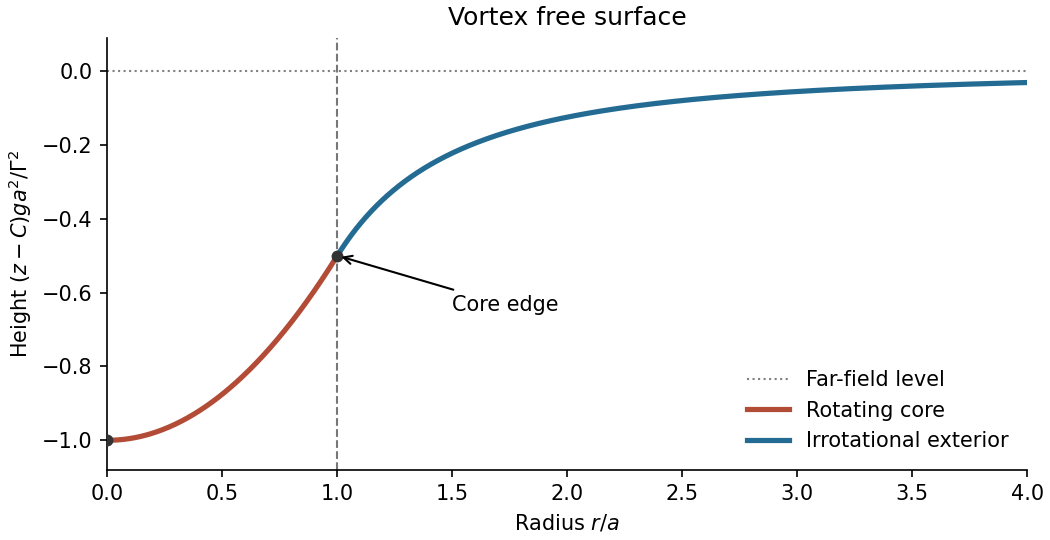
Free surface through the vortex core and irrotational exterior
. Details. Use the convention , with . ThenIndeed , giving velocity components . The streamlines are the level sets of the stream function:For these are rectangular hyperbolas, restricted to . The level consists of the vertical axis and the wall . Directly on the wall the normal velocity is , so it is a streamline. The arrows point down toward the wall and then away from the stagnation point along the wall.
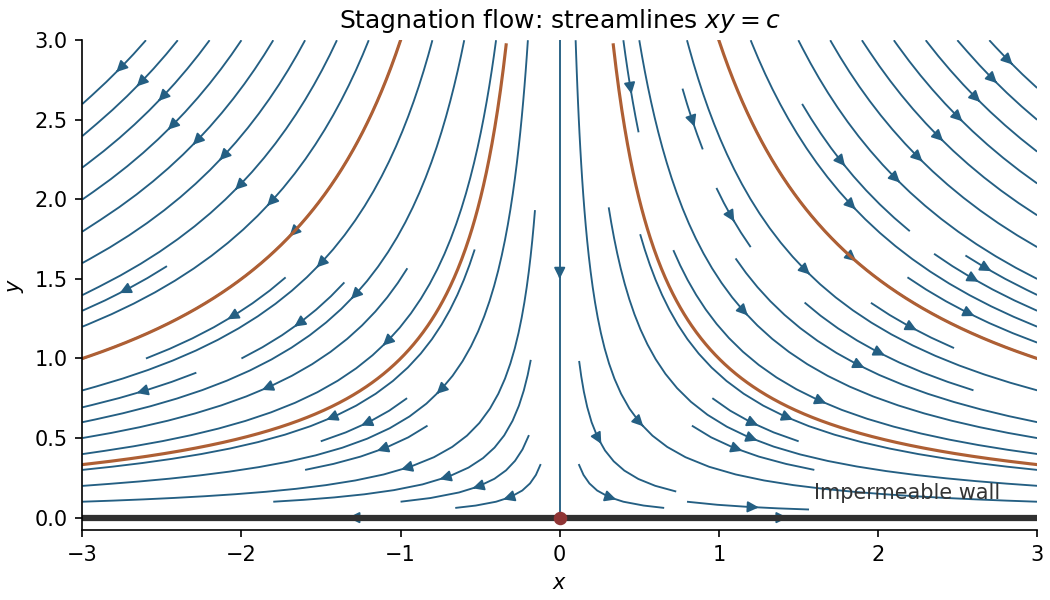


A point vortex of circulation at contributes the complex potential of a two-dimensional potential flow with the stated convention. The method of images places a vortex of the opposite circulation at below the wall, outside the fluid domain. Superposition with the stagnation flow givesFor real , the distances and agree. The two vortex contributions to the stream function are and , which cancel. The background stream function is also zero there, so remains an impermeable streamline. The image changes the boundary condition without introducing another singularity in the upper fluid region.
For a point vortex in stagnation flow beside a wall, a freely moving point vortex is transported by the regular velocity due to the background and its image, excluding its own singular velocity. Differentiate the potential and evaluate that regular part at :Thus the equations of motion areWriting , differentiate the proposed path function:HenceFor initial position , an explicit check is and . Their substitution makes the linear terms in cancel in the path function and also shows that the vortex stays above the wall at every finite time.
Articles by others on the same topic
There are currently no matching articles.