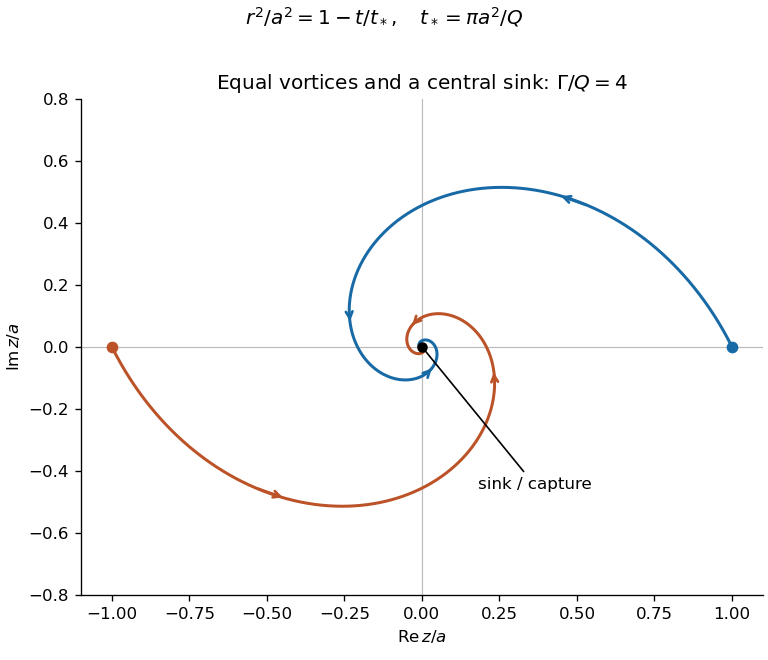
Use the complex potential of a two-dimensional potential flow convention , for which . A positive circulation is counterclockwise. The two point vortices and the two-dimensional point sink giveBranch choices change additive constants, not the local velocity field. A vortex is transported by the nonsingular velocity due to the other vortex and the sink; its own singular term is omitted. At this givesThe other vortex follows by symmetry. Put , with and . Multiplication by givesFor , integration yieldsEquivalently, with ,The curves obey , so they are logarithmic spirals. At , both vortices reach the sink at the origin. For nonzero circulation they make infinitely many turns in that finite time; for zero circulation they approach radially. The point-vortex evolution becomes singular at capture, so the formula does not define a regular continuation through the event.
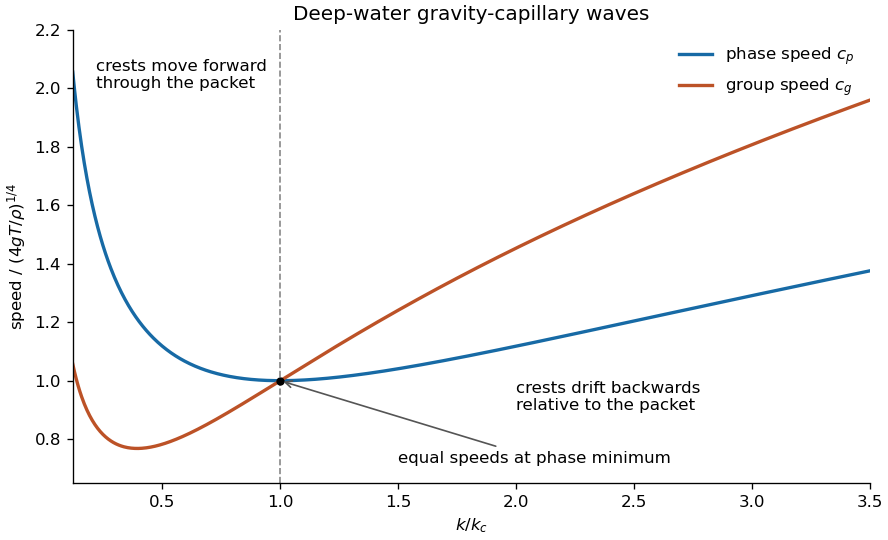
Put and take the positive-frequency branch for . The phase velocity and group velocity areSince the square root is increasing, minimizing is equivalent to minimizing . Its derivative is , which changes sign from negative to positive atThe phase speed diverges at both positive endpoints and , so this stationary point is its global minimum. At , , givingThe relative speed is especially transparent:A narrow wave packet moves with , while its crests move with . For , : crests move forward through the packet, from its rear towards its front. For , : crests drift backwards relative to the packet, although both absolute velocities are positive. At the leading-order relative drift vanishes. This is the minimum phase speed of a gravity-capillary wave.


Articles by others on the same topic
There are currently no matching articles.