For a fixed centre , the triangle inequality gives , so the distance-to-centre function is continuous. Its preimage of is the closed ball, hence is closed. Since that closed set contains the corresponding open ball, it contains its closure:Here the bar on the right denotes a closed ball, while the bar on the left denotes closure.
The condition gives the closed squareIts four edges and corners are included, as shown in the left panel of the figure below.
Intersect the ambient balls with . All points on the vertical arm have distance at least from the centre, so the open ball isThe closed ball also contains the endpoints of that segment and the lower half of the vertical arm:The closure of the open ball in is just . Both endpoints are limits of points in the open segment, whereas a vertical point of positive height has a small enough neighbourhood disjoint from it. Thus every point with witnesses strict containment.
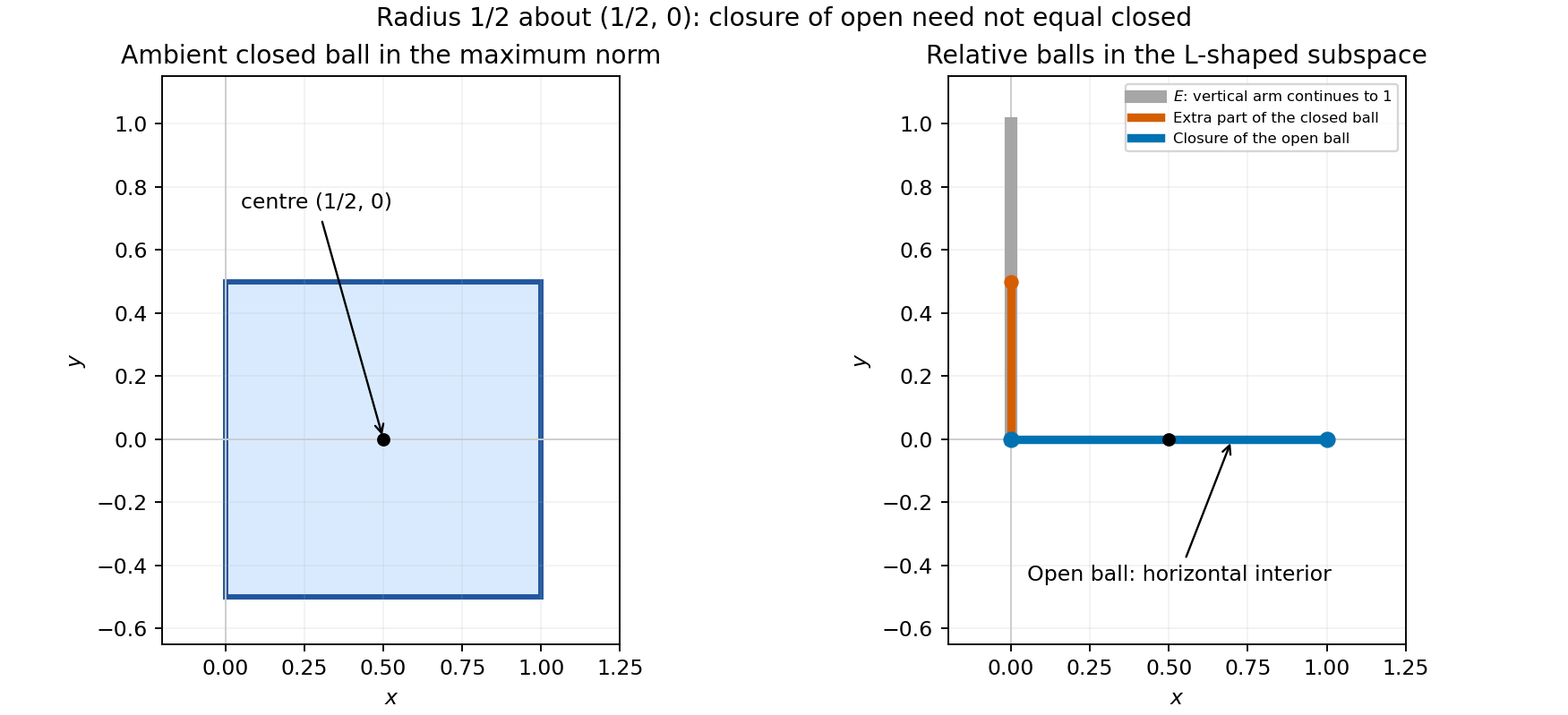
Ambient and relative maximum-norm balls
. The square on the left is the ambient closed ball. On the right, the open ball is the horizontal segment without its endpoints; its closure omits the additional vertical part of the relative closed ball. Details.
Take radius . Part (a) gives one containment. For a point with , define for . Then , while as . Hence every point of the closed ball belongs to the closure of the open ball, proving equality. Positive radius is the standard open-ball convention; a zero-radius open ball would be empty.
In the usual real line, take for . The sets are closed, nonempty and nested, but no real number belongs to all of them.
Every is closed in the Hausdorff ambient space, because it is compact. Inside the compact space , these sets have the finite intersection property: a finite intersection equals the member with largest index and is nonempty. If the total intersection were empty, their open complements would cover ; a finite subcover would contradict that property. Thus
If no were contained in , the sets would be nonempty, nested and compact, since each is closed in . Part (i) would supply a point in , belonging to every but not to , a contradiction. Thus some , and nesting gives the same containment for every later index.
The claim is false for an arbitrary codomain . Let with its usual topology, let be the Sierpiński space with open sets , and define , for . This is a continuous map: the only nontrivial open-set preimage is , which is relatively open in .
The sets are nonempty, nested and compact. ButThus the extra generality in the printed codomain changes the assertion materially. This is the failure of nested compact image intersection without closed fibers.
If the codomain is a T1 space, the continuous images of nested compact intersections theorem does give the desired equality. The forward inclusion holds for every map. For the reverse, take and set . The fibers are closed by continuity and the T1 property, so the are nested nonempty closed subsets of the compact set . The finite intersection property gives , with . It is enough that these particular fibers be closed in ; a Hausdorff codomain, as in the native self-map formulation, is a familiar sufficient assumption.
Articles by others on the same topic
There are currently no matching articles.