The original Feynman diagrams below distinguish elementary weak and electromagnetic vertices from an effective hadronic vertex. fermion arrows track fermion number; time runs left to right.
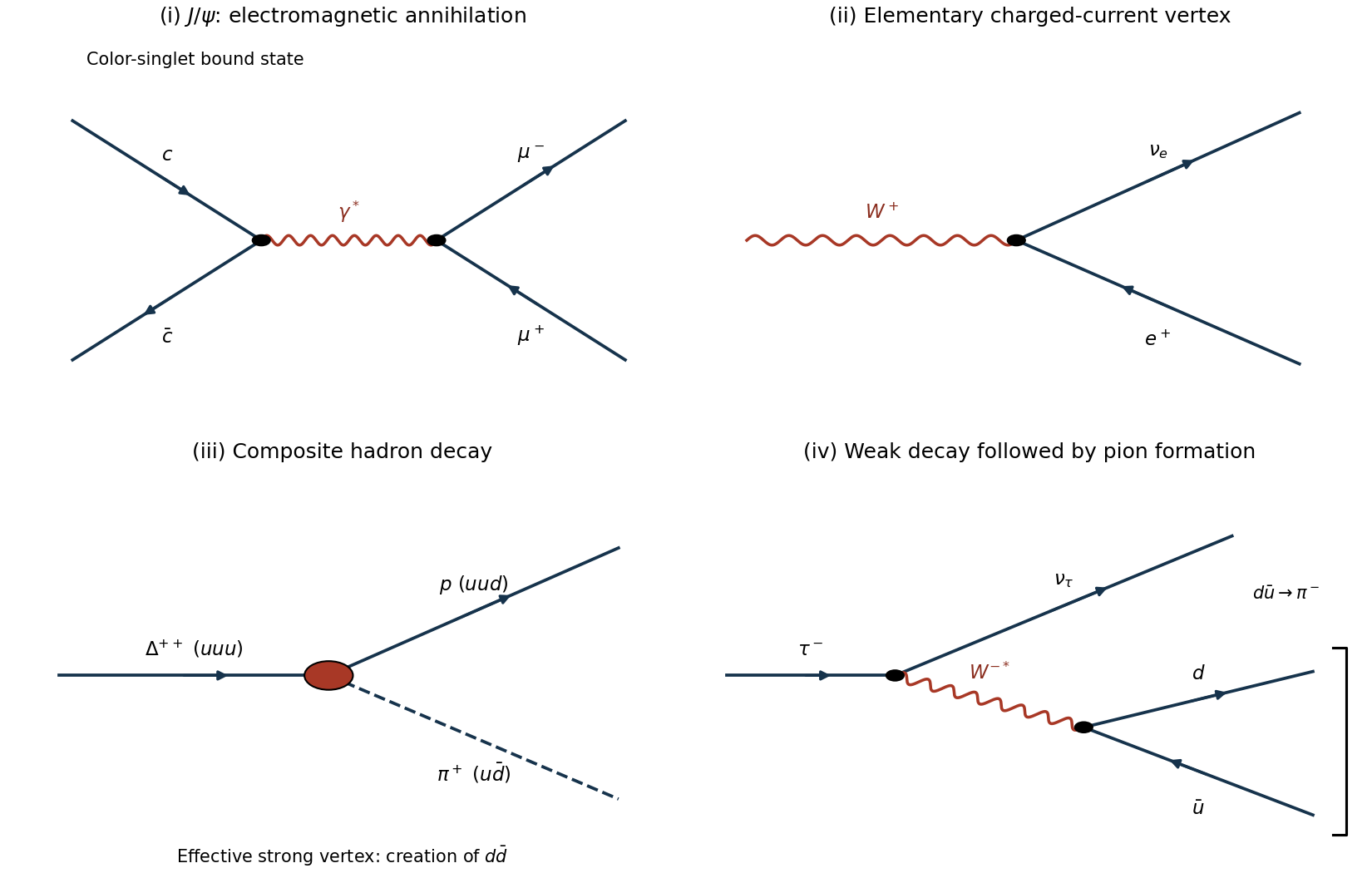
Four decay channels and their dominant interactions
. Original diagrams. Panel (iii) is an effective strong hadronic vertex; panel (iv) brackets the quark pair forming the pion. Details.
The dominant interaction is electromagnetic. The color singlet charm-anticharm component of the J/psi meson annihilates through a virtual photon, which creates a muon and an antimuon:Panel (i) shows the two electromagnetic vertices. Vector quantum numbers allow the one-photon channel. A Z boson contribution is negligible at this mass scale; a single gluon cannot connect a color singlet initial state to colorless leptons. The dominant interaction for this specified final state need not dominate the meson's total decay width.
This is a weak charged-current decay. Panel (ii) has one vertex. The outgoing Positron and electron neutrino have total charge and cancelling lepton numbers. The W boson is on shell here; a second virtual boson is unnecessary.
The dominant interaction is strong. At hadron level, panel (iii) is an effective hadronic vertex for . The initial constituents rearrange into and after creation of a pair:One original up quark enters the charged pion; the other two join the new down quark in the proton. Gluon-induced pair creation supplies the quark-flow diagram interpretation. This is nonperturbative hadronization: the effective hadronic vertex does not claim that one elementary perturbative quark graph calculates its width. Charge, baryon number and net quark flavor are conserved.
The dominant interaction is weak. In panel (iv),The quark vertex carries the Cabibbo-Kobayashi-Maskawa matrix factor . The down quark and anti-up quark form a color singlet pion. The pion bracket represents its bound-state matrix element, conventionally specified by the pion decay constant; it is not an additional weak vertex. The neutrino carries the initial tau lepton number.
Articles by others on the same topic
There are currently no matching articles.