Original source: Released original, physical PDF pages 403–407. All four questions and every option are covered.
In the nuclear shell model, a level with total angular momentum has substates for each nucleon species. The first three levels accommodate protons or eight neutrons. nuclear pairing makes a filled shell or a pair of like nucleons contribute , and an orbital has spatial parity .
For oxygen-17, eight protons and eight neutrons form a closed core; the remaining neutron occupies , so . For nitrogen-15, eight neutrons close their shell, while the seventh proton occupies . Equivalently it is a proton hole relative to the closed eight-proton shell, giving . beryllium-10 is an even-even nucleus; pairing its four protons and six neutrons gives .
boron-10 needs an additional qualification. The fifth proton and fifth neutron each occupy . addition of angular momentum permitsThe experimentally correct ground-state assignment is , corresponding to aligned unpaired contributions in this simple description. However, one-particle level ordering alone does not select it over the other couplings: their splitting requires the nuclear residual interaction. Assuming a preference for the aligned proton-neutron coupling gives the intended prediction; without that assumption, the strictly deducible result is the allowed positive-parity multiplet. The evaluated ground state is , with a level above it.[ref]
Energy levels of boron-10 by TUNL (2004). Table 10.18, ground state and first excited state, physical page 1
Use natural units and write the common light constituent quark mass as , and the strange one as . For two spin one-half constituents,The relative hyperfine contributions are and . Absorb their normalization and spatial overlap into pair-dependent parameters . The meson hyperfine mass splitting model givesA common color-magnetic coefficient gives , but its numerical value is not needed.
In the specified Eta octet state used for the eta meson the light-flavor probability is and the strange-flavor probability . Assuming a flavor-diagonal mass operator,Inserting the five mass expressions into the proposed combination makes the coefficient of equal to . Those of are . ConsequentlyThis is an identity within the assumed mass operator and octet flavor assignment. It is not an exact relation among measured masses: eta mixing and additional spin-independent binding effects are outside those assumptions.
For neutrino-electron elastic scattering, work in the laboratory frame with a stationary electron and a massless incoming neutrino of energy . If the electron receives kinetic energy and momentum , its relativistic energy-momentum relation givesconservation of energy fixes the outgoing neutrino energy to , and conservation of momentum fixes its momentum to . Its zero mass therefore requiresSubstitution and cancellation giveFor , this requires ; squaring must not introduce a backward-electron branch. Squaring, cancelling and solving givesThe expression increases with on the physical interval . Maximum transfer occurs for a forward electron and a backward outgoing neutrino:The remaining is carried by the neutrino. An elastic collision cannot transfer the entire incident energy to a free massive electron.
A muonic atom binds a negative muon in the nuclear Coulomb potential. The muon is a spin one-half lepton with the electron's charge but about 207 times its mass. For a point nucleus of mass and charge , the reduced mass and nonrelativistic hydrogenic scales, with fine-structure constant , areFor a heavy nucleus , giving a radius roughly of the corresponding electronic radius and transition energies roughly 207 times larger. For hydrogen, nuclear recoil matters: gives and rather than the infinite-nuclear-mass value about .
A slowed negative muon is captured into an excited orbit and undergoes a radiative cascade, ejecting atomic electrons and emitting muonic X-rays. Inner orbits penetrate the nuclear charge distribution, particularly at large . Replacing a point charge by an extended charge makes the central attraction less singular and shifts states with substantial nuclear overlap. Measured transition energies consequently constrain the nuclear charge radius. Sensitivity is particularly strong for states, whose contact density scales as .
An instructive experiment is Randolf Pohl's team's muonic-hydrogen spectroscopy. A stopped-muon target prepared a metastable population; a tunable pulsed laser drove a transition, followed by a detectable X-ray. Scanning laser frequency located a resonance whose interpretation included the proton finite-size contribution to the Lamb shift. Delayed detection selected the long-lived population against prompt cascade backgrounds. Laser-off or detuned measurements provide a background control; energy and time selection alone would not establish a laser-induced resonance.[ref]
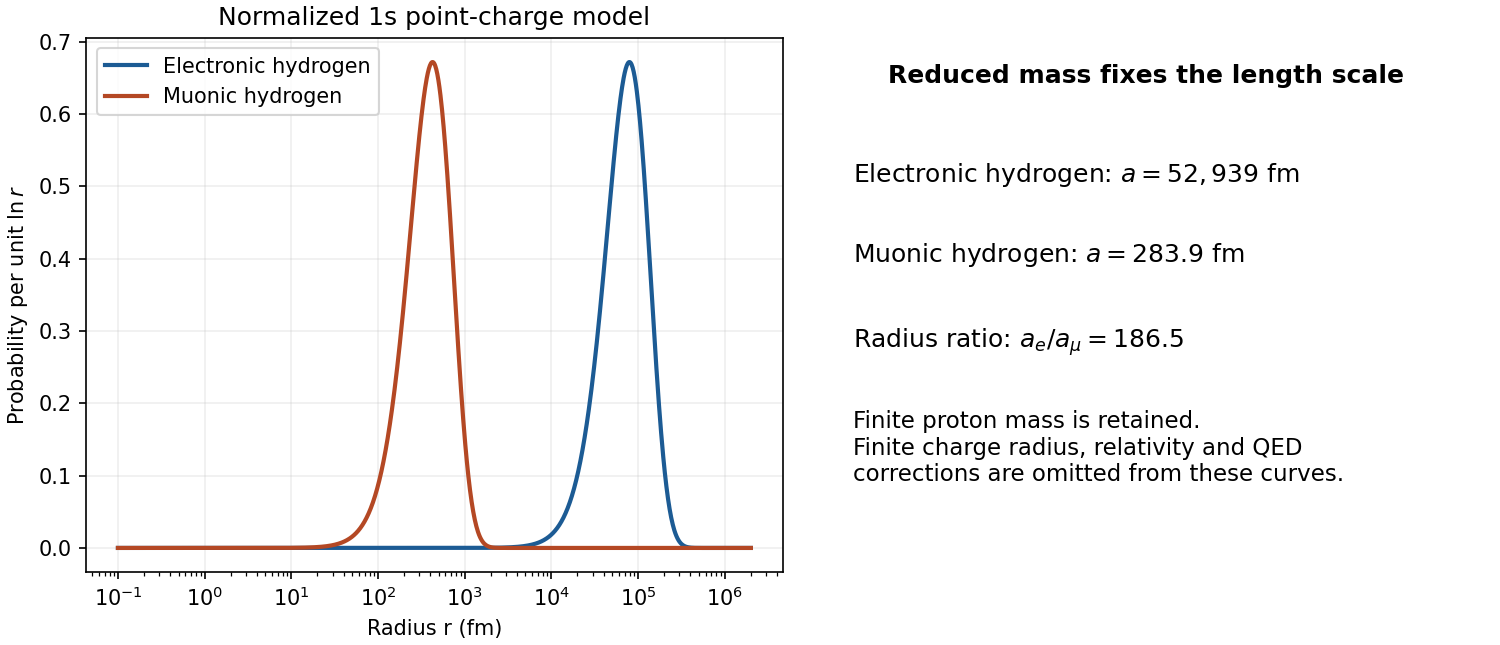
reduced mass changes the orbital scale and nuclear-size sensitivity
. Original calculated hydrogenic radial probabilities, plotted against physical radius with probability measured per logarithmic interval. The Bohr radii are stated alongside; these are point-nucleus model curves, not measured nuclear densities. Details.
Extracting a radius requires quantum electrodynamics, including vacuum polarization, recoil and nuclear-structure corrections. A free muon decays on a microsecond timescale; a bound negative muon can instead undergo muon capture, for example . These processes limit observation time. In heavy atoms, relativistic motion and nuclear overlap make the simple Bohr formulas only qualitative. Muonic spectroscopy converts a smaller orbital scale into enhanced sensitivity to nuclear charge structure, provided atomic and nuclear corrections are controlled.
The nuclear Fermi gas model treats protons and neutrons as two species of spin one-half fermions moving approximately independently in a confining nuclear mean field. At a temperature small compared with their Fermi temperature, the Pauli exclusion principle fills the lowest available momentum states. It does not allow all nucleons to sit at zero momentum.
For species , two spin states occupy each momentum-space cell . Counting a filled sphere giveswhere . The Fermi energy is measured from the mean-field well bottom; it need not equal the energy needed to remove a nucleon into vacuum. Occupied-state averaging givesEven at zero temperature there is kinetic energy and degeneracy pressure. As an explicitly illustrative input, total density and give and . These numbers illustrate the formula; they are not additional data supplied by the paper.
Separate proton and neutron seas explain a kinetic contribution to nuclear symmetry energy. At fixed , put and define at . ThenIncreasing one species' population raises its Fermi surface and costs energy, favoring similar populations before electrostatic and interaction terms are included.
pauli blocking suppresses collisions deep in a filled sea because scattering needs unoccupied final states. An energetic external probe can knock a nucleon into an empty state and reveal its initial Fermi motion, making the model useful for broad inclusive scattering distributions. A finite surface can be approximated using a position-dependent nuclear mean field.
A free gas cannot produce nuclear binding or saturation: those require an attractive interaction and its density dependence. The smooth gas picture also omits discrete nuclear shells, nuclear spin-orbit splitting, nuclear pairing, short-distance correlations and deformation. It cannot assign all ground-state spins from a momentum sphere. Its useful prediction is the scale and occupancy of nucleon motion, with a surrounding mean field supplied separately.
The Standard Model is a gauge theory with group , matter quarks and leptons, gauge bosons and a Higgs field. It combines Quantum chromodynamics with the electroweak interaction. Its successes do not make its field content a complete account of nature. Established missing phenomena should be distinguished from theoretical questions about its parameters.
neutrino oscillation demonstrates nonzero mass-squared differences and mixing of flavor states. The minimal renormalizable Standard Model has no right-handed neutrino and no neutrino mass term. The atmospheric experiment compared zenith-angle distributions of muon-like and electron-like events in a large water Cherenkov detector. A direction-dependent muon-neutrino deficit, with different path lengths through Earth and comparison samples, discriminated against a uniform flux-normalization error.[ref]
Evidence for oscillation of atmospheric neutrinos by Y. Fukuda and others. Abstract and zenith-angle distributions, Physical Review Letters 81, pp. 1562–1567 (1998)
One extension adds right-handed neutrinos and small Dirac Yukawa couplings; another has a Majorana mass term and seesaw mechanism, with light eigenvalue of order . Oscillations alone do not decide whether neutrinos are Majorana neutrinos.dark matter is inferred from gravitational observations such as galactic motions and gravitational lensing; Standard Model particles do not supply the required dominant cold component. Active neutrinos contribute some matter but cannot constitute all the cold dark matter. A new stable weakly interacting particle, an axion, or other hidden-sector states are possible explanations, with different scattering, production and astrophysical signals. Dark-matter evidence does not identify a particular new particle. The institutional account distinguishes gravitational evidence from proposed particle candidates.[ref]
Dark matter by CERN. Gravitational evidence and candidate-particle discussion
The matter-antimatter imbalance poses a different problem. Dynamical baryogenesis needs Sakharov conditions, including baryon-number violation, CP violation and departure from thermal equilibrium. Although the Standard Model contains relevant ingredients in principle, they do not generate the observed asymmetry in its conventional thermal history with measured parameters. Additional CP phases, a stronger electroweak transition, or leptogenesis from heavy Majorana neutrinos are possible extensions. Each needs a quantitative mechanism.
gravity is absent as a dynamical quantum interaction, motivating quantum gravity and unification. The hierarchy problem asks why the Higgs mass scale is small compared with much higher scales when scalar masses receive sensitive quantum corrections. supersymmetry can cancel particular contributions between partner fields if its breaking pattern is suitable; compositeness gives another interpretation of the Higgs sector. Neither motivation proves that the corresponding new particles exist. The Strong CP problem asks why the allowed QCD CP-violating parameter is so small; an axion mechanism is one possible answer.
A grand unified theory embeds the separate gauge factors in a larger group and can relate couplings or fermion representations, sometimes predicting proton decay. Its tests differ from dark-matter or neutrino-mass searches. A useful extension must explain a specified deficiency, preserve successful low-energy predictions and supply distinguishable experimental consequences. Attractive new symmetries alone are not evidence.
The original Feynman diagrams below distinguish elementary weak and electromagnetic vertices from an effective hadronic vertex. fermion arrows track fermion number; time runs left to right.
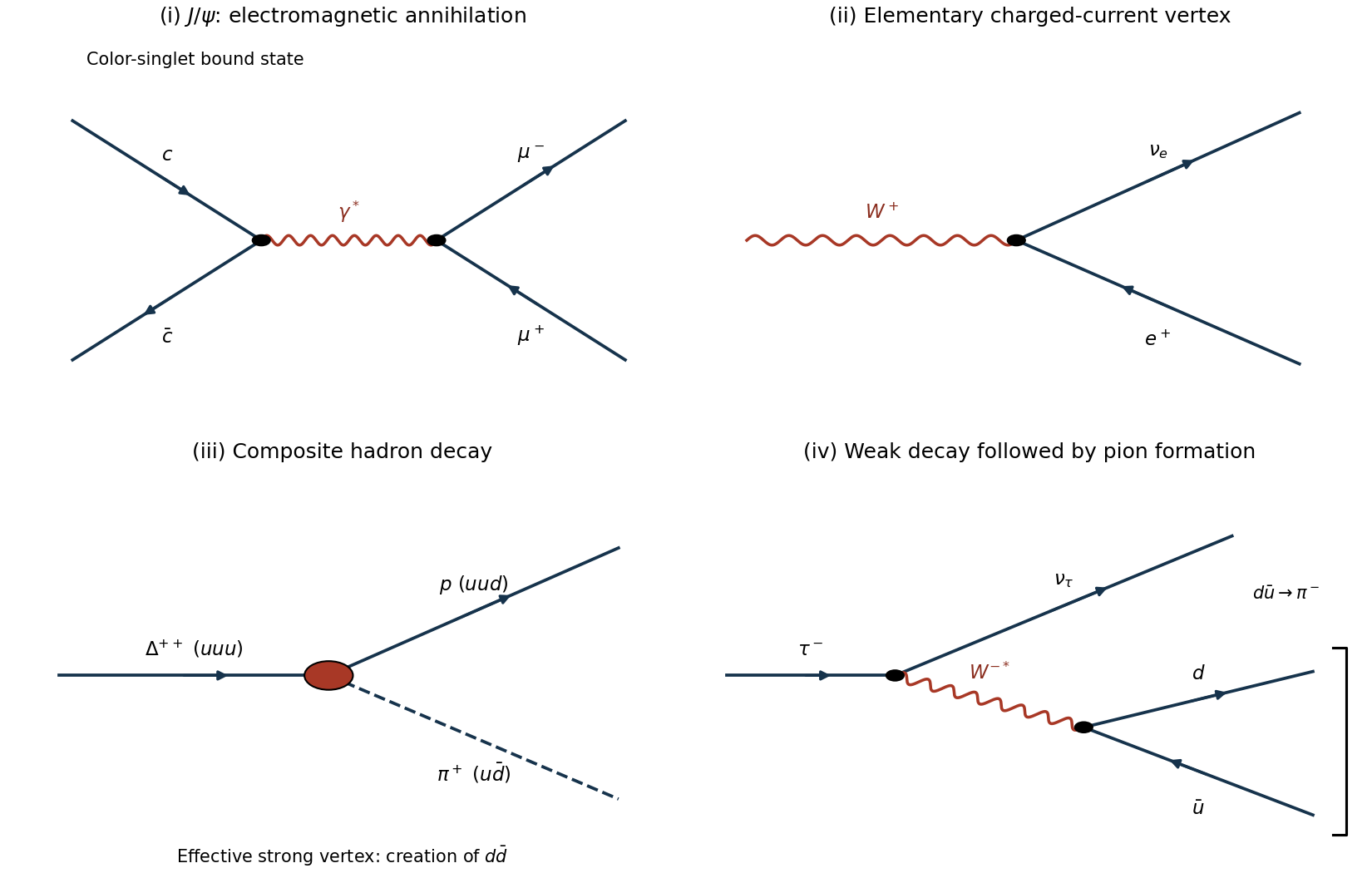
Four decay channels and their dominant interactions
. Original diagrams. Panel (iii) is an effective strong hadronic vertex; panel (iv) brackets the quark pair forming the pion. Details.
The dominant interaction is electromagnetic. The color singlet charm-anticharm component of the J/psi meson annihilates through a virtual photon, which creates a muon and an antimuon:Panel (i) shows the two electromagnetic vertices. Vector quantum numbers allow the one-photon channel. A Z boson contribution is negligible at this mass scale; a single gluon cannot connect a color singlet initial state to colorless leptons. The dominant interaction for this specified final state need not dominate the meson's total decay width.
This is a weak charged-current decay. Panel (ii) has one vertex. The outgoing Positron and electron neutrino have total charge and cancelling lepton numbers. The W boson is on shell here; a second virtual boson is unnecessary.
The dominant interaction is strong. At hadron level, panel (iii) is an effective hadronic vertex for . The initial constituents rearrange into and after creation of a pair:One original up quark enters the charged pion; the other two join the new down quark in the proton. Gluon-induced pair creation supplies the quark-flow diagram interpretation. This is nonperturbative hadronization: the effective hadronic vertex does not claim that one elementary perturbative quark graph calculates its width. Charge, baryon number and net quark flavor are conserved.
The dominant interaction is weak. In panel (iv),The quark vertex carries the Cabibbo-Kobayashi-Maskawa matrix factor . The down quark and anti-up quark form a color singlet pion. The pion bracket represents its bound-state matrix element, conventionally specified by the pion decay constant; it is not an additional weak vertex. The neutrino carries the initial tau lepton number.
Assume allowed beta decay, so the leading matrix element has negligible lepton-momentum dependence. Neglect nuclear recoil and neutrino mass. Let be the kinetic energy available to the electron and antineutrino, , and . The neutrino energy and momentum magnitude are .
Fermi's golden rule weights accessible final states. After angular integration, the momentum-space factors are and . The energy-conserving Dirac delta function removes the neutrino integral:The constant includes the allowed nuclear matrix element, weak-coupling and angular factors. Including the usual Fermi function for electron-nucleus Coulomb distortion givesFor the kinetic-energy spectrum, instead yieldsThe two distributions differ by a Jacobian; forgetting it changes the shape.
A pure fifth-power law additionally neglects electron mass and Coulomb distortion and keeps the nuclear matrix element fixed. Then , , andTwo momentum powers come from each final particle and one from the remaining integration. This is the origin of the Sargent rule. Exact dependence requires the relativistic-electron, constant-matrix-element limit. For , the same approximation without Coulomb distortion has and instead scales as . Forbidden-transition factors, nuclear-structure changes and Coulomb distortion also modify the simple law.
The negative muon emits a virtual and becomes a muon neutrino; the boson creates an electron and an electron antineutrino:Both vertices are weak charged currents.
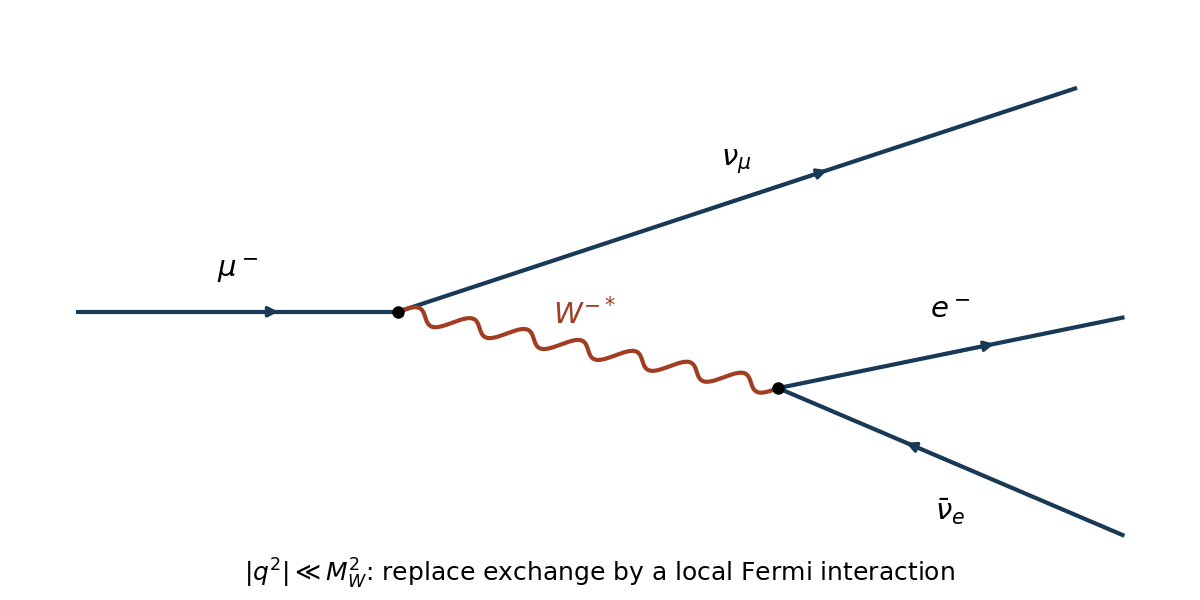

Typical transfers satisfy , so the propagator factor expands as plus small corrections. Contracting this short-distance exchange produces the local Fermi interaction, with strength contained in . This effective description does not assume that the real W mass vanishes. The same treatment applies to leptonic tau decays with the relevant masses changed.[ref]
Review of Particle Physics by Particle Data Group (2022). Muon Decay Parameters, §57.1 introduction and §57.2
In GeV units, and . ThusThe modest difference from a precision experimental lifetime is expected from the rounded mass and omitted radiative and final-electron-mass corrections.
Use an inclusive spectator model: one heavy constituent decays through the Fermi interaction, and sum the open charged-current channels. In weak-decay channel counting, each massless final lepton pair gives basic widthA quark pair contributes three colors multiplied by its squared Cabibbo-Kobayashi-Maskawa matrix element. Do not multiply by three just because the initial quark has three colors: its lifetime is the width of one initial state, averaged over initial color when appropriate. Define
For the tau lepton, two leptonic channels contain an electron or a muon; light hadronic channels have or . ThereforeNo charmed hadron can be produced: the lightest charmed meson exceeds the tau mass. [ref]
Review of Particle Physics by Particle Data Group (2022). D-zero and D-plus listings, physical page 1 of each, masses 1864.84 and 1869.66 MeV
The supplied charm-quark parameter is not a free asymptotic final-particle mass. The leading count neglects electron and muon masses and light hadronic threshold effects.For the charm quark, and dominate. The emitted current has two light leptonic channels and the same light hadronic channels as above; a tau cannot be produced:
For the bottom quark, retain with the supplied and neglect the much smaller channel. The emitted current can produce three lepton flavors and two up-type quark families, with three colors for each family. In particular is open at the given masses, although suppressed by phase space. Counting each open channel as massless givesSetting Cabibbo sums to one recovers the familiar counts , and . Despite its larger mass, the bottom quark is slowed by its small interfamily mixing factor.
These are leading estimates rather than precise lifetimes of free quarks. confinement makes charm and bottom observable in hadrons, whose lifetimes involve spectator interactions, Quantum chromodynamics corrections and bound-state effects. mass corrections are significant for bottom: even the single-charm channel with massless leptons has the three-body weak-decay mass correctionTau and double-charm channels have different suppressions, so multiplying the entire width by this one factor is inconsistent. Accurate hadron lifetimes require those channel-dependent factors and hadronic dynamics; the exercise supports the explicitly stated leading counts.
An S wave has and positive parity. The deuteron's therefore requires a spin-one-half triplet state, . The two-nucleon isospin description makes this the antisymmetric channel. Its existence proves sufficient attraction to bind in the -dominated channel.
A spin one-half pair could also form . The absence of a bound deuteron indicates that the singlet interaction does not bind, not that it is everywhere repulsive. Together with triplet binding, this shows that a spin-independent central attraction is insufficient. No radial excited bound level also constrains the strength and range: the attraction supports only a shallow low-energy bound state.
For identical neutrons or protons, two-particle isospin has and is symmetric. At even , spatial exchange is symmetric, so the Pauli exclusion principle requires an antisymmetric spin state, . A low-energy or pair cannot occupy the deuteron's channel. With approximate charge independence of nuclear forces, their singlet strong interaction corresponds to the unbound neutron-proton singlet; proton-proton electrostatic repulsion further disfavors binding. There is no bound dineutron or diproton in these physical low-energy channels. The inference uses charge independence and singlet-channel behavior; the deuteron's quantum numbers alone do not constrain every imaginable potential.
The nuclear binding energy is the separated-nucleon rest energy minus the bound-state rest energy. Consistent nuclear masses avoid atomic-electron bookkeeping:It is positive because the bound deuteron has lower total energy.
In a pure stretched state both spins point along the total angular momentum, with no orbital contribution. The nuclear magnetic moment would beThe measured differs. More decisively, a pure S wave spatial state is isotropic and has zero electric quadrupole moment. Its nonzero value requires a nonspherical component of the quantum charge distribution.
Positive parity allows even ; coupling to permits and . The state contains a deuteron D-state admixture:with radial wavefunctions implicit. A nuclear tensor force couples the orbital components. The quadrupole moment involves their interference as well as a D-state contribution, making it sensitive to a small admixture. This is a quantum angular correlation, not two particles permanently fixed in space.
In the nonrelativistic one-body magnetic-moment approximation,The D-state coupling has and at ; the proton supplies approximately half the relative orbital magnetic moment. ThusThe robust conclusion is a predominantly S wave state with a small tensor-induced D wave component. The 4% estimate is model dependent: exchange currents and other corrections also affect the magnetic moment, and a wavefunction component probability is not itself a uniquely measured observable.[ref]
Modern Theory of Nuclear Forces by Evgeny Epelbaum and others. §I.F, Observables and not-so observable quantities; §II.B, spin-dependent nuclear interactions
Use the relative coordinate and reduced massTake inside, outside, and . For , define inverse lengthsThe radial equation becomes inside and outside. Finiteness of the full wavefunction at the origin imposes ; normalizability excludes the growing exterior exponential. HenceContinuity of was built in. Continuity of its derivative at the finite step givesFor the nodeless ground state, selects the first branch. Higher roots would correspond to different wells with more bound states. Normalization is
For the requested weak-binding estimate, makes . On the first branch , and . The leading threshold estimate isThis is the zero-binding threshold of a spherical square well, so nonzero positive binding needs a depth above it. Corrections start at order , not just at order : setting gives and
The actual numbers permit an accuracy check: and are not extremely small. Retaining the exterior decay, solveThis gives , and the full square-well result isNeglecting only in the interior kinetic relation while retaining the measured exterior decay instead estimates . These approximations should be identified: 23.2 MeV is the leading threshold, whereas matching the supplied nonzero binding requires a boundary phase shift and a deeper well.
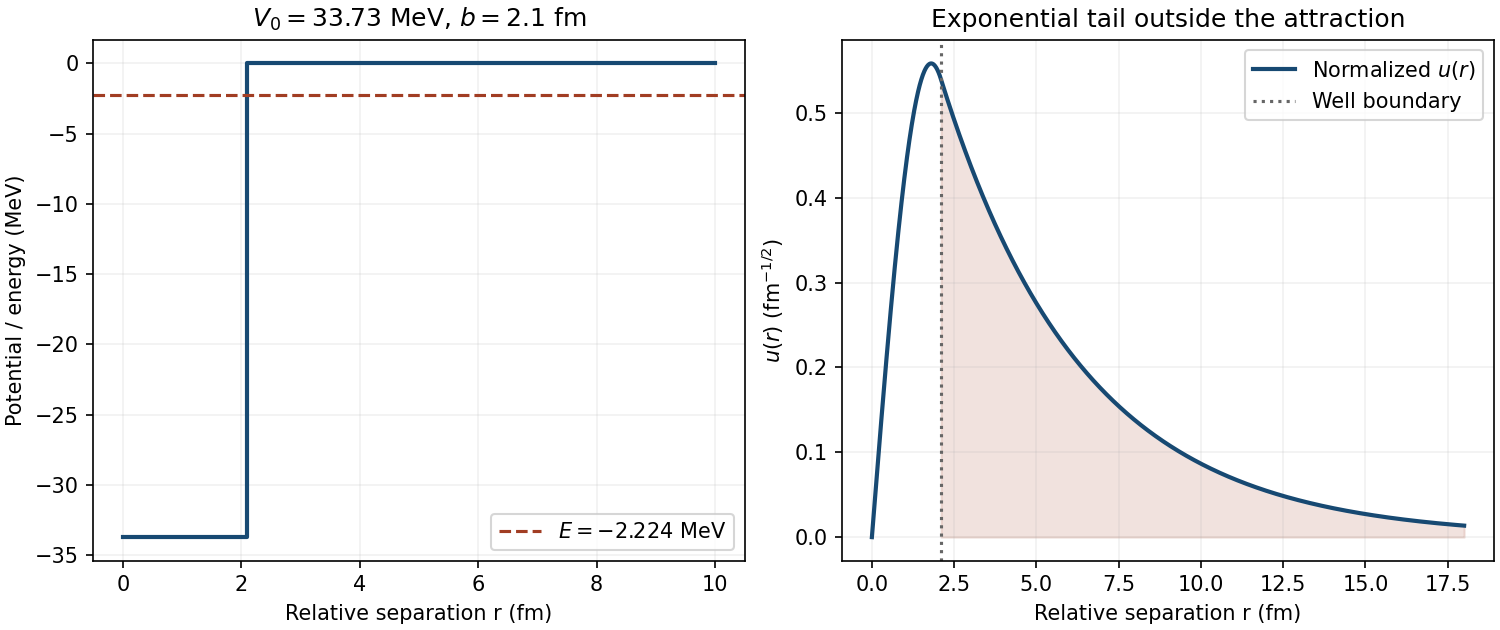
A weakly bound radial state extends beyond the finite nuclear well
. Original calculation from the stated masses, radius and binding. The reduced radial function is normalized with and matches its derivative at the well edge. The central-well model omits the tensor-induced D component. Details.
In neutron-proton radiative capture, the initial pair at rest has total energy , where . The emitted photon carries momentum, requiring equal and opposite nuclear recoil. Some binding energy becomes deuteron kinetic energy.
Exact two-body kinematics in natural units givesSince ,With the stated rounded masses,The photon energy is . At leading order the difference equals the nonrelativistic recoil estimate ; exact kinematics fixes the small distinction between using and in that approximation.
Articles by others on the same topic
There are currently no matching articles.