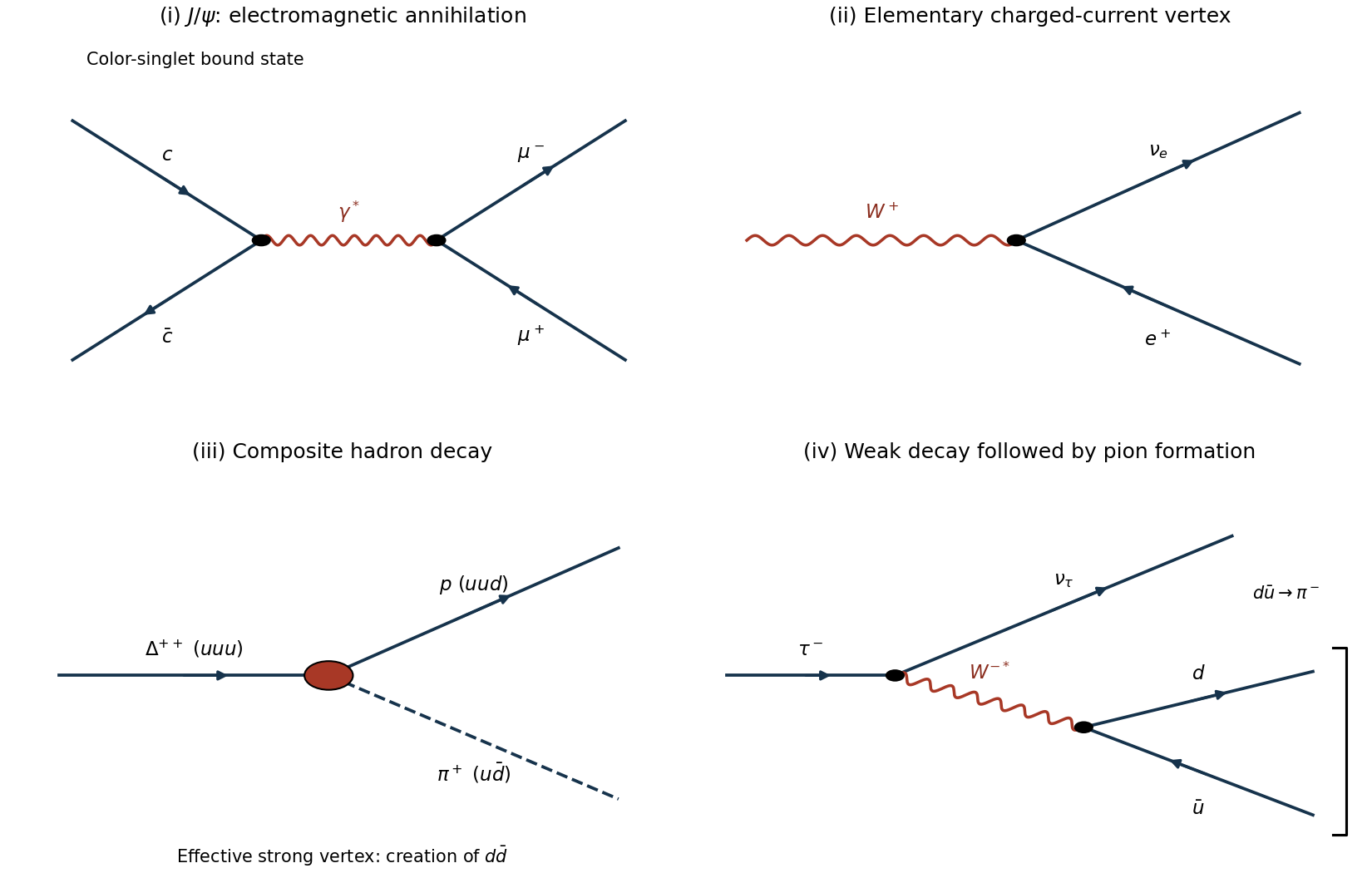
The original Feynman diagrams below distinguish elementary weak and electromagnetic vertices from an effective hadronic vertex. fermion arrows track fermion number; time runs left to right.
Four decay channels and their dominant interactions
. Original diagrams. Panel (iii) is an effective strong hadronic vertex; panel (iv) brackets the quark pair forming the pion. Details.
The dominant interaction is electromagnetic. The color singlet charm-anticharm component of the J/psi meson annihilates through a virtual photon, which creates a muon and an antimuon:Panel (i) shows the two electromagnetic vertices. Vector quantum numbers allow the one-photon channel. A Z boson contribution is negligible at this mass scale; a single gluon cannot connect a color singlet initial state to colorless leptons. The dominant interaction for this specified final state need not dominate the meson's total decay width.
This is a weak charged-current decay. Panel (ii) has one vertex. The outgoing Positron and electron neutrino have total charge and cancelling lepton numbers. The W boson is on shell here; a second virtual boson is unnecessary.
The dominant interaction is strong. At hadron level, panel (iii) is an effective hadronic vertex for . The initial constituents rearrange into and after creation of a pair:One original up quark enters the charged pion; the other two join the new down quark in the proton. Gluon-induced pair creation supplies the quark-flow diagram interpretation. This is nonperturbative hadronization: the effective hadronic vertex does not claim that one elementary perturbative quark graph calculates its width. Charge, baryon number and net quark flavor are conserved.
The dominant interaction is weak. In panel (iv),The quark vertex carries the Cabibbo-Kobayashi-Maskawa matrix factor . The down quark and anti-up quark form a color singlet pion. The pion bracket represents its bound-state matrix element, conventionally specified by the pion decay constant; it is not an additional weak vertex. The neutrino carries the initial tau lepton number.
Assume allowed beta decay, so the leading matrix element has negligible lepton-momentum dependence. Neglect nuclear recoil and neutrino mass. Let be the kinetic energy available to the electron and antineutrino, , and . The neutrino energy and momentum magnitude are .
Fermi's golden rule weights accessible final states. After angular integration, the momentum-space factors are and . The energy-conserving Dirac delta function removes the neutrino integral:The constant includes the allowed nuclear matrix element, weak-coupling and angular factors. Including the usual Fermi function for electron-nucleus Coulomb distortion givesFor the kinetic-energy spectrum, instead yieldsThe two distributions differ by a Jacobian; forgetting it changes the shape.
A pure fifth-power law additionally neglects electron mass and Coulomb distortion and keeps the nuclear matrix element fixed. Then , , andTwo momentum powers come from each final particle and one from the remaining integration. This is the origin of the Sargent rule. Exact dependence requires the relativistic-electron, constant-matrix-element limit. For , the same approximation without Coulomb distortion has and instead scales as . Forbidden-transition factors, nuclear-structure changes and Coulomb distortion also modify the simple law.
The negative muon emits a virtual and becomes a muon neutrino; the boson creates an electron and an electron antineutrino:Both vertices are weak charged currents.
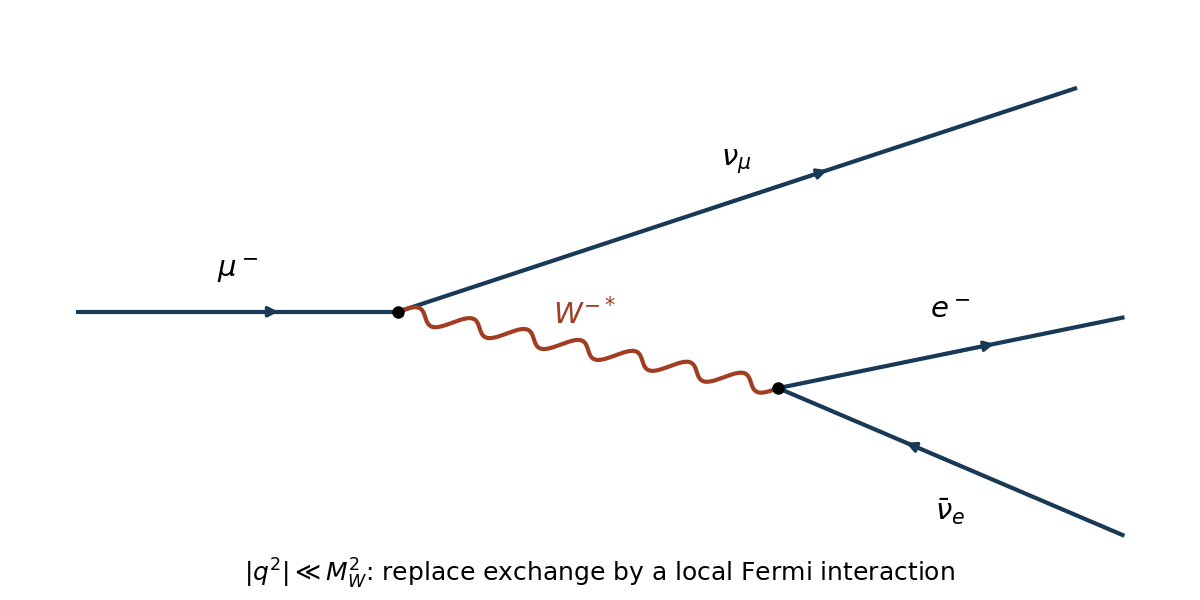

Typical transfers satisfy , so the propagator factor expands as plus small corrections. Contracting this short-distance exchange produces the local Fermi interaction, with strength contained in . This effective description does not assume that the real W mass vanishes. The same treatment applies to leptonic tau decays with the relevant masses changed.[ref]
Review of Particle Physics by Particle Data Group (2022). Muon Decay Parameters, §57.1 introduction and §57.2
In GeV units, and . ThusThe modest difference from a precision experimental lifetime is expected from the rounded mass and omitted radiative and final-electron-mass corrections.
Use an inclusive spectator model: one heavy constituent decays through the Fermi interaction, and sum the open charged-current channels. In weak-decay channel counting, each massless final lepton pair gives basic widthA quark pair contributes three colors multiplied by its squared Cabibbo-Kobayashi-Maskawa matrix element. Do not multiply by three just because the initial quark has three colors: its lifetime is the width of one initial state, averaged over initial color when appropriate. Define
For the tau lepton, two leptonic channels contain an electron or a muon; light hadronic channels have or . ThereforeNo charmed hadron can be produced: the lightest charmed meson exceeds the tau mass. [ref]
Review of Particle Physics by Particle Data Group (2022). D-zero and D-plus listings, physical page 1 of each, masses 1864.84 and 1869.66 MeV
The supplied charm-quark parameter is not a free asymptotic final-particle mass. The leading count neglects electron and muon masses and light hadronic threshold effects.For the charm quark, and dominate. The emitted current has two light leptonic channels and the same light hadronic channels as above; a tau cannot be produced:
For the bottom quark, retain with the supplied and neglect the much smaller channel. The emitted current can produce three lepton flavors and two up-type quark families, with three colors for each family. In particular is open at the given masses, although suppressed by phase space. Counting each open channel as massless givesSetting Cabibbo sums to one recovers the familiar counts , and . Despite its larger mass, the bottom quark is slowed by its small interfamily mixing factor.
These are leading estimates rather than precise lifetimes of free quarks. confinement makes charm and bottom observable in hadrons, whose lifetimes involve spectator interactions, Quantum chromodynamics corrections and bound-state effects. mass corrections are significant for bottom: even the single-charm channel with massless leptons has the three-body weak-decay mass correctionTau and double-charm channels have different suppressions, so multiplying the entire width by this one factor is inconsistent. Accurate hadron lifetimes require those channel-dependent factors and hadronic dynamics; the exercise supports the explicitly stated leading counts.
Articles by others on the same topic
There are currently no matching articles.