Treat the quoted maximum as the resonant Z boson contribution described by the Breit-Wigner resonance cross section. The Electron and Positron each have spin , while the Z boson has spin one, soNeglect the electron mass at this centre-of-mass energy. Each incident momentum magnitude is then in natural units. Write . At the resonance peak the denominator is , and the same partial decay width appears for production and decay:The peak resonance cross section and branching fractions relation contains , because the electronic channel occurs at both ends of the resonant process.
For an area in ordinary units, restore . The original PDF prints , which is dimensionally incomplete: the intended standard conversion is . Also,ConsequentlyThis estimate uses the supplied resonance model. The full physical elastic Electron-Positron cross section also contains nonresonant photon exchange and interference; an experimental use of the formula must isolate the resonant contribution.
For gamma decay, the nuclear gamma-ray multipole selection rules require the radiation's angular momentum to satisfy the triangle inequalityHere , so . A real emitted photon has no monopole radiation mode, leaving .
The two nuclear quantum states have the same parity. An electric multipole has parity factor , while a magnetic multipole has factor . Thus electric radiation requires even and magnetic radiation odd :In particular, an nuclear transition cannot emit the single real photon requested here; processes such as internal conversion are different decay channels.
For usual nuclear gamma ray energies, , where and is the nuclear size. Higher multipole radiation orders bring extra powers of this small parameter, so and are the likely important contributions, with , and generally much smaller. Often is dominant, but an allowed matrix element can be hindered and an transition can be collectively enhanced. The quantum numbers alone do not fix a numerical relative contribution or an unconditional ordering of the and rates.
The four tree-level diagrams for electron-positron annihilation into W-boson pairs are
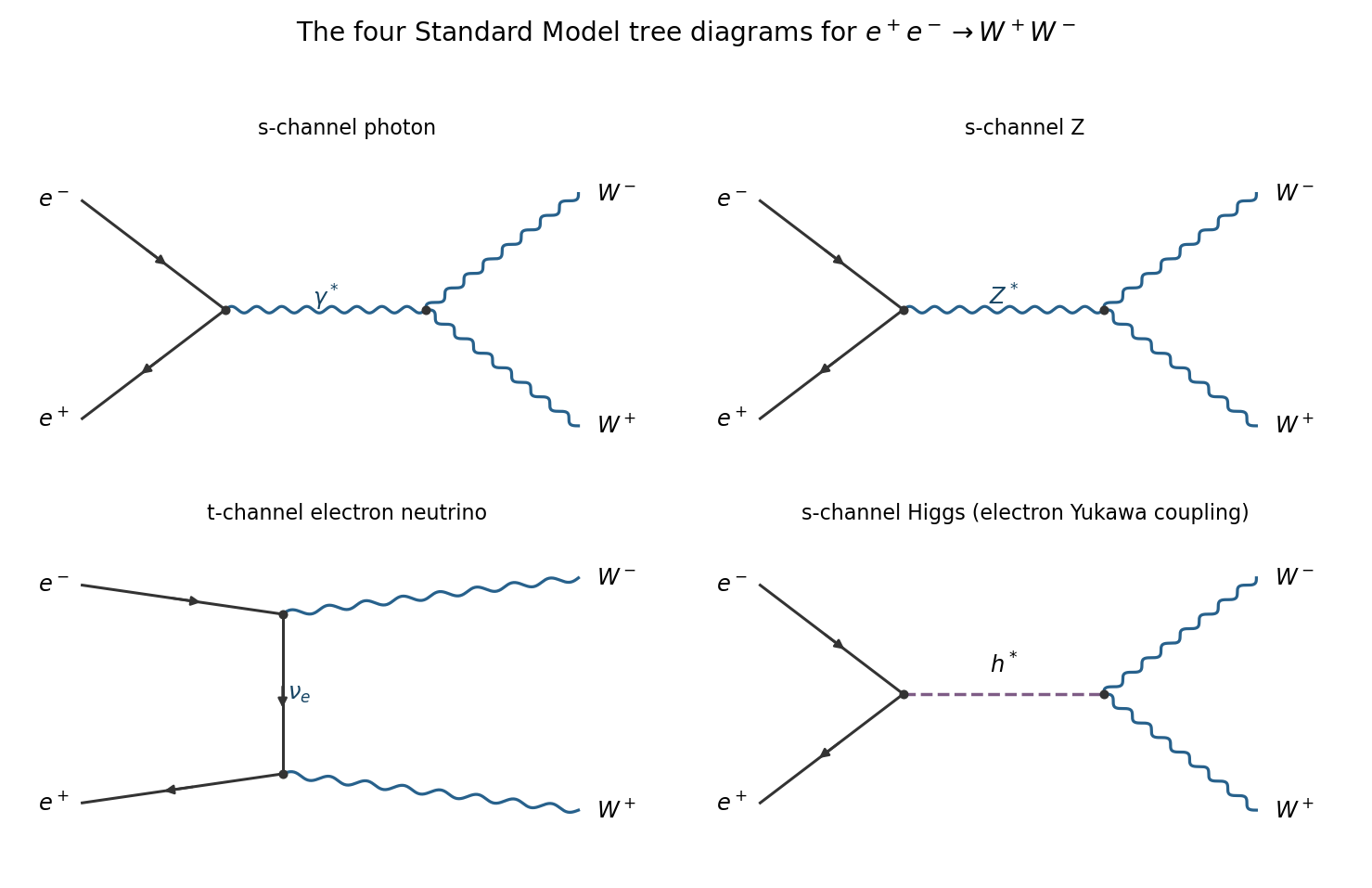

The first two diagrams contain the electromagnetic interaction and weak interaction neutral electron currents and the gauge boson self-interaction vertices and . The third has two weak charged current vertices joined by an electron neutrino propagator. In the fourth, the incoming Electron-Positron pair couples to the Higgs boson, which then couples to .
The small factor is at the initial Higgs-electron vertex. With the usual electroweak vacuum value , electron Yukawa suppression of Higgs production givesThese are tiny compared with ordinary electroweak interaction gauge couplings. The decay amplitude for the Higgs boson diagram carries this small coefficient, and its separate squared contribution carries its square. Thus the Higgs diagram is negligible because the electron Yukawa coupling is proportional to the electron mass. It vanishes in the massless-electron approximation, even though the Higgs boson-W boson coupling itself is not small. The remaining three gauge diagrams must be added coherently, including their interference.
Articles by others on the same topic
There are currently no matching articles.