For negligible fermion masses, the neutral-current vertex connects a fermion and antifermion of opposite helicity. The two incoming choices are and ; the two outgoing choices are and . Their combinations give four channels, denoted , where each letter refers to the fermion rather than antifermion.
Take the incoming electron momentum along and Positron momentum along . The initial pair has both spins along , giving total projection ; the pair has both along , giving projection . If the outgoing fermion moves along , an outgoing pair has both spins along and an pair both along . The figure shows momentum and spin arrows separately for all four channels.
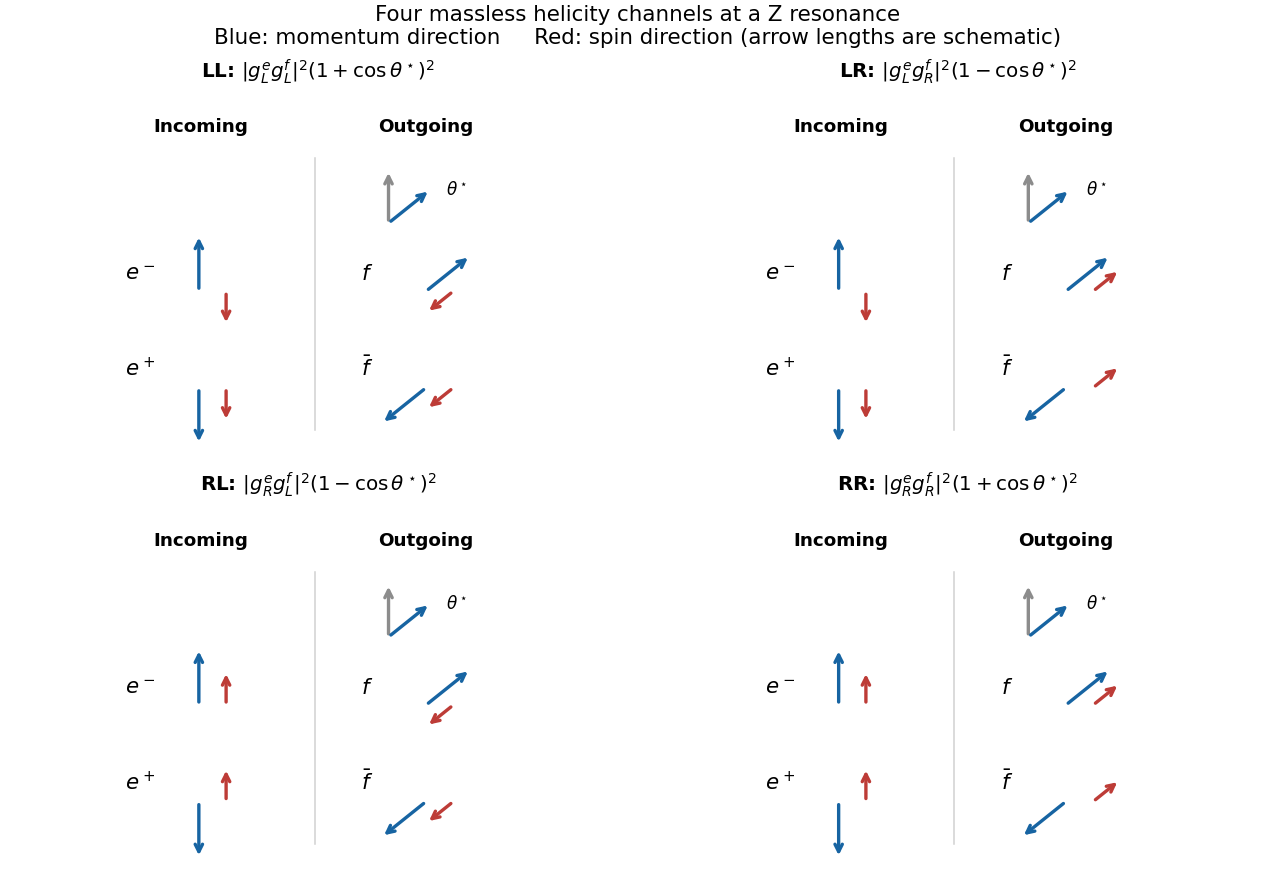

Let . Rotating the spin-one intermediate state between initial and final axes gives probability amplitudes proportional to for equal fermion helicities and for opposite ones. Thus, apart from a common positive normalization,
| Channel | Angular weight \ | | \ | | \ | | \ | | |
|---|
The common factor from the rotation elements is absorbed into the normalization. Distinct external helicities are orthogonal, so an unpolarized rate adds their squared probability amplitudes incoherently.
The source interchanges the conventional left and right electron coupling labels. With and , the physical electron values areAt , for example, the left electron still carries weak isospin , while the right electron is a weak singlet; the printed assignment gives the opposite result. This fixes how the helicity-channel table should be interpreted.[ref]
Electroweak Model and Constraints on New Physics by J. Erler and A. Freitas (2024). §10.1: fermion neutral-current interaction and weak-isospin assignments
For a muon final state, lepton universality gives the same pair of couplings. Crucially, swapping both labels does not change the summed distribution. Put , ; thenHere includes the resonance propagator, initial spin average and common coupling normalization. Equivalently,The source's simultaneous label interchange reverses but leaves its square unchanged.
For the Pole forward-backward asymmetry for charged leptons, integrating the normalized distribution over the two hemispheres cancels the even term in the numerator. Since and ,Within this single-, tree-level model, a nonzero asymmetry requires unequal left/right coupling magnitudes, demonstrating parity violation in the vertices. For the odd angular term vanishes and ; equal magnitudes with opposite signs also give zero. This inference is process-specific: a forward-backward asymmetry is not universally a parity-odd observable, since reversing both beam and outgoing momenta leaves their relative Angle unchanged. Purely electromagnetic Bhabha scattering is a concrete parity-conserving process with a forward-peaked, asymmetric distribution.
For the supplied ,The measurement differs by , or times its quoted uncertainty of , so it is consistent with the prediction. Statistical fluctuations alone preclude exact equality; photon exchange, initial-state radiation and electroweak radiative corrections also modify the idealized pure-resonance prediction and provide physical reasons for small differences.
Articles by others on the same topic
There are currently no matching articles.