The CKM matrix converts down-type quark mass eigenstates into the combinations entering the weak charged current. Its entry controls a charged-current transition between up-type flavour and down-type flavour . In the three-generation Standard Model, is a product of unitary matrices from diagonalizing the quark mass matrices, so .
The Wolfenstein parametrization displays the hierarchyThus diagonal transitions dominate; first-second generation mixing is larger than second-third generation mixing, and direct first-third generation mixing is smallest. The parameters refine this order estimate. With nondegenerate quark masses, a nonzero irreducible weak phase permits CP violation; at leading order the Jarlskog invariant is . Individual complex entries are not enough: the phase must survive allowed quark-field rephasings.
The exact physical CKM matrix is unitary, whereas its displayed cubic truncation is only approximately so. For example its first-row norm is , which is not exactly one for nonzero . The omitted higher-order terms repair this; unitarity must be tested to the retained order.
The inner product of columns one and three isThe leading terms cancel, establishing compatibility with unitarity at cubic order. Direct multiplication of the printed truncation leaves , so it must not be treated as exactly unitary beyond its stated accuracy.
For the exact matrix, conjugate the closure relation and defineDivide by and let . Then and , giving a CKM unitarity triangle with verticesAt leading Wolfenstein order these are . The barred coordinates define the exact triangle; they differ from the unbarred parameters beyond leading order.
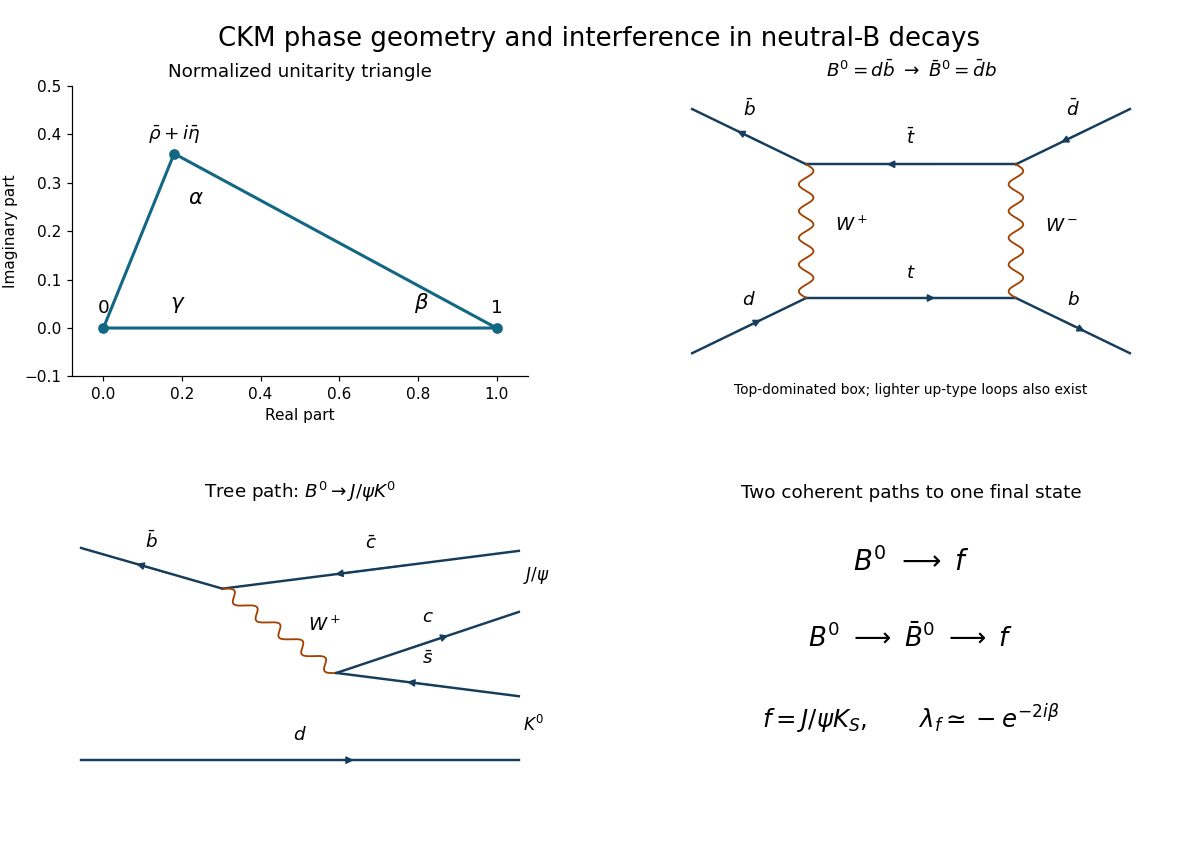
Original normalized unitarity triangle, top-dominated neutral-B mixing box, and the leading tree topology for a common charmonium-kaon final state. The triangle coordinates are illustrative.
Details. 
For positive , define at the origin, at , and at the apex. Comparing the directions of the incident complex sides gives the rephasing-invariant relationsTo leading order and ; the remaining angle follows by subtraction. Each ratio cancels the unphysical common phase of the corresponding column-orthogonality terms.
Use and . A box Feynman diagram with two W bosons and internal up-type quarks changes one neutral flavour into the other. The top quark contribution dominates the dispersive mixing amplitude and carries the squared CKM combination involving . With a consistent meson phase convention,The illustration in b shows this box and the dominant decay topology. A suitable common final state is , reconstructed for example through and . The leading tree transition gives , while the conjugate gives . Neutral kaon mixing projects both kaon flavours onto the observed .
The final state is approximately a CP eigenstate with : and each have CP approximately , and their relative orbital angular momentum is to couple the vector charmonium to the spin-zero parent. Neglecting the small kaon CP impurity and subleading decay amplitudes,There are two indistinguishable paths, direct decay and mixing followed by decay, so their amplitudes interfere. For and negligible direct CP violation, the time-dependent neutral-B CP asymmetry isMeasure the production flavour and proper decay time, fit the oscillation coefficient, and extract . This determines up to the usual trigonometric ambiguities unless further information is used. The cancellation of the dominant decay phase is why this channel isolates the angle involving without needing .
In a proton-proton collision, associate the reconstructed neutral B meson with the accompanying opposite-side bottom hadron. A direct semileptonic decay tags a on that side and hence an initial , or , on the signal side. The opposite charged lepton tags the conjugate assignment. Charged kaons from the opposite-side decay chain and same-side fragmentation tracks can supply additional statistical flavour tagging information; the common CP final state alone does not reveal the production flavour.
A magnetic spectrometer with precise silicon vertex tracking, charged-particle identification and muon or electron identification is suitable. A forward geometry can exploit the boosted bottom-hadron pairs at the LHC. It reconstructs displaced decay vertices, measures the signed tagging tracks, and infers the signal proper time from . The supplied lifetime corresponds to a rest-frame mean flight length , enlarged by the boost.
Even a perfect detector cannot remove physical mistags. An opposite-side neutral bottom meson can oscillate before its semileptonic decay, reversing the lepton charge relative to its production flavour. A cascade produces the charge opposite to a direct decay. Additional bottom pairs or unrelated fragmentation particles can also make the chosen association incorrect. For mistag probability , the measured asymmetry is diluted by ; this is why the tagging calibration is part of a CP measurement.
Articles by others on the same topic
There are currently no matching articles.