The cover establishes Trinity Term 2019 despite the annual bundle's 2018 filename. Use and the mostly-minus Minkowski metric. All six questions are solved, including the alternatives allowed by the paper's choice of four questions.
A leading valence-level process is , with the up quark supplied by the proton and the down antiquark by the antiproton. The same Feynman diagram works with replaced by . Both vertices are weak charged current vertices; the production scattering amplitude contains the CKM matrix element or its conjugate according to the chosen fermion-flow convention. The intermediate W boson is produced near its mass shell.
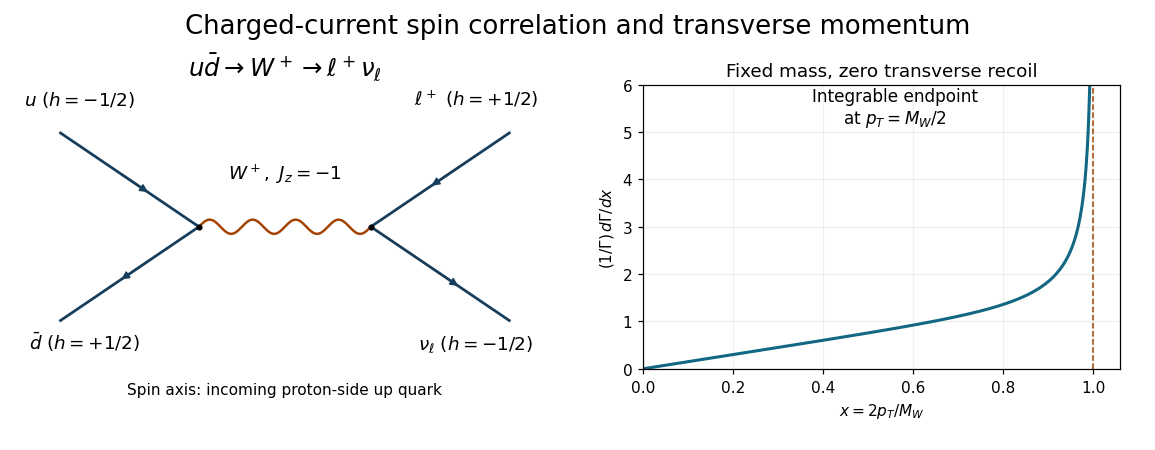
Original charged-current production diagram and the normalized ideal charged-lepton transverse-momentum density. The angular axis is measured from the proton-side incoming up quark.
Details. 
Neglect the participating quark and lepton masses, so that the weak charged current selects a left-helicity and a right-helicity . Choose along the proton beam in the partonic centre-of-momentum frame. Then the up quark moves along with spin projection , while the down antiquark moves along with helicity and also has spin projection along . ThusThe collinear two-body initial state has no orbital projection about its collision axis. In this approximation the produced W boson therefore has the indicated transverse polarization; its longitudinal spin state is absent. The unpolarized hadron beams contain other constituent spin states, but these do not participate in this massless charged-current subprocess.
In the final state the Positron has helicity and the electron neutrino has helicity . Along the outgoing charged-lepton direction their combined angular-momentum projection is , because the oppositely moving neutrino has spin projection on that axis. Finite masses, noncollinear production and sea contributions modify the ideal configuration.
Let be the angle from the incoming up quark, along the proton direction, to the outgoing charged antilepton in the W boson rest frame. The initial and final spin projections in ii are and . The Wigner small-d matrix therefore givesAfter squaring and normalizing over , the charged-lepton angular distribution isIts integral is one since . The charged antilepton is preferentially emitted toward the antiproton. Measuring the angle from the incoming down antiquark instead replaces by and produces ; the axis convention is part of the answer. Per unit solid angle the normalized density is .
Take an on-shell W boson of fixed mass , zero transverse recoil, negligible charged-lepton mass, and unrestricted angular acceptance. In its rest frame the charged lepton has momentum magnitude . A longitudinal Lorentz boost to the laboratory preserves transverse momentum, soBoth angular roots contribute to the same . Set and . The change-of-variable Jacobian determinant has , and the two-root angular weight is . ConsequentlyThis is the ideal W-decay Jacobian peak. The divergence at the endpoint is integrable; it is a change-of-variable effect, not an infinite decay probability. Reversing the polar axis does not change this transverse momentum density, because the sum of the two roots removes the term odd in .
Initial-state radiation of gluons gives the W boson nonzero transverse momentum. Its transverse Lorentz boost then changes the charged-lepton , washing out the sharp edge and permitting events above it. The recoil must be modelled with Quantum chromodynamics and constrained by measured hadronic activity. Independently, the finite W boson decay width spreads its actual invariant mass, also smearing the fixed-mass endpoint. Either is a theoretical broadening mechanism; neither is a detector-resolution effect.
The useful modes are and their charge conjugates. An electron gives an isolated track and localized electromagnetic shower; a muon gives an isolated penetrating track. Both allow a well-calibrated charged-lepton transverse momentum and a missing transverse momentum measurement for the neutrino.
The tau lepton decays before detection, usually adding further neutrinos. Its visible momentum is only part of the original tau momentum, so the simple two-body endpoint is lost. For the direct electron and muon modes, the transverse massalso has an ideal endpoint at and avoids needing the unmeasured neutrino longitudinal momentum. Fits to this distribution or the charged-lepton spectrum determine .
Choose . Important backgrounds include Quantum chromodynamics production of heavy-flavour hadrons with semileptonic decays, in-flight pion or kaon decays, and hadrons penetrating the calorimeters. These generally have accompanying jet activity; semileptonic decays can contain real neutrinos, while jet mismeasurement can fake missing transverse momentum. Heavy-flavour tracks can originate at a displaced decay vertex. Require a high- isolated muon, agreement between inner tracking and the external muon system, and substantial missing transverse momentum inconsistent with detector noise or a mismeasured jet.
The genuine electroweak backgrounds include with one muon lost and . Veto a second reconstructed opposite-sign muon and use the dimuon invariant mass when both are present to reject the Z boson channel. The tau-mediated spectrum is softer and contains extra missing particles; template fits and control samples estimate its residual contribution. Detector acceptance determines how much of the lost-muon background survives.
For the selected muon channel, finite curvature resolution in the magnetic tracking system broadens the reconstructed transverse momentum spectrum. A high- track has small sagitta, so spatial measurement errors, alignment errors and magnetic-field calibration errors become important; at high momentum an approximately fixed uncertainty in gives . Multiple Coulomb scattering contributes at lower momenta. If the transverse mass is fitted, finite hadronic-recoil resolution additionally smears the inferred missing transverse momentum. These are experimental effects, distinct from the physical recoil and width in ii.
Quadrupole magnets provide transverse restoring forces proportional to displacement from the reference orbit. Their magnetic field increases linearly away from the axis, so an off-axis particle receives a kick that can bring its trajectory back toward the design orbit. A magnetic quadrupole focuses in one transverse plane and defocuses in the other; a single quadrupole cannot confine both planes.
An alternating-gradient focusing lattice alternates quadrupole orientations with drift spaces. With suitable strengths and separations, a focusing-defocusing sequence gives stable betatron oscillations in both planes. The focusing acts on transverse position, while the phase advance through the lattice converts an initial angular deviation into position and then a corrective kick. The beam is thus transported within a bounded envelope rather than allowed to drift into the pipe. Dipoles provide the main bending; the quadrupole lattice controls the small deviations.
Write , with and . Differentiating twice givesThe coefficients must vanish for arbitrary initial phase . The sine coefficient givesThe conventional Courant-Snyder parameters normalize the phase so that ; any positive constant can be absorbed into the scale assigned to and . Explicitly, and preserve the orbit while making . With this convention,The second expression is the Ermakov-Pinney equation for the beam envelope. It follows by substituting into the cosine coefficient.
The printed equation omits the factor multiplying . For a concrete counterexample, take the constant periodic focusing strength and the constant envelope . Then and solve . The correct envelope equation is , whereas the printed equation gives .
The associated invariant isThus fixes the phase-space ellipse of a trajectory; a beam's rms geometric emittance uses the corresponding second-moment convention. Factors of depend on whether emittance means ellipse area or area divided by and do not alter the envelope equation.
For a beam with rms geometric emittance , its vertical size at the collision point is . Reducing therefore concentrates the beam, increasing the number of particles encountering the opposite beam per transverse area. For identical Gaussian beams colliding head-on,Keep bunch populations, horizontal size, collision frequency and emittances fixed. If both vertical beta values are decreased by a factor , meaning , both vertical beam sizes decrease by , andThe luminosity is inversely proportional to the common vertical size, not its square, because only one transverse dimension has changed. The same ratio follows from the unequal-beam overlap denominator .
A final-focus quadrupole system on either side of the interaction point forms a waist there. Strong quadrupole doublets or triplets, with suitable matching sections, focus both planes. At a symmetric waist and the nearby drift gives , so small requires large beam envelopes and strong optical gradients in the adjacent magnets. Chromatic correction is needed for off-momentum particles. The formula assumes negligible crossing-angle and hourglass reductions; a bunch length comparable to changes the effective overlap.
For a paraxial orbit , where is transverse momentum and longitudinal momentum. Acceleration mainly increases , so a given transverse kick produces a smaller angular deviation. In an ideal matched accelerator without scattering or radiation, the conserved transverse canonical phase-space area becomes a smaller area in the coordinates . This is adiabatic damping of geometric emittance, not loss of canonical phase-space volume.
The invariant normalized emittance isHere is speed in units of , distinct from the lattice beta function. Neglecting dilution mechanisms, each acceleration stage thus supplies a beam with smaller angular spread and geometric emittance for injection into the next stage.
A chain of increasingly energetic particle accelerators lets each ring operate over a manageable range of magnetic rigidity and radio-frequency settings. It also avoids injecting a large-emittance low-energy beam directly into the small-aperture high-field main ring. Higher injection energy reduces space-charge effects and improves capture and transmission. Emittance dilution, mismatching and collective instabilities can oppose the ideal damping; acceleration alone does not reduce normalized emittance.
Use the orthonormal basis . The normalized flavour singlet isThe SU(3) invariant contraction pairs each fundamental flavour with its conjugate. Applying any supplied raising operator to the singlet gives zero because its quark and antiquark contributions cancel.
To fix the neutral isospin triplet phase consistently with the source's charged states, apply to :Thus one missing member of the meson octet isIndeed , the correct ladder operator strength for the triplet.
The other missing state is orthogonal to both and . For coefficients , orthogonality requires and . Choose the convenient overall phase and normalize:It can also be obtained by adding the supplied ladder operations and . The three displayed states are mutually orthonormal. The meson octet here is the traceless adjoint component of ; the source's word “antisymmetric” does not impose antisymmetry on all its quark-antiquark flavour wavefunctions.
Only the singlet and isoscalar octet member can mix without violating isospin: they have the same and, for the vector multiplet, the same . The neutral triplet member has and is excluded in the isospin limit.
Set and , with precisely the phases in a. Define . Taking overlaps givesTherefore the source's rotation convention is satisfied byThis yields and exactly. Reversing the octet phase changes the quoted sign, with an irrelevant compensating phase on the physical phi state; exchanging the basis order gives the complementary angle. The physical statement of ideal vector-meson mixing is the pure strange and pure nonstrange content, rather than a convention-independent sign for the angle.
The observed dominance of kaons supports a predominantly phi meson. In a connected strong decay, the original strange quark and antiquark survive into different kaons, while a gluon produces a light pair:This gives or and is allowed by the OZI rule. A pionic final state contains no strange valence constituents, so the initial pair must annihilate. The strong annihilation of a colour-singlet state requires at least three gluons: one gluon cannot carry the singlet colour, and two have the wrong charge-conjugation quantum number. This disconnected flavour topology is suppressed by the OZI rule, although it need not vanish.
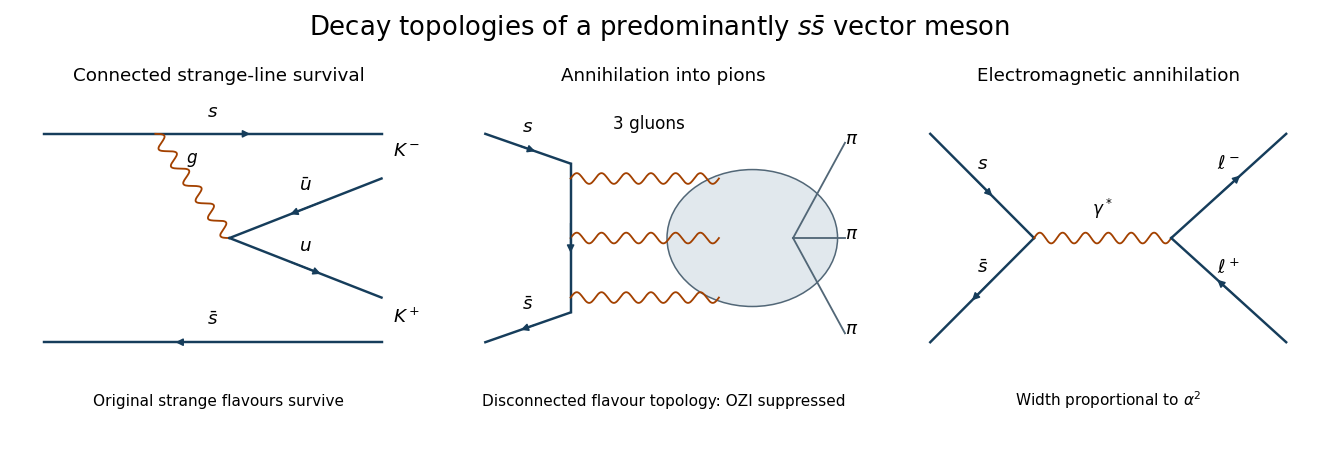
Original quark-level topologies for connected kaon production, three-gluon annihilation into pions, and electromagnetic annihilation into leptons. The hadronization blob is schematic.
Details. 
The leptonic mode proceeds through and is suppressed by electromagnetic couplings; its width is proportional to times the vector-meson overlap. Unlike a strong hadronic decay, it cannot create its final particles through quark rearrangement. Hence a branching fraction of order is qualitatively consistent with electromagnetic annihilation competing with strong modes.
Kaon dominance is especially suggestive because phase space is limited: using the supplied neutral-kaon and phi masses,The two spin-zero kaons have orbital angular momentum to match the vector parent, so their partial width has the additional near-threshold factor . Pionic modes have more phase space yet remain subdominant because of their annihilation topology. The observations therefore support, but do not establish exact, ideal vector-meson mixing: a small nonstrange admixture, electromagnetic amplitudes and nonperturbative strong dynamics can all contribute to the pionic rate.
Quark mass differences break flavour symmetry. Isospin exchanges , so its strong breaking is controlled by the small difference . U-spin exchanges , so its strong breaking involves the much larger . Relative to the characteristic strong-interaction scale, the latter is much larger; this explains why U-spin is a substantially poorer symmetry.
Flavour-dependent interactions are a second source. Electromagnetism distinguishes from because and , and therefore breaks isospin. However, both have charge , so their electromagnetic couplings alone do not break U-spin in the equal-mass limit. If two breaking mechanisms for each symmetry are required, the second common mechanism is the weak interaction: the CKM matrix and weak flavour transitions distinguish the flavours and do not conserve either strong-interaction flavour symmetry. The dominant difference in the quality of the two approximate strong symmetries is still the mass splitting.
The CKM matrix converts down-type quark mass eigenstates into the combinations entering the weak charged current. Its entry controls a charged-current transition between up-type flavour and down-type flavour . In the three-generation Standard Model, is a product of unitary matrices from diagonalizing the quark mass matrices, so .
The Wolfenstein parametrization displays the hierarchyThus diagonal transitions dominate; first-second generation mixing is larger than second-third generation mixing, and direct first-third generation mixing is smallest. The parameters refine this order estimate. With nondegenerate quark masses, a nonzero irreducible weak phase permits CP violation; at leading order the Jarlskog invariant is . Individual complex entries are not enough: the phase must survive allowed quark-field rephasings.
The exact physical CKM matrix is unitary, whereas its displayed cubic truncation is only approximately so. For example its first-row norm is , which is not exactly one for nonzero . The omitted higher-order terms repair this; unitarity must be tested to the retained order.
The inner product of columns one and three isThe leading terms cancel, establishing compatibility with unitarity at cubic order. Direct multiplication of the printed truncation leaves , so it must not be treated as exactly unitary beyond its stated accuracy.
For the exact matrix, conjugate the closure relation and defineDivide by and let . Then and , giving a CKM unitarity triangle with verticesAt leading Wolfenstein order these are . The barred coordinates define the exact triangle; they differ from the unbarred parameters beyond leading order.
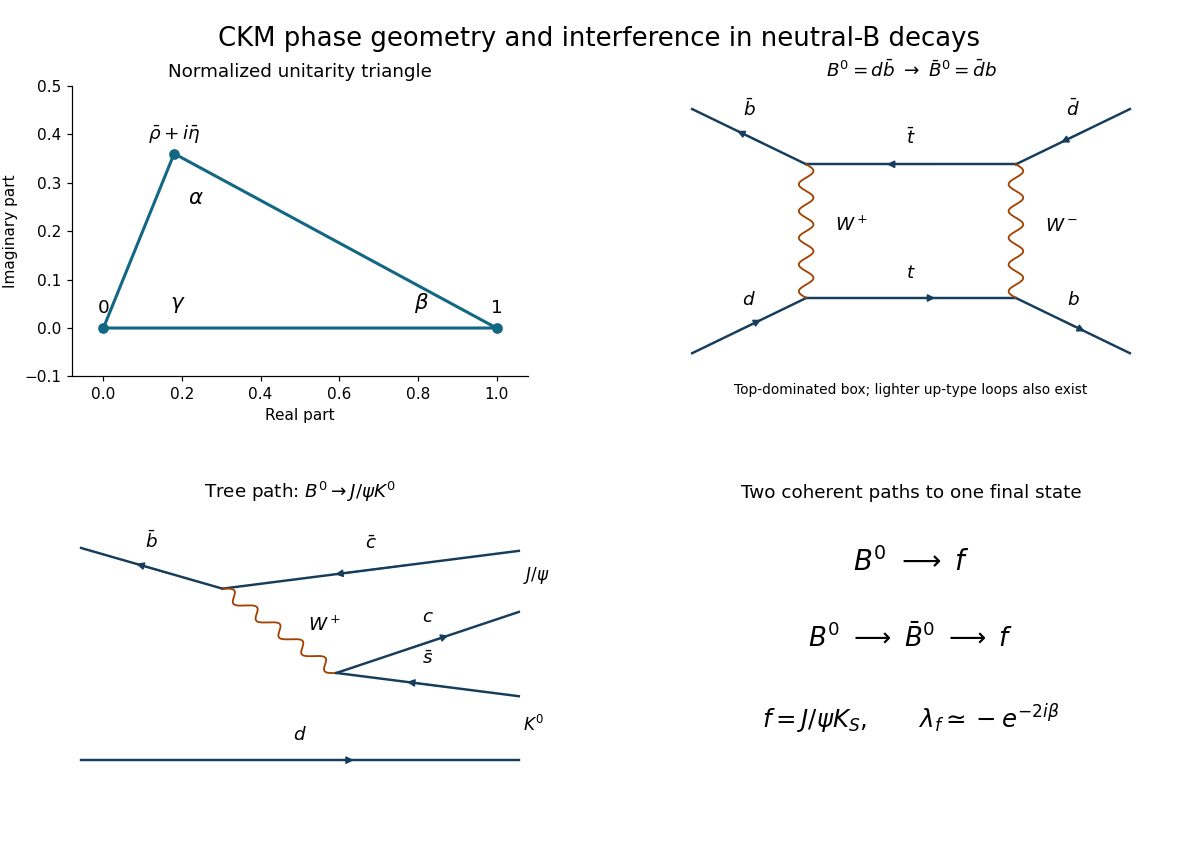
Original normalized unitarity triangle, top-dominated neutral-B mixing box, and the leading tree topology for a common charmonium-kaon final state. The triangle coordinates are illustrative.
Details. 
For positive , define at the origin, at , and at the apex. Comparing the directions of the incident complex sides gives the rephasing-invariant relationsTo leading order and ; the remaining angle follows by subtraction. Each ratio cancels the unphysical common phase of the corresponding column-orthogonality terms.
Use and . A box Feynman diagram with two W bosons and internal up-type quarks changes one neutral flavour into the other. The top quark contribution dominates the dispersive mixing amplitude and carries the squared CKM combination involving . With a consistent meson phase convention,The illustration in b shows this box and the dominant decay topology. A suitable common final state is , reconstructed for example through and . The leading tree transition gives , while the conjugate gives . Neutral kaon mixing projects both kaon flavours onto the observed .
The final state is approximately a CP eigenstate with : and each have CP approximately , and their relative orbital angular momentum is to couple the vector charmonium to the spin-zero parent. Neglecting the small kaon CP impurity and subleading decay amplitudes,There are two indistinguishable paths, direct decay and mixing followed by decay, so their amplitudes interfere. For and negligible direct CP violation, the time-dependent neutral-B CP asymmetry isMeasure the production flavour and proper decay time, fit the oscillation coefficient, and extract . This determines up to the usual trigonometric ambiguities unless further information is used. The cancellation of the dominant decay phase is why this channel isolates the angle involving without needing .
In a proton-proton collision, associate the reconstructed neutral B meson with the accompanying opposite-side bottom hadron. A direct semileptonic decay tags a on that side and hence an initial , or , on the signal side. The opposite charged lepton tags the conjugate assignment. Charged kaons from the opposite-side decay chain and same-side fragmentation tracks can supply additional statistical flavour tagging information; the common CP final state alone does not reveal the production flavour.
A magnetic spectrometer with precise silicon vertex tracking, charged-particle identification and muon or electron identification is suitable. A forward geometry can exploit the boosted bottom-hadron pairs at the LHC. It reconstructs displaced decay vertices, measures the signed tagging tracks, and infers the signal proper time from . The supplied lifetime corresponds to a rest-frame mean flight length , enlarged by the boost.
Even a perfect detector cannot remove physical mistags. An opposite-side neutral bottom meson can oscillate before its semileptonic decay, reversing the lepton charge relative to its production flavour. A cascade produces the charge opposite to a direct decay. Additional bottom pairs or unrelated fragmentation particles can also make the chosen association incorrect. For mistag probability , the measured asymmetry is diluted by ; this is why the tagging calibration is part of a CP measurement.
The ordering of Weyl components depends on the supplied basis transformation. In this paper use . Applying the printed to the printed Dirac matrices givesThus is right chiral and left chiral in this ordering. The free massless Weyl equations areThey describe spin-one-half massless fields in the two inequivalent chiral spinor representations of the Lorentz group. Their rotation generators agree, but their boost generators have opposite signs; spatial parity interchanges the two. A positive-energy particle in the field has helicity , and one in the field has helicity . Their antiparticles have the opposite helicities, so a Weyl field is not a field containing only one helicity for both particles and antiparticles.
Neutrinos provide the observed ultrarelativistic approximation to a left-chiral particle and right-helicity antiparticle. However, neutrino oscillation establishes nonzero neutrino mass differences, so physical neutrinos are not all exactly massless Weyl particles. Chiral Weyl fields occur in the Standard Model, but an isolated exactly massless elementary Weyl particle is not established by neutrino observations. Whether neutrino mass eigenstates are Dirac or Majorana remains a separate question.[ref]
neutrino masses, mixing, and oscillations by Particle Data Group (2024). Sections 14.2, 14.4 and 14.9.2: massive-neutrino extensions, mass-induced oscillations, and the Dirac–Majorana question
With the gamma matrices derived in a, the momentum-space Dirac equation readsFor a positive-energy particle at rest, and , so . The Dirac adjoint in this basis is , and the specified normalization givesTherefore, for any normalized two-component spinor ,Equivalently, choosing and gives the two independent rest-frame spin states. A strictly massless particle has no rest frame; this step requires .
Choose the active boost producing and . The supplied two-component boost acts on the left-chiral block ; the right-chiral block transforms by its inverse. Applying them to b givesUse and to obtainBoth are particle spinors, with spin respectively parallel and antiparallel to the positive axis. A compact equivalent expression is , , using the positive matrix square roots.
The products of corresponding nonzero upper and lower components equal , so and . Substitution also verifies and . These checks fix which boost belongs to which component and prevent silently exchanging the chiral ordering defined by the source's .
Take and . Then while . HenceThe helicity operator is for momentum along . It givesThe positive-helicity state becomes entirely right chiral, while the negative-helicity state becomes entirely left chiral. The suppressed opposite-chirality amplitude is of relative order ; at finite mass chirality is not the same as helicity. If , helicity is measured along the reversed momentum and the labels of the two spin-axis states interchange.
Use the leading-order parton model: scatter incoherently from an approximately on-shell collinear quark carrying nucleon momentum fraction , neglect quark and lepton masses, use an unpolarized target, and neglect nuclear binding and higher-twist corrections. The condition suppresses target-mass effects, while permits the local Fermi interaction instead of the full W propagator. CKM-weighted accessible final flavours are approximated by their leading light-quark sums. The struck-quark centre-of-mass energy is , with .
A neutrino scatters through or , and through the corresponding crossed antiquark channels such as . The chiral charged current makes the massless quark contribution independent of and the antiquark contribution proportional to . The scattering probability is weighted by the parton distribution functions; the explicit factor comes from . In the usual convention is a number probability density, while is a momentum density. Approximate Bjorken scaling leaves mainly dependence; QCD evolution adds a logarithmic dependence.
The printed proton-density formula is not an isoscalar formula in the standard PDF convention. For a proton, neglecting incoming charm and taking accessible CKM sums as unity, the conventional leading-order result isFor an isoscalar target per nucleon, average proton and neutron and use charge symmetry of nucleon parton distributions: , , . This givesThe standard normalization follows equivalently by inserting and into the charged-current structure-function formula.[ref]
structure functions by Particle Data Group (2024). Section 18.1, Eqs. (18.8) and (18.19): charged-current normalization and proton quark combinations
A concrete discrepancy remains even with a simple valence model: take , and all sea densities zero. The correctly averaged isoscalar bracket is , while the printed bracket is only with the same prefactor. Thus the intended helicity and dependence can be explained, but the literal printed isoscalar claim cannot be derived. If the symbols were instead defined as momentum densities, the extra explicit would also need removal.
For the stationary target, . The invariant definition immediately givesNo massless approximation is needed for this laboratory identity when binding and target recoil conventions are neglected.
For the angular relation, specify the neutrino-parton centre-of-momentum frame and neglect masses there. The incoming and outgoing leptons then each have energy . Their momentum transfer satisfiesSince and , cancellation givesThis identifies the antiquark weight with the corresponding squared angular factor. The relevant massless condition is sufficient energy in the lepton-parton subprocess; alone does not control every endpoint configuration.
The frame qualifier matters: the complete neutrino-nucleon centre-of-mass final state contains a variable-mass hadronic system. In that frame, still neglecting masses but retaining , direct two-body kinematics for gives insteadFor example and give , not . Thus the simple angle-only relation implicitly uses the partonic frame.
For a valence-dominated isoscalar target, . A left-chiral incident neutrino has unsuppressed scattering on a left-chiral quark and the weight for a right-chiral quark. Summing the up and down contributions yieldswhere and . The common normalization here uses the conventional Fermi coupling and PDFs in a; the requested shape is independent of an overall normalization convention.
Put . With , , and ,soFit the relative constant and components to determine their coupling ratio, or use the NC-to-CC cross-section ratio to constrain the absolute combination. In this valence limit, integrating over givesThe same valence momentum integral cancels between numerator and denominator. Experimentally, NC events have hadronic activity without the charged-current outgoing muon; known fluxes or CC normalization, muon identification and acceptance corrections are needed. Sea-quark contributions, charm thresholds, QCD corrections and departures from isoscalarity must be included for a precision weak-mixing-angle measurement.
The charged-current expressions in Section 18.1 specify the conventions used to audit a; the normalization is per target nucleon with standard number-density PDFs.
Articles by others on the same topic
There are currently no matching articles.