For , put , so . The Laplace transform for the Gamma function, analytically continued from positive real , givesChoose in the upper half-plane. Since ,This integral is absolutely convergent throughout the upper half-plane. On the nonzero real axis it converges conditionally by Dirichlet test for improper integrals, and its value is the upper boundary limit of the same branch. In particular negative real has argument , not in this formula.
At the integral diverges at infinity; in the lower half-plane its exponential function factor grows and the ordinary improper integral diverges. The origin itself causes no local-integrability problem for . A useful continuation of the chosen power uses a branch cut descending from with argument in .
Use the Fourier transform convention , initially in a class where the integral transforms and subsequent limits are defined. Transforming Laplace's equation gives on real . Decay for selectsThe boundary trace is the sum of its negative-half-line unknown and the given positive-half-line datum. The normal derivative is zero on the negative side. ThereforeFor the convention, negative support gives a integral transform analytic for , and positive support gives one analytic for , subject to the appropriate endpoint interpretation. The normal trace in this particular problem requires a finite-part interpretation, detailed below.
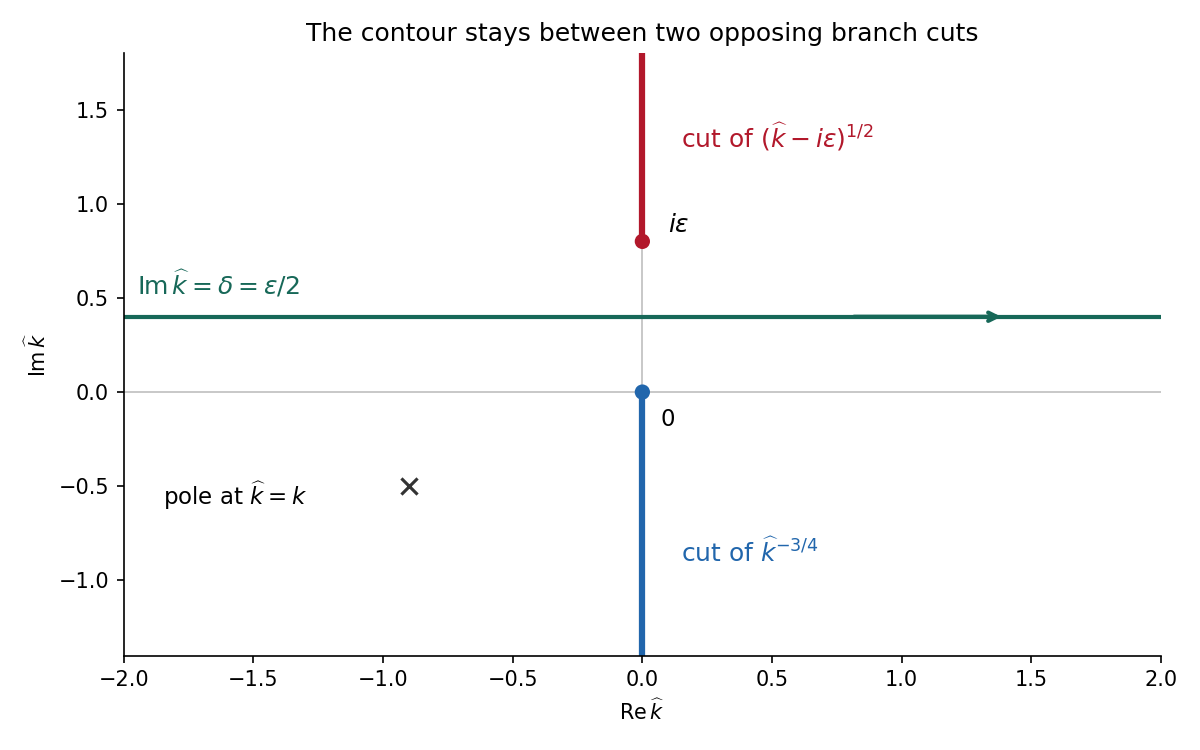
For the Wiener-Hopf method, regularize the real-axis kernel byTake the branch cut of vertically downward from and that of vertically upward from . Their product on the real axis is the positive square root . The branch of has its cut downward from zero. Dividing the regularized equation by givesThe forcing is analytic in , between its two cuts. Decompose by Cauchy integrals on two horizontal lines within that strip. Separation giveswhen the endpoint growth class makes the common entire remainder bounded. For one can take the minus Cauchy integral on , with , obtainingThe integrand is at infinity, so the Cauchy integral converges there. In the limit choose , for example ; a fixed positive cannot remain between zero and . With denoting the limiting lower-analytic branch and with the prescribed limiting interpretation,The numerator square root has a cut going upward from ; the power has a cut going downward from zero. The contour passes between them. The pole is below this contour when is in the lower integral transform domain. These branch choices are essential, rather than independent principal powers of the factors.

There is an important mathematical limitation in the source's ordinary integral definition of . An explicit harmonic function particular solution in polar coordinates isEach separated polar power is harmonic function; at it has the required Dirichlet boundary condition value, and at its angular derivative vanishes, giving the required zero normal derivative. It also decays at infinity. Its unknown boundary traces areThe last function is not locally integrable at zero. Therefore the printed ordinary integral diverges, even for . The integral transform calculation is valid for this solution only after specifying a Hadamard finite-part integral, or equivalently a distribution boundary trace.
For the canonical homogeneous extension of this power, the two transformed traces areThe first is analytic below and the second above. The second formula follows from and the finite-part continuation of the Laplace transform. Substituting their real-axis boundary values directly verifies the boxed integral transform relation for both signs of , so the qualification can be checked without relying only on formal factorization.
There is also homogeneous corner freedom:satisfies zero Dirichlet boundary condition data on the positive axis, zero Neumann boundary condition data on the negative axis and decay at infinity. Its negative trace has integral transform , corresponding to the term . Higher singular modes would also satisfy the homogeneous boundary conditions for integers , but are excluded if the negative trace is required to be locally integrable. Thus the one-constant formula belongs to a specified corner-growth class. The original boundary conditions alone, without that class, do not assert uniqueness. These facts form the finite-part normal trace for mixed quarter-power boundary data.
Articles by others on the same topic
There are currently no matching articles.