A geostationary orbit has the same angular velocity as the Earth. Let and . Balancing the required centripetal acceleration with the exterior gravitational field givesThe orbital plane must be equatorial and the motion prograde for the satellite to remain over one point. The uniform density assumption supplies in terms of the specified and .
Taking the Earth's sidereal rotation period as , , and givesThe orbital radius is therefore about , or an altitude of about . Replacing the sidereal day by changes this estimate by less than .
For the uniform unloaded space-elevator cable, let the constant linear mass density be and the outer endpoint be . In the co-rotating frame the outward effective force per unit length is . The cable is just clear of the surface, with neither a ground load nor an endpoint counterweight, so both ends have zero applied tension. The integrated effective force must vanish:Using , this becomesThe root is a zero-length cable. The physical nonzero cable hasIt extends well beyond the geostationary orbit so its outer centrifugal force balances the inner segment's weight. If a cable is anchored with a nonzero endpoint load or has a counterweight, that load changes the integrated balance; its length is not fixed by the zero-end-load formula.
An element of the rotating cable satisfiesWith , integration givesIt increases below , decreases above , and returns to zero at . HenceThe tension is greatest at the geostationary orbit, where local effective gravity is zero. A zero local effective force does not mean zero tension: that section transmits the loads of the entire inner and outer cable portions.
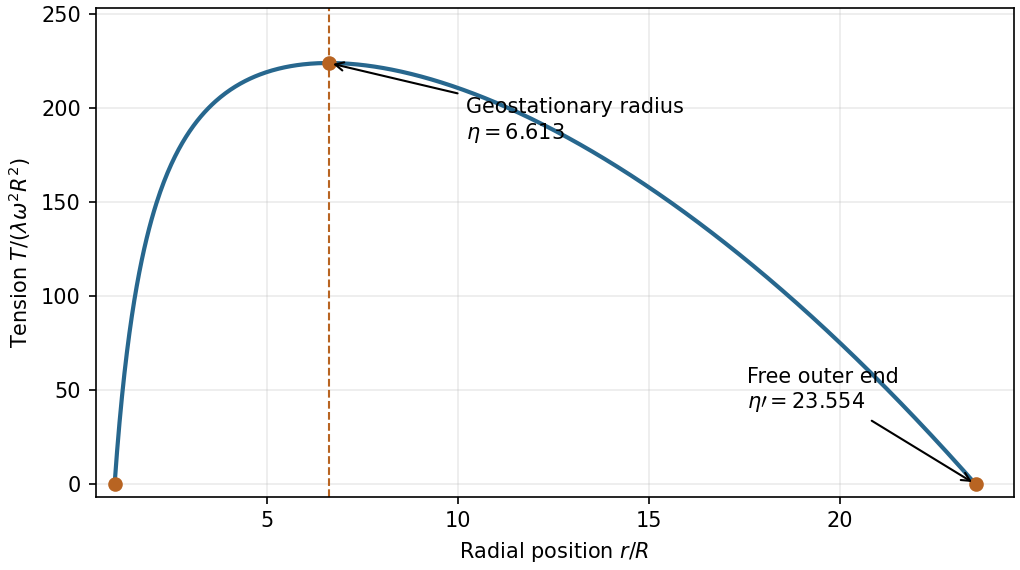
Tension in the uniform unloaded space-elevator cable
. The tension vanishes at both ends and peaks at the geostationary radius. The outer endpoint follows from the integrated rotating-frame force balance, using the specified uniform Earth density. Details.
Articles by others on the same topic
There are currently no matching articles.