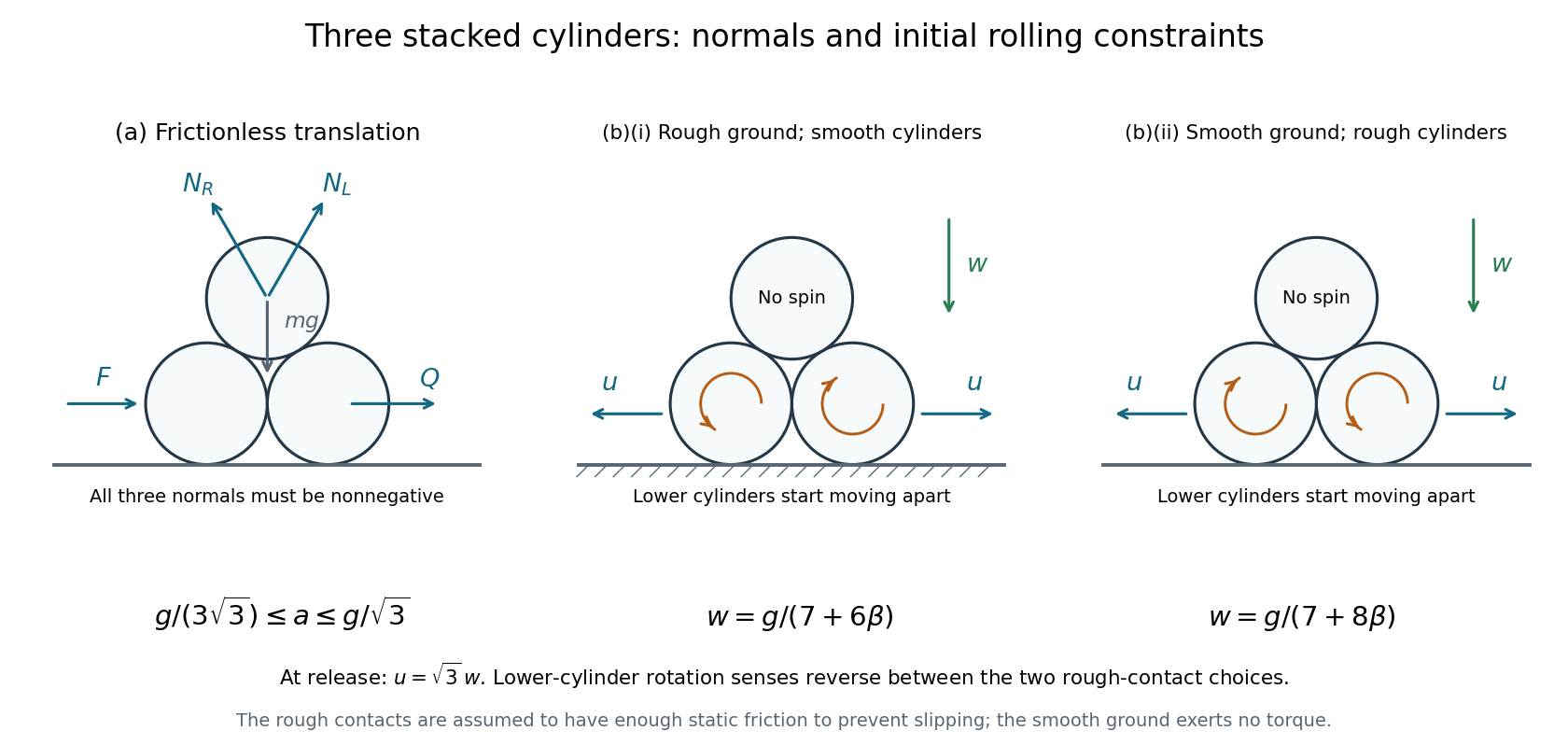
Smooth ground, rough cylinder contacts. Write for the tangential contact force magnitude at each upper-to-lower contact. On the top cylinder, its tangential components point upward and outward, while their horizontal components and torques cancel by symmetry. For a lower cylinder, the tangential force has an inward horizontal component and a downward vertical component .
The rolling condition is now at the contact between cylinders, not at the ground. At the initial zero velocity, equality of the tangential contact-point accelerations givesThus gives . The lower cylinder's outward translation equation and the top cylinder's downward equation areUsing gives and henceFor solid cylinders this is . Here the left lower cylinder rotates clockwise while moving left, and the right rotates counterclockwise while moving right. They may slip freely on the smooth ground, so imposing the ground-rolling relation would be incorrect. No slip at the cylinder contacts requires initially.
These are the two cases of the initial acceleration of three stacked cylinders. As a check, as the rotational contribution disappears in both formulas and they approach the smooth-contact release result .

Articles by others on the same topic
There are currently no matching articles.