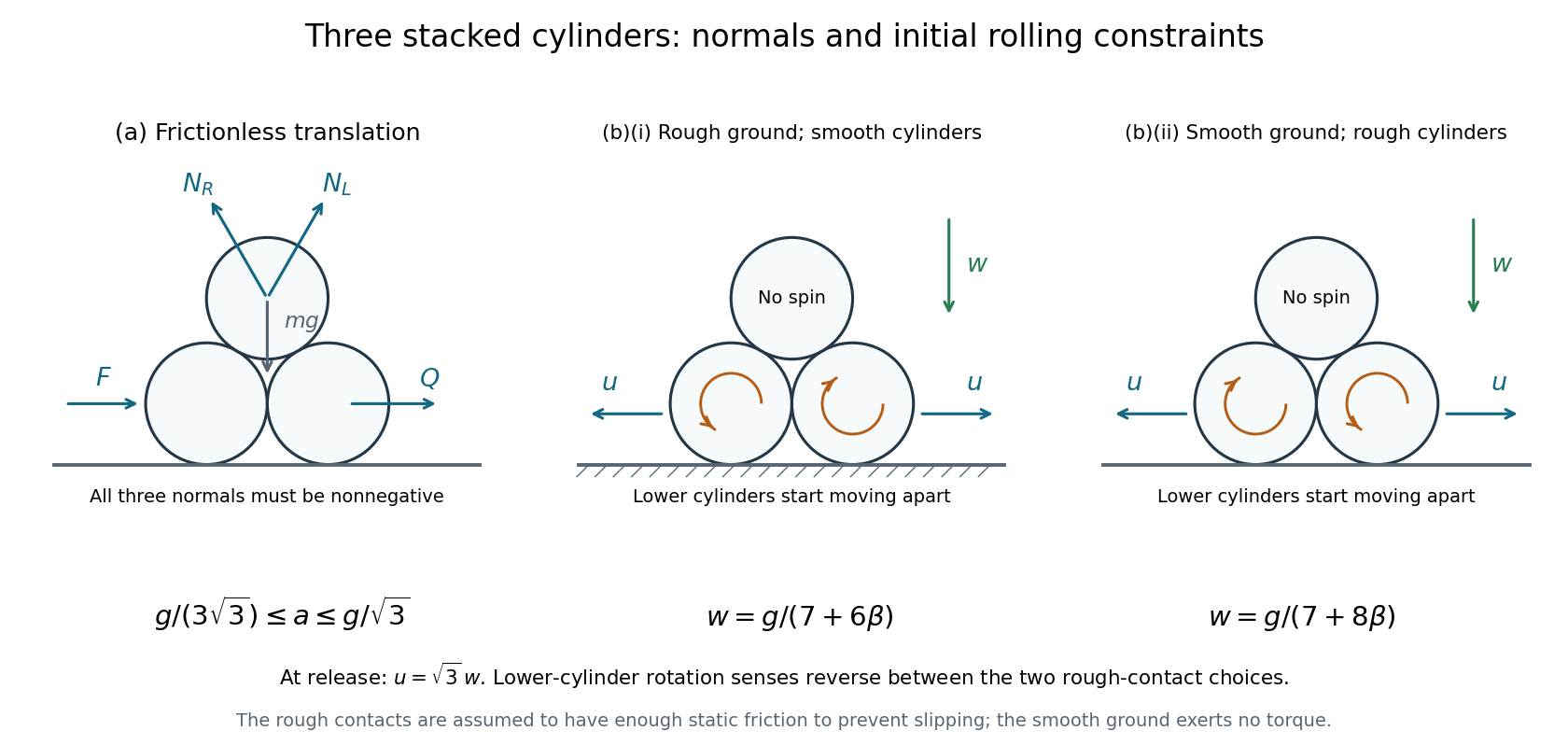
Assume the cylinders are released from rest. In each case, “there is friction” is interpreted as sufficient static friction for rolling without slipping at the rough contacts. Without a coefficient or a no-slip assumption, sliding cases would not have a unique specified acceleration. On release the two lower cylinders separate; their mutual contact must not be retained as a rigid constraint.
Let the top cylinder's initial downward acceleration be , and each lower cylinder's outward horizontal acceleration be . The top cylinder initially has no horizontal acceleration. Differentiating the fixed upper-to-lower centre separation twice at the initial zero velocity givesBy reflection symmetry the top cylinder has zero angular acceleration, while the lower cylinders rotate in opposite senses.
Rough ground, smooth cylinder contacts. Let be either upper-to-lower normal force, and the magnitude of the inward ground friction force on each lower cylinder. Pure rolling on the ground requires . The torque equation about a lower cylinder's centre isThe outward translation equation is , giving . The top cylinder's vertical equation is . Using yieldsFor uniform solid cylinders, and . The left lower cylinder rotates counterclockwise while rolling left; the right rotates clockwise while rolling right.
The assumed no-slip ground contact is possible if its coefficient of static friction satisfies at release. This follows from and ground normal force .
Smooth ground, rough cylinder contacts. Write for the tangential contact force magnitude at each upper-to-lower contact. On the top cylinder, its tangential components point upward and outward, while their horizontal components and torques cancel by symmetry. For a lower cylinder, the tangential force has an inward horizontal component and a downward vertical component .
The rolling condition is now at the contact between cylinders, not at the ground. At the initial zero velocity, equality of the tangential contact-point accelerations givesThus gives . The lower cylinder's outward translation equation and the top cylinder's downward equation areUsing gives and henceFor solid cylinders this is . Here the left lower cylinder rotates clockwise while moving left, and the right rotates counterclockwise while moving right. They may slip freely on the smooth ground, so imposing the ground-rolling relation would be incorrect. No slip at the cylinder contacts requires initially.
These are the two cases of the initial acceleration of three stacked cylinders. As a check, as the rotational contribution disappears in both formulas and they approach the smooth-contact release result .

Articles by others on the same topic
There are currently no matching articles.