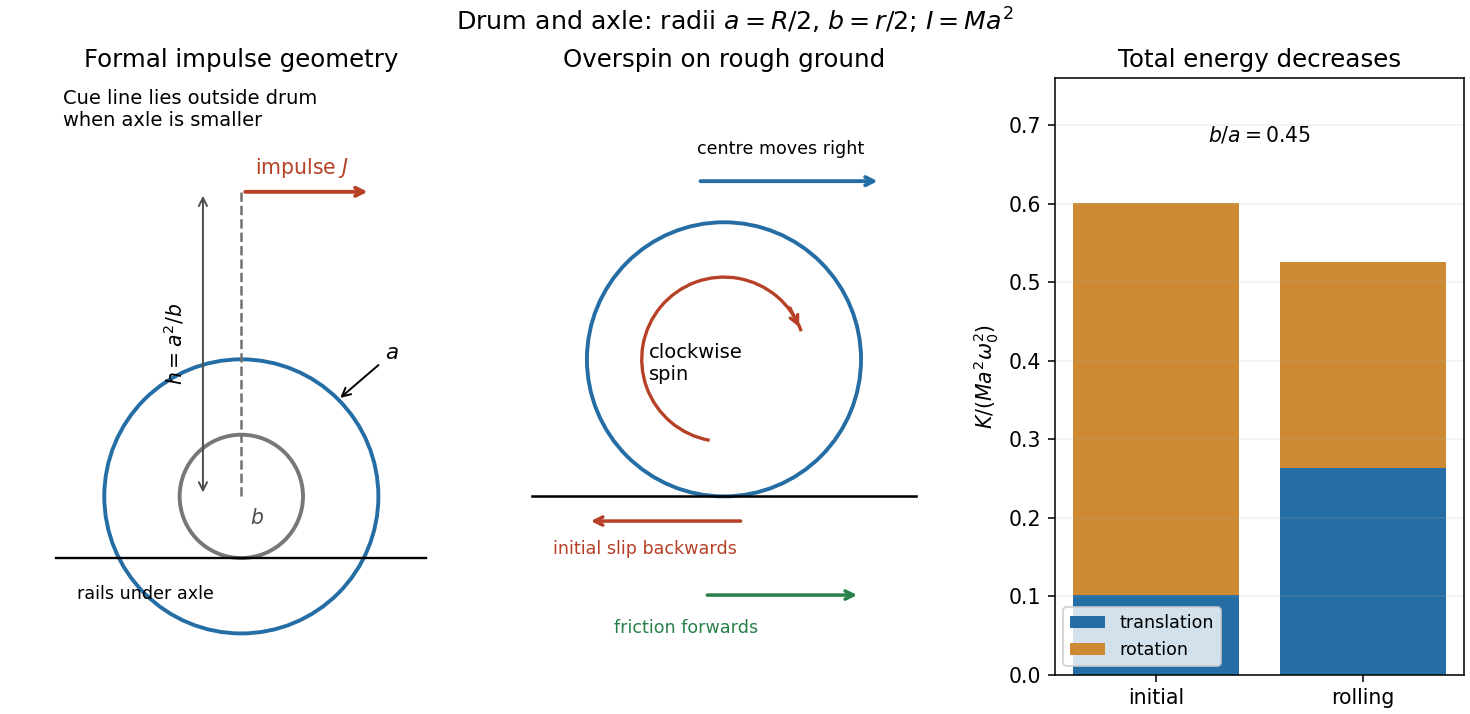
For the frictional conversion of spin to rolling, consider the horizontal slipping stage on the rough surface, whose contact radius is now , and neglect extra vertical impact or height-change energies at the transition. A friction impulse changes by and clockwise spin by . Thus is conserved. At the end , givingBecause , the final total kinetic energy is . Subtraction yieldsThe result is independent of the friction coefficient, provided sufficient contact time allows rolling without slipping to be regained. Initially , so the contact point slips backwards. Friction acts forwards and can increase translational kinetic energy, while decreasing rotational kinetic energy by more. A finite vertical drop or inelastic landing would require additional geometric information; the boxed expression describes the horizontal rolling-conversion loss.

Articles by others on the same topic
There are currently no matching articles.