Take upward velocity as positive. The linear drag force is , so it opposes the motion both during ascent and descent. Newton's second law gives . With , the integrating factor yieldsThe terminal velocity is . The limit at fixed recovers ; expanding the exponential is necessary to see the cancellation of the apparently singular terms.
The familiar right-angle result requires an elastic collision with conserved horizontal momentum and the appropriate treatment of rotational kinetic energy. In the ideal smooth-sphere model the spins do not change during the collision, so the translational kinetic energy is separately conserved. For equal masses, with initial velocity and outgoing velocities ,Squaring the first equality and using the second givesThus the two nonzero outgoing directions are perpendicular. In the head-on limiting case one sphere stops, so an angle for its zero velocity is undefined. An ideal elastic model that enforces rolling without slipping at both ends gives the same energy equation: each solid sphere has total kinetic energy , and the common factor cancels.
Elasticity is not stated explicitly in the question. It cannot be omitted from the argument: for a smooth equal-mass collision with normal incoming component and coefficient of restitution , the outgoing scalar product is . Moreover, after a smooth impact the spheres need not still be rolling; subsequent frictional relaxation can change their directions. The right-angle statement therefore concerns the specified ideal elastic collision, not arbitrary later rolling trajectories.
In spherical coordinates, the Lagrangian isA central force exerts zero torque, so the angular momentum vector is constant and the orbit lies in a fixed plane. Choose that plane as ; then is conserved. Substituting this relation into the energy givesThe effective potential reduces radial motion to a one-dimensional problem. Allowed radii have , radial turning points satisfy equality, and a circular orbit occurs at . A strict local minimum gives stable radial oscillations. Eliminating directly inside the original Lagrangian would require a Routhian; the energy derivation avoids giving the centrifugal term the wrong sign.
Let the motor's constant power be and put . The braking coefficient in the proposed formula must describe a retarding torque . This constant-power rotational acceleration obeys the energy balance:Consequently the steady angular velocity is , and the ordinary rotational frequency is . Solving the linear equation for from rest givesThe printed time formula is missing a minus sign. Its logarithm is negative for , whereas elapsed time must be positive. The terminal speed is approached only as .
A constant-power motor starting exactly from rest is an idealization: its driving torque would diverge. The energy equation has a regular solution for , although the initial angular acceleration is singular. If were literally a tangential force, a lever arm would also be needed; the dimensions of the requested expression identify as a rotational damping coefficient.
Centre the square on the plane, with uniform surface mass density . For an in-plane axis at angle to the direction, the perpendicular distance of from the axis is . Therefore its moment of inertia isThe mixed integral vanishes by symmetry, while the and integrals are equal. ThusThis is the in-plane isotropy of the square's inertia tensor: its two central in-plane principal moments coincide. It does not assert isotropy about arbitrary three-dimensional axes, nor about parallel axes that miss the centre.
Choose the emitted beam direction as positive . In the original laboratory frame the sensor moves with velocity ; let the laser recede from it with velocity . The collinear relativistic Doppler shift from source to laboratory and then to sensor givesAt the detection threshold this ratio is . HenceThe minimum collinear speed is therefore about , away from the approaching sensor, while the laser is still aimed towards it. The source must recede fast enough to overcome the sensor's approach-induced blueshift. A larger recession speed gives a longer received wavelength, if the detector has no additional upper cutoff.
As a check, the required relative recession speed is ; relativistic velocity addition gives this same value from .
The initial total momentum is zero, so the outgoing neutron recoils with momentum magnitude . Put . Conservation of relativistic energy givesFor example the rest energies , and for the proton, charged pion and neutron give this value.[ref]
Review of Particle Physics by Particle Data Group (2022). Charged-pion, proton and neutron listings, page 1 of each: mass values in MeV
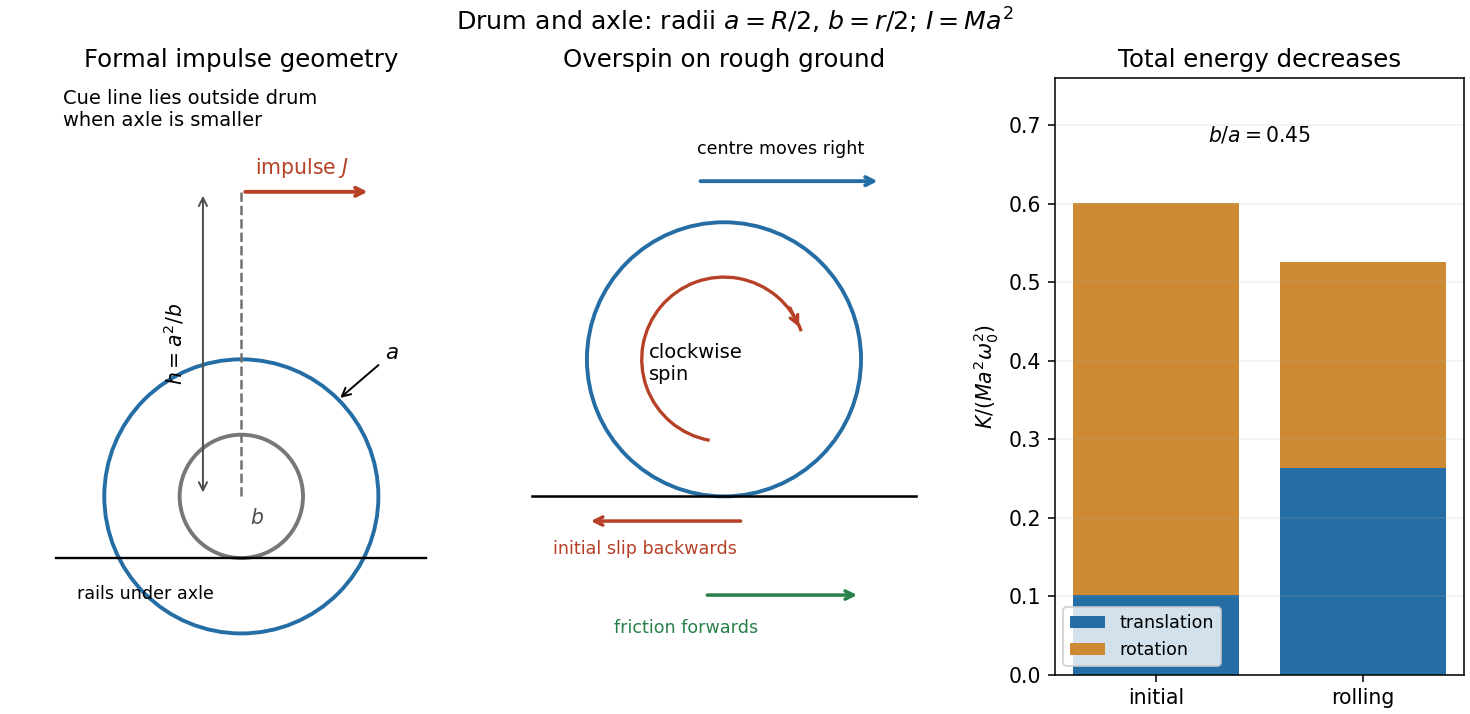
The result is smaller than the initial-to-final rest-energy difference of about , because some released energy becomes neutron recoil kinetic energy. Atomic binding of a captured pion is neglected in the stated stationary-particle model.The symbols in the question are diameters: write drum radius , axle radius . For a thin hollow drum, . A rightward horizontal impulse applied at height above the centre gives and clockwise angular velocity . Rolling on the axle requires , soThe frictionless rails do not create the required rotation; the initial impulse must give exactly this ratio of linear to angular motion. For the usual case , the required height is greater than the drum radius. It cannot be reached by striking the bare cylindrical surface horizontally; an extension or equivalent applied couple would be needed. This geometric limitation should accompany the formal result.
With clockwise rotation taken positive and , the total kinetic energy isAngular momentum needs an origin. Its spin about the centre is , in the clockwise direction. About a fixed point in the horizontal rail plane, spin and orbital contributions add toHere the drum centre is height above that plane. The signed clockwise convention fixes the displayed signs; the associated vector points perpendicular to the vertical plane of motion.
For the frictional conversion of spin to rolling, consider the horizontal slipping stage on the rough surface, whose contact radius is now , and neglect extra vertical impact or height-change energies at the transition. A friction impulse changes by and clockwise spin by . Thus is conserved. At the end , givingBecause , the final total kinetic energy is . Subtraction yieldsThe result is independent of the friction coefficient, provided sufficient contact time allows rolling without slipping to be regained. Initially , so the contact point slips backwards. Friction acts forwards and can increase translational kinetic energy, while decreasing rotational kinetic energy by more. A finite vertical drop or inelastic landing would require additional geometric information; the boxed expression describes the horizontal rolling-conversion loss.

Let be the launch rate and . Treat many small impacts as a continuous momentum flux, justified by . Write for truck displacement from its initial position and , with at the first impact. First neglect vertical motion, so every projectile has horizontal velocity .
A fixed launch rate is different from a fixed impact rate on a receding truck. Projectiles reaching the truck at time were launched at retarded time , after an irrelevant constant initial-flight offset. The moving-target interception rate is thereforeFor an elastic collision with a much heavier truck, each ball transfers momentum approximately . The elastic-ball truck keeps mass , soSolving from rest and integrating once more givesThe rebound reverses the ball's motion relative to the truck; its laboratory velocity can still be forwards once . The truck approaches asymptotically, while its decreasing impact rate prevents exponential approach in laboratory time. The approximation omits the velocity jumps of individual finite-mass impacts.
For sticking snowballs, let be the instantaneous truck-plus-snow mass, with . The variable-mass system obeysIntegrating the second equation gives . Therefore , and with ,Retaining the accumulated mass is necessary even though each individual snowball is small.
For the range calculation, take the intended idealization of horizontal launch from height , no air resistance, and interception possible until the projectile reaches the ground. Its flight time is and horizontal range is . If the initial truck distance from the boy is , substitute in the last expression. The speed at the range limit isFor an initially nearby truck, in this point-target model and . A different launch angle or finite interception height changes the available range and must be specified separately.
If instead one idealizes one impact each second, regardless of the truck's changing position, the answers are different: elastic balls give and ; sticking balls give and . Those expressions assume controlled arrival times, whereas the boxed results respect the stated fixed launch rate.
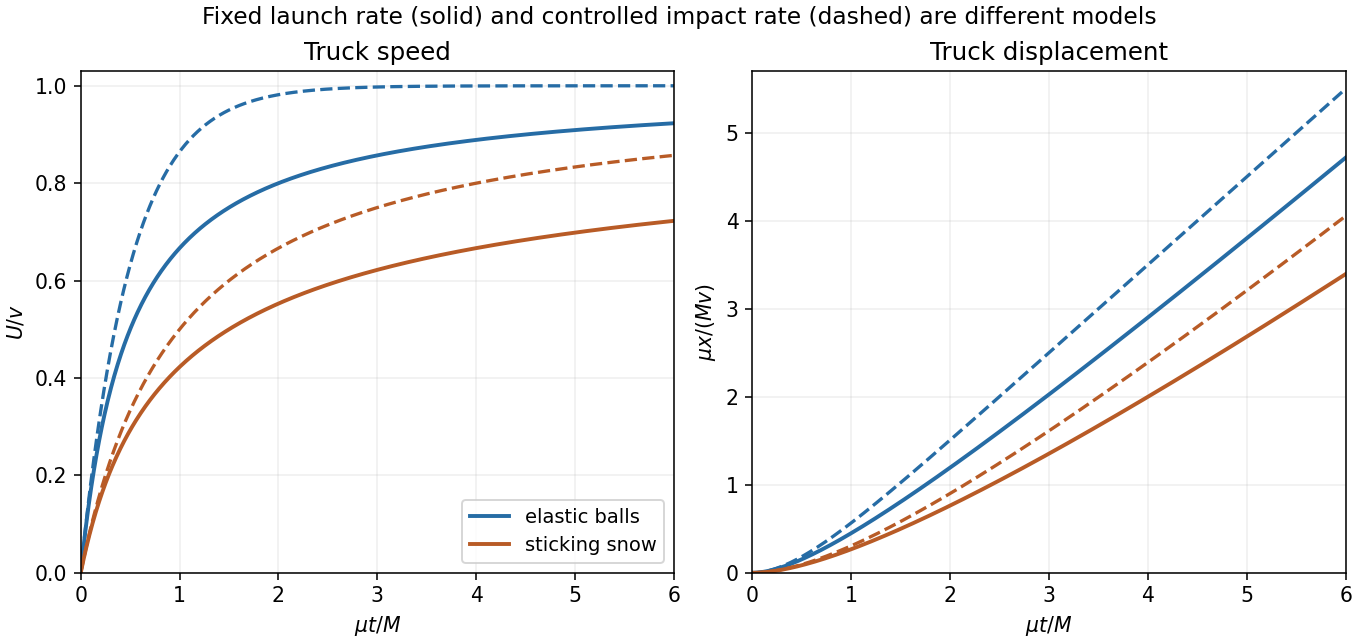
Truck response with a fixed launch rate, contrasted with the different assumption of a fixed collision rate
. Details. 
Use the test-particle approximation, neglecting the planet's recoil. The conserved specific angular momentum is and the specific energy at infinity is . At closest approach the radial velocity vanishes, so the effective potential givesThe positive root and the tangential speed areThe second form for avoids subtracting two nearly equal numbers for a small impact parameter. These formulas describe a nonradial orbit; gives a collision rather than a finite nonzero pericentre in the point-planet model.
Put and let be the circular orbit speed. Take the captured half to move in the original tangential direction, the minimum-energy choice. Conservation of momentum during the short explosion gives the other half speed . The gravitational potential energy is unchanged at the instant of separation, so the necessary generated energy is the increase in kinetic energy:The captured half has zero radial velocity and exactly the required tangential speed, so it can enter the stable Newtonian circular orbit at this radius. Internal self-binding and any mass lost to radiation are neglected.
For the prograde captured orbit, the departing half has instantaneous velocity tangent to the original orbit, in the original direction, with speedIt exceeds the local escape speed: since , . This is its speed immediately after the explosion, not its later speed at infinity.
If a counterrotating circular captured orbit is allowed, its signed velocity is , the outgoing speed is instead , and the required generated energy is . The usual answer takes the prograde orbit; specifying that choice removes the directional ambiguity.
Use emission, reflection and return-to-source events . In the source-and-mirror rest frame their coordinates are , and . The laser and mirror have vertical worldlines; the two light rays have slopes on a diagram with equal spatial and scales.
For a frame moving with velocity along the outgoing beam, let and . A Lorentz transformation givesBoth laser and mirror now move towards negative , with worldlines and . Light still has slopes . The moving observer's own worldline is ; it should not be confused with the moving source worldline.
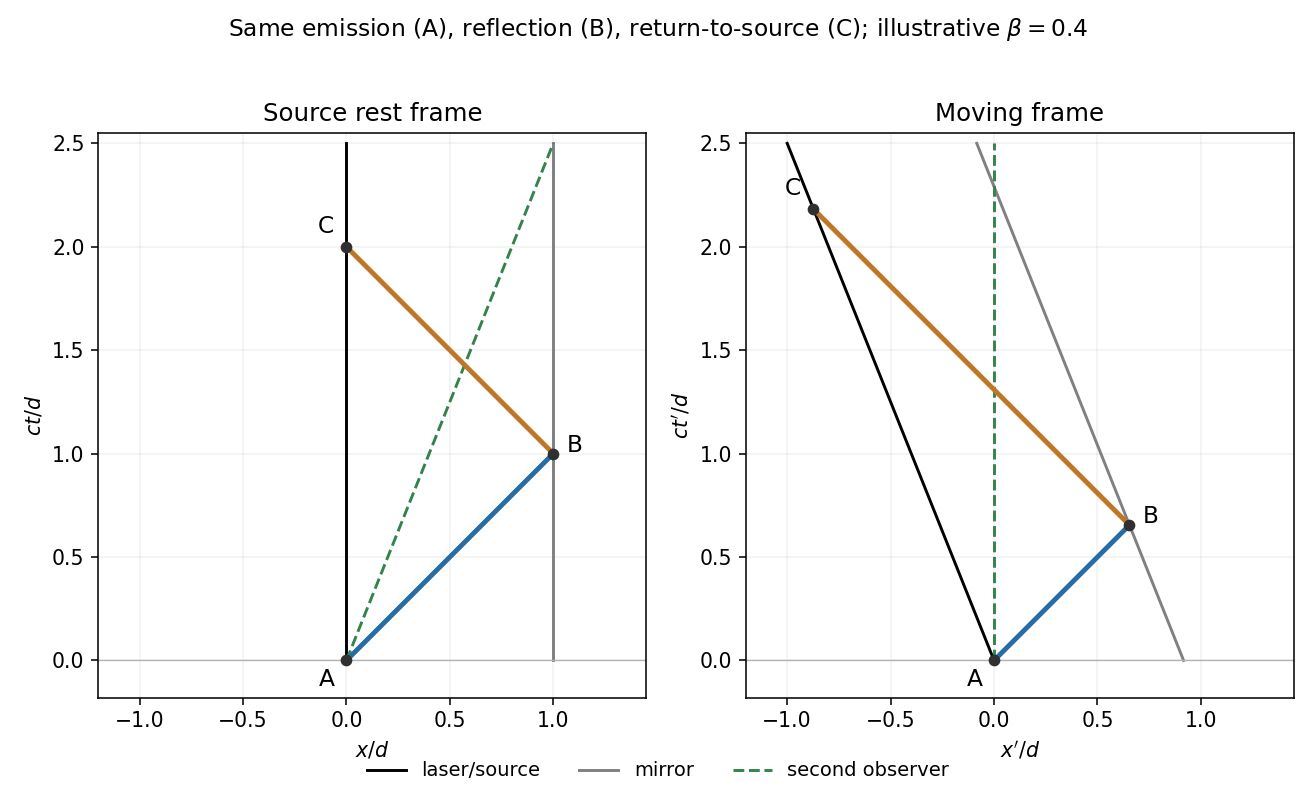
Emission, mirror reflection and return to the original source in the rest frame and a moving Lorentz frame
. Details. 
In the original rest frame each leg takes , so the round trip takes . For the moving frame, use the coordinate differences between the same three events. The Lorentz transformation givesThe outbound leg is shorter because the mirror approaches the outgoing ray; the inbound leg is longer because the source retreats from the returning ray. Their sum is larger than the original round-trip proper time by the time dilation factor .
These are coordinate times for return to the original source, not a claim that the pulse returns to the second observer's body at event . If that observer starts at , it intercepts the returning light at a different event, earlier than , at its own time . Distinguishing those events is necessary when interpreting “seen” or “return”.
Replace the frame speed by , requiring . With ,The outbound leg is now the longer one and the inbound leg the shorter one. Doubling the speed also changes the Lorentz factor; it is not enough to swap the two original leg times. A proposed doubled speed at or above does not define an inertial observer frame.
Articles by others on the same topic
There are currently no matching articles.